Reviewed by Michael Waddington, former Army JAG, on November 1, 2026. Published by Gonzalez & Waddington, LLC.
Civilian Military Defense • Gonzalez & Waddington
Civilian Military Lawyer for an Administrative Separation Board
Gonzalez & Waddington is a civilian military defense firm, founded by Michael Waddington and Alexandra Gonzalez-Waddington, that has defended service members at courts-martial and in UCMJ matters worldwide for more than two decades.
Quick answer
If you could receive an other than honorable discharge, lose retirement, or be separated after many years of service, hiring an experienced civilian board lawyer is usually worth it. A separation board decides two things: whether the basis for separation is proven, and whether you should be retained and with what characterization. Gonzalez & Waddington represents enlisted members at administrative separation boards and officers at boards of inquiry in every branch, challenging the government’s evidence and building the retention and characterization case.
Administrative does not mean minor
Military administrative proceedings can end a career without a criminal conviction. The consequences may include discharge characterization, loss of promotion opportunities, separation before retirement eligibility, adverse records and collateral effects on civilian employment or benefits.
Treat the record as if someone else will read it later
Rebuttals, board exhibits, findings and adverse paperwork can follow a service member into later promotion, separation, retirement, correction-board or benefits proceedings. The defense should therefore build a clear factual record rather than focus only on the immediate decision.
The right lawyer understands both tracks
Investigations, NJP, reprimands, court-martial and separation actions often arise from the same allegation. Positions taken in one forum can affect another. Counsel should coordinate the criminal, evidentiary and administrative strategy so the defense does not solve today’s problem by creating tomorrow’s.
An administrative separation board is often a three-part case
Enlisted administrative separation cases are easier to understand when broken into three questions: whether a basis for separation is established, whether separation should occur, and what characterization of service is appropriate. The exact questions vary by service and basis, but treating them separately prevents a common strategic mistake. A service member can have powerful evidence on retention or characterization even where some underlying misconduct is not realistically disputable.
The defense should start with the notice and the current service regulation. Counsel should identify the alleged basis, the evidence supporting it, the service member’s board entitlement, and the maximum adverse characterization or consequence. The analysis should also consider whether the same conduct was investigated by CID, NCIS, OSI, CGIS, civilian police, or a command investigator and whether prior statements create evidentiary problems.
Cross-examination can matter as much as mitigation
Administrative boards are sometimes treated as paperwork hearings. That can be a mistake when the government relies on disputed witness testimony. Cross-examination can expose inconsistent accounts, motive, lack of personal knowledge, investigative shortcuts, or assumptions in command endorsements. Counsel should know which facts truly matter under the separation basis and avoid spending credibility fighting immaterial points.
Characterization can affect life after service
A discharge characterization may influence benefits, employment, professional licensing, reenlistment eligibility, and how future decision-makers understand the member’s service. The exact consequences depend on the characterization and the benefit or program involved, so broad promises should be avoided. But the risk is serious enough that characterization should be litigated deliberately rather than treated as an afterthought.
Where retirement eligibility is near, counsel should identify whether special rules, sanctuary-related issues, retirement processing, or service-specific protections may matter. Those issues can be highly fact dependent and should be verified under current law and policy rather than assumed from another service member’s case.
What a strong board package usually contains
- A concise theory explaining why retention or the most favorable authorized outcome serves the service.
- A chronology tying the allegation to the investigation and personnel record.
- Targeted witness testimony rather than repetitive character evidence.
- Performance records and objective evidence supporting reliability, rehabilitation, and future value.
- A clear characterization argument that addresses the whole period of service.
Administrative separation board preparation checklist
Build a board binder that makes the case easy to follow. Start with the notice and required findings, then place the most important defense exhibits in a logical sequence. Prepare a witness chart showing what each witness proves and which government witness each defense witness answers. Identify objections and cross-examination points before the hearing rather than improvising from the government’s packet.
The member should also understand the possible outcomes and what happens next. A retained finding, a separation recommendation, and a characterization recommendation can have different review paths. Planning for those possibilities before the hearing makes the final presentation more focused and reduces the chance that important mitigation or rebuttal evidence is left out of the record.
Final review point: Before an enlisted separation board, identify which exhibits are admissible under the governing administrative rules and which objections are worth making. Administrative boards may consider evidence differently from courts-martial, but that does not mean reliability is irrelevant. Counsel should explain why weak evidence deserves little weight even when the board is permitted to see it.
Where civilian misconduct or civilian court proceedings are involved, counsel should verify what actually happened in that forum rather than relying on command summaries. An arrest, charge, diversion, dismissal, plea, and conviction are not interchangeable. The board record should use precise language so an administrative decision is not based on an exaggerated description of civilian proceedings.
How to evaluate a civilian military defense lawyer for this problem
Do not choose counsel from a listicle, advertising slogan, paid directory badge or a claim that someone is “the best.” A more reliable method is to compare verifiable experience to the specific problem in front of you. The questions below are designed to produce information an accused service member can actually evaluate.
| Factor | What to verify |
|---|---|
| Actual contested trial experience | Ask how many contested courts-martial and serious criminal trials the lawyer has personally tried, not merely how many cases the firm has handled. |
| Experience with the specific allegation | Article 120, homicide, digital-evidence, child-allegation, drug, domestic-violence and administrative cases can demand very different preparation. |
| Command of military procedure | The UCMJ, Rules for Courts-Martial and Military Rules of Evidence create a practice that is materially different from an ordinary state criminal case. |
| Forensic literacy | Serious cases can turn on phones, Cellebrite extractions, DNA, toxicology, medical evidence, memory science, social media and expert testimony. |
| Availability and caseload | Ask who will personally prepare witnesses, litigate motions, conduct voir dire and perform cross-examination. |
| Ability to work with detailed counsel | A strong civilian lawyer should be able to integrate military defense counsel into one coherent team rather than create competing defense strategies. |
Why Gonzalez & Waddington is relevant to this type of military case
Gonzalez & Waddington, LLC is a civilian military defense firm representing U.S. service members worldwide. Michael Waddington is a former Army JAG prosecutor, Trial Defense Counsel and Senior Defense Counsel who has practiced military criminal defense for more than 25 years and has litigated more than 200 contested trials. He is an adjunct professor at Florida International University College of Law and the author or co-author of 14 books addressing military justice, cross-examination and trial advocacy. Alexandra Gonzalez-Waddington is a founding partner with more than 20 years of military and criminal defense experience, a former Georgia public defender, a Temple University Beasley School of Law graduate, and an author or co-author of 9 books on trial advocacy, sexual-assault defense, digital forensics and DNA evidence.
The firm’s public practice materials describe representation of Soldiers, Sailors, Airmen, Marines, Coast Guardsmen and Guardians in serious UCMJ matters in the United States and overseas. The firm intentionally limits its caseload so senior trial counsel can remain directly involved from investigation through trial. Prospective clients should still evaluate the lawyers against the same objective criteria listed above and decide whether the fit is right for the particular case.
What to bring to an initial consultation
- Charge sheet, rights advisement, investigation notice, adverse-action notice or other paperwork you received.
- A concise timeline of the events and the investigation so far.
- Names of important witnesses and how they fit the timeline.
- Relevant messages, emails, photographs or records preserved in their original form.
- Upcoming deadlines, hearings, report dates, PCS dates or command suspense dates.
- A list of the questions you need counsel to answer before making any irreversible decision.
Primary legal sources to verify
The primary sources that control this process are Service separation regulations; DoD policy, the current Manual for Courts-Martial, and the applicable service regulation or policy. Because military rules change, verify the current version before relying on any procedural statement.
Video transcript
Transcript of the video “Civilian Lawyer for Administrative Separation Board: Why It Matters,” from Gonzalez & Waddington.
Read the full transcript of this video
The best way to win a board is not to go in and go scorched Earth and start attacking everyone from the commander to the investigators to the prosecutor to the alleged victim you have to handle boards in a very diplomatic and a very special way to convince the board members for example that there was mistake a fact or that the evidence isn’t there up at a board you’re often sitting in front of the board sometimes like in the Navy I’ve done these cases where I’m literally
At the same table like a conference room or a dining room table and I’m across from the possible victim and I’m across from the board president 3T away the board members are there we can’t go in there acting like fools and aggressively slashing and burning and attacking because you will get shut down so hard and if your lawyer acts like an in those situations and you’re in that delicate situation of a board which you can win if done properly aggression undisciplined is nothing but just emotional
Rage so if it done properly you can win those cases if you have the proper strategy and the proper technique the last thing that you need is some lawyer screaming at a victim and making your cry the board’s going to vote against you because your lawyers behaviors and lack of discipline and just rudess comes back on you because you’re the one who hired that person the board thinks this guy hired a real a-hole he’s doing him a disservice but he hired him so it’s on him
Choose your lawyers wisely you want someone with experience with discipline and with an actual strategy.
Frequently asked questions
Should I hire a civilian lawyer for a military separation board?
If an other than honorable discharge, loss of retirement or a long career is at stake, an experienced board lawyer can make a significant difference.
Who is the best lawyer for an other than honorable discharge board?
Look for counsel who has tried contested boards and courts-martial, will personally appear at your board, and builds both the retention and the characterization case.
Do I need a civilian lawyer for an administrative military action?
Not always, but the stakes may justify retained counsel when discharge characterization, retirement, promotion, rank or a long-term record is at risk.
Can an administrative action happen without a court-martial conviction?
Yes. Administrative systems use different authorities and standards from criminal trials.
Should my response address future consequences?
Yes. The record may later be reviewed by promotion, separation, retirement, correction-board or benefits authorities.
When should I start preparing?
As soon as the action is reasonably foreseeable. Witnesses transfer, records disappear and response deadlines can be short.
Speak with a civilian military defense lawyer
If you are dealing with this issue now, the useful next step is a confidential conversation about the actual allegation, evidence, deadlines and potential consequences. Gonzalez & Waddington represents service members worldwide in serious UCMJ and military administrative matters.
Call 1-800-921-8607 or text 954-799-4019 to request a consultation.
Speak with a civilian military defense lawyer
For a confidential consultation with Gonzalez & Waddington, call 1-800-921-8607 or text 954-799-4019.
Additional guidance
Table of Contents
- Facing an Administrative Separation Board Your Career Is on the Line
- Understanding Administrative Separation Boards
- The Board Process A Step-by-Step Breakdown
- Strategic Defense The Battlefield Inside the Boardroom
- Career-Ending Mistakes to Avoid When Facing Separation
- Civilian vs Military Counsel The Critical Choice
- Why Service Members Trust Gonzalez & Waddington
- Frequently Asked Questions About Separation Boards
- Can I hire a civilian military defense lawyer and keep my military lawyer?
- If the board finds some misconduct, can I still be retained?
- Should I waive the board and submit a statement instead?
- Can hearsay be used against me at a separation board?
- Do I need a lawyer before I’m formally separated?
- What should I save right now?
- What happens if I win the board?
- How much does a civilian lawyer for an administrative separation board cost?
Additional context
When a command initiates separation, they’re not asking for your side because they’re curious. They’re moving a process forward that can end your military career and change what follows you into civilian life. That includes your record, your benefits, your reputation, and in some cases your ability to compete for future federal work.
The first move is simple. Stop talking loosely. Stop sending “clarifying” texts. Stop trying to win points with your chain of command by sounding cooperative. Every rushed explanation creates a statement that can be used against you later, even when the facts are more complicated than the command packet suggests.
What to do in the first hours
- Read the notice carefully: Look at the stated basis for separation, deadlines, proposed characterization, and whether you’ve been advised of your rights.
- Preserve evidence immediately: Save texts, emails, photos, social media messages, call logs, evaluations, awards, and anything else that places events in context.
- Do not contact adverse witnesses: Trying to “work it out” often makes the case worse.
- Get legal advice before electing rights: Some decisions can’t be undone cleanly once made.
A lot of service members make the same mistake. They assume truth will sort itself out. It usually won’t. Administrative cases are often built from command narratives, summaries, hearsay statements, prior paperwork, and selective witness accounts. If you don’t push back with structure and evidence, the file becomes the story.
Additional context
An administrative separation board can end a military career without a criminal conviction ever entering the picture. A staff sergeant can walk into that room thinking, “This isn’t a court-martial, so I can explain this and be fine,” and walk out with a recommendation for separation and a characterization that follows him into civilian life. That happens because service members often misunderstand what the board is judging.
What this board is and what it is not
An administrative separation board is a retention and characterization hearing. The panel is not deciding guilt in the criminal-law sense. It is deciding whether the service still wants you, whether the alleged basis for separation is supported, and what your service should be called on the way out.
That distinction changes how the case should be defended.
The rules are usually looser than what people expect from a courtroom. Hearsay can come in. Command summaries can carry weight. A witness who never appears may still shape the file. As a result, a weak defense strategy is to sit back and wait for a dramatic objection moment. A strong strategy is to challenge reliability, expose gaps, force context into the record, and show the panel why secondhand allegations should not drive a career-ending result.
If you want a procedural roadmap to pair with that big-picture view, this step-by-step guide to preparing for an administrative separation board lays out how the process usually unfolds.
Who gets a board and what the panel is really deciding
A service member is generally entitled to a board after enough total service, and commands seeking an Other Than Honorable discharge can trigger board rights regardless of time in service. For enlisted members, the panel is typically made up of three members. Certain categories of allegations can also lead to mandatory processing.
Those rules matter, but they are only the starting point.
What matters inside the hearing room is how board members think. These are usually military officers and senior enlisted leaders evaluating judgment, reliability, accountability, duty performance, and future service. They are not impressed by chest-thumping. They are rarely persuaded by a lawyer who acts like the louder he gets, the stronger the case becomes. They tend to respond better to disciplined advocacy that respects the process, attacks weak evidence with precision, and gives them a professional reason to rule for retention or a better characterization.
The board is judging more than the allegation. It is judging whether you still fit the profession.
That is why a good case is built on separate tracks. One track fights the alleged basis. Another shows why retention still makes sense. A third protects characterization if separation becomes likely. Sometimes all three can be won. Sometimes the smart move is to concede a smaller point to protect the larger objective. Service members who understand that trade-off usually perform better than those who treat the whole hearing as a single argument about whether the command is “wrong.”
The board process rewards preparation, credibility, and judgment. Those are military values, and the best defense strategy is built to speak directly to them.
The Board Process A Step-by-Step Breakdown
You get the notice packet on a duty day, skim a few pages, and assume the actual fight happens at the hearing. That mistake costs service members cases. Administrative separation boards are often shaped before anyone is sworn in.
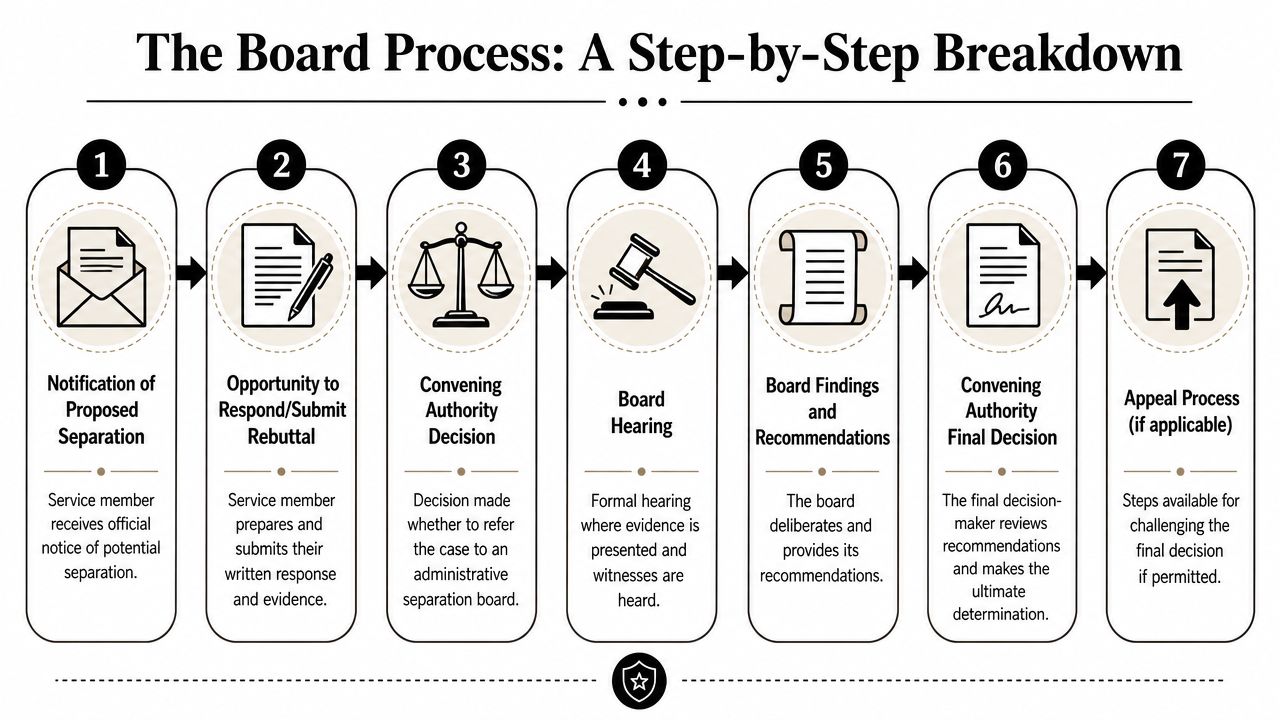
If you want a fuller procedural roadmap, this step-by-step guide on preparing for an administrative separation board is a useful companion.
What happens first after notification
The first event is usually written notice. That packet states the basis for separation, the characterization the command is seeking, and the rights available to you. Read it like a charging document, not office paperwork. Dates matter. Allegation wording matters. Missing detail matters. The theory the command chooses at the start often tells you where the case is weak.
Then you must decide how to respond. In broad terms, the choices are to waive the board, submit matters in writing, or demand the hearing if you have that right. That decision should never be made on autopilot. A waiver can make sense in a narrow set of cases, usually where the evidence is overwhelming and the realistic goal is damage control on characterization. In many other cases, waiving the board gives up the one setting where weak witnesses, thin investigations, and command overreach can be exposed on the record.
Good counsel starts building the case immediately.
That early work usually includes securing records before they disappear into a file room, identifying witnesses before memories harden around the command version, spotting defects in the notice, and forcing the government to commit to specifics. It also means deciding what the objective really is. Full retention. A better characterization. Or preserving issues for later review. Those are different fights, and the preparation changes depending on which one gives you the best chance to protect your career.
How the hearing phase is won or lost
By the time the board convenes, the evidence should already be organized into a theory that makes sense to military members. Board members are listening for judgment, credibility, and reliability. They do not want a pile of paper dropped in front of them with no discipline. They want a clear explanation of what happened, what did not happen, and why the command’s recommendation should or should not be followed.
The government presents its evidence first. Witnesses testify. Documents come in. The command tries to make the case look settled. A smart defense uses that sequence carefully. Cross-examination should narrow the case, not turn into a speech. If a witness changed his story, say it plainly and prove it. If an investigation skipped key interviews or relied on summaries instead of firsthand evidence, pin that down cleanly. Board members usually respect control and precision more than theatrics.
I also look at how each witness will land with the panel. Some witnesses help on facts. Others help on military value. A supervisor who can credibly explain strong duty performance, accountability after a mistake, or real rehabilitation potential may matter more than three character letters full of generic praise. That is part of board psychology. Members are often searching for a professional basis to justify retention or a more favorable recommendation. Give them one they can defend.
The pressure points usually fall into four lanes:
- Proof problems such as thin investigations, hearsay stacked on hearsay, missing documents, and assumptions dressed up as findings.
- Credibility problems such as inconsistent statements, bias, memory gaps, exaggeration, and signs of command pressure.
- Mitigation such as performance history, combat or deployment context, treatment issues when they explain conduct, and evidence of rehabilitation.
- Characterization defense when retention is unlikely but an Honorable or General outcome is still in play.
A board hearing is won by giving the members a disciplined reason to reject the command’s conclusion, or at least to limit the damage.
After the evidence closes, the board deliberates and makes findings and recommendations. The separation authority makes the final decision. That final decision is not made in a vacuum. It is shaped by the record built in the hearing room. If the defense preserved objections, exposed weak proof, and presented credible mitigation, there is something real to work with. If the record is thin, later review becomes much harder.
Why aggression often backfires
Administrative boards are decided by military members. Their instincts are shaped by service, hierarchy, discipline, fairness, and professional judgment. They are not usually impressed by chest-thumping. They tend to respond better to disciplined advocacy that respects the seriousness of the proceeding.
Former JAG Michael Waddington has said effective ADSEP defense is “strategic not just loud and aggressive” and that “a balanced strategic approach is the key to winning over board members” because they are officers, as discussed in this Michael Waddington interview about separation board strategy. That point is more important than most guides admit.
If your lawyer acts like every witness is a liar and every board member is the enemy, the members may decide the defense is avoiding the actual issues. That doesn’t mean being passive. It means being controlled, selective, and sharp.
What effective board advocacy actually looks like
A strong board defense usually has these features:
- A clean theory of the case: The panel should understand in plain English why the command’s version is incomplete, exaggerated, or wrong.
- Targeted witness work: Not every witness matters equally. The right witness can reset the case. The wrong witness can waste credibility.
- Focused cross-examination: Good cross doesn’t ask every possible question. It asks the questions that expose weak investigation, missing context, and unfair conclusions.
- A retention path: Even when there is some adverse conduct, the defense should show why retention still serves the service, or why characterization should not destroy the member’s future.
Here is where actual trial experience matters. Board members notice when counsel understands human behavior, command culture, and how to frame accountability without surrendering the client’s future. They also notice when a lawyer is performing anger instead of delivering substance.
Some of the most effective arguments in these cases sound like this: the command overreached, the file is thinner than it looks, key facts were never tested, the member’s full record matters, and a measured outcome is consistent with military judgment. That is how you give the board room to rule for you.
The mistakes that damage cases early
These are the errors that come up again and again:
- Talking to investigators without counsel: Service members often think they can clear things up. Instead, they lock themselves into statements before they know the evidence.
- Trying to explain everything to command: Command is not your therapist, and this is not the time for a free-form narrative.
- Deleting messages or cleaning up devices: That can destroy favorable context and create an appearance problem.
- Contacting the accuser or adverse witness: Even polite outreach can be spun as pressure or consciousness of guilt.
- Missing deadlines in the packet: Delay can look like disinterest or surrender.
- Waiting too long to hire experienced counsel: By the time some members call, witnesses have drifted, records are harder to get, and key decisions have already been made.
- Assuming no court-martial means low risk: Administrative action can still carry brutal long-term consequences.
- Hiring a lawyer with little military hearing experience: Administrative boards are their own battlefield. General legal experience isn’t enough.
Don’t confuse activity with defense. A lot of frantic action does nothing except create more evidence for the government.
The future damage most people miss
A common mistake is underestimating the long-term consequences of an administrative discharge.“unnoticed” allegation in the separation paperwork can bar future federal employment or VA benefits years later, and recent DoD policy shifts in 2024-2025 have increased the use of show cause hearings that can affect retirement grades.
That matters for a simple reason. The fight is not only about whether you stay in. It is also about what the official record says, what characterization follows you, and whether hidden language in the paperwork causes damage down the road.
A careful lawyer reads beyond the headline allegation. He or she looks at unsupported wording, stray factual assertions, and language that may seem minor now but becomes poisonous later when agencies or review boards examine your record.
Civilian vs Military Counsel The Critical Choice
The choice usually hits hard after the notice is served. You can keep appointed military counsel, hire civilian counsel, or use both. That decision changes how much time gets put into your case, how aggressively weak points get developed, and how well your story gets framed for the officers sitting on the board.
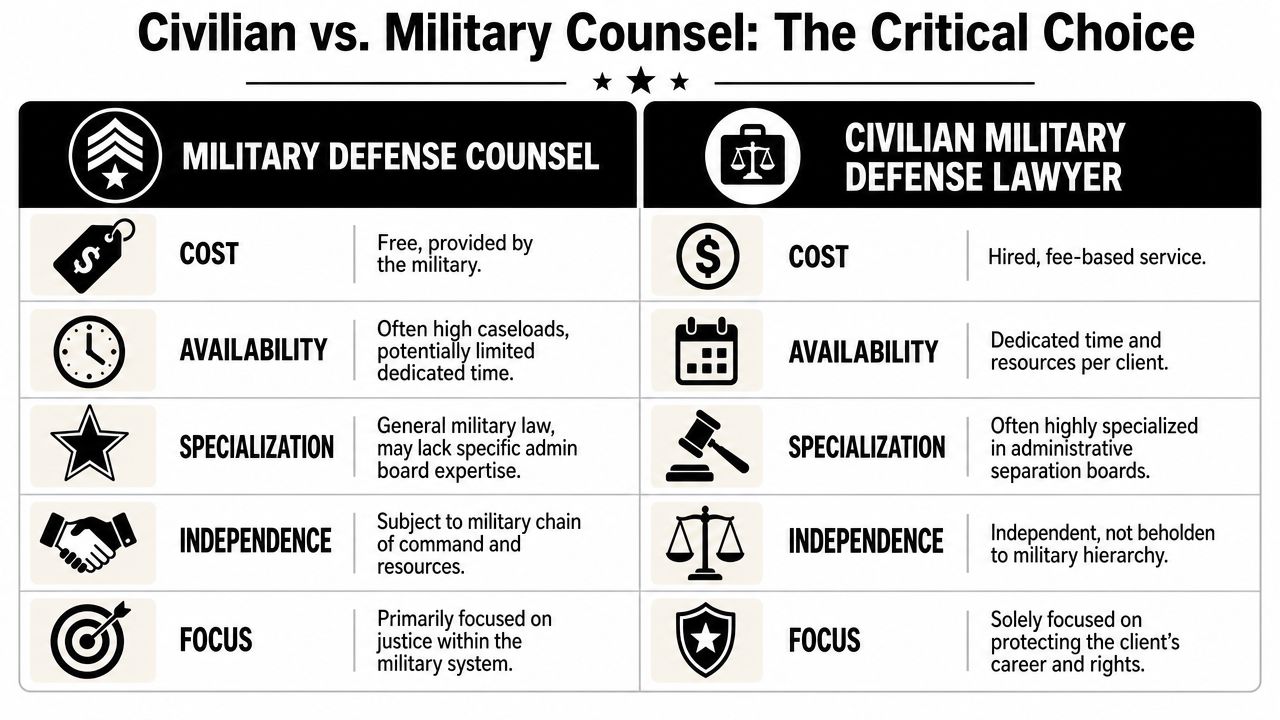
If you are weighing that decision, this comparison of military defense lawyer vs civilian defense counsel explains the differences in more detail.
What appointed military counsel does well
Detailed military counsel can be a real asset. They know the installation, understand local personalities, and often know how that command or legal office tends to present separation cases. That local knowledge can matter.
They also come at no cost to the service member.
But there are real limits. Military defense counsel often carry heavy caseloads, competing duties, training requirements, and office demands that have nothing to do with your board. Even a good lawyer can be constrained by time. In an administrative separation case, time is often the difference between a thin presentation and a defense that gives the board a reason to pause.
What civilian counsel changes
A civilian military defense lawyer works for one person only. The client.
That independence affects the case in practical ways. More witness interviews. More document review. More time spent preparing your testimony. More effort on exhibits, rebuttal evidence, and written themes that fit how military board members make decisions.
That last point gets missed all the time. Officers on a separation board are not a civilian jury. They are evaluating credibility, judgment, duty performance, rehabilitation potential, and whether keeping you aligns with good order and discipline. Loud, theatrical advocacy usually plays poorly in that room. Respectful, disciplined advocacy usually works better. Former JAGs understand that psychology because they have seen how board members react behind closed doors.
A practical comparison helps:
| Issue | Detailed military counsel | Civilian military defense lawyer |
|---|---|---|
| Cost | No fee to the member | Hired at the member’s expense |
| Time | Often split across other cases and duties | Usually more dedicated preparation time |
| Independence | Works inside the military system | Works outside the chain of command |
| Case development | Quality can be high, but resources vary | More room for witness prep, record review, and mitigation work |
| Board presentation | May be shaped by office workload and local practice | Can be built around a focused theory of retention or damage control |
For some service members, appointed counsel is enough. For others, it is not. If the case involves a serious allegation, a contested factual record, prior discipline, retirement exposure, or a command that has already decided it wants you out, more focused preparation can change the outcome or at least improve the record you leave with.
Using both lawyers together is often the strongest setup. Military counsel may know the local terrain. Civilian counsel can spend the extra hours building the case and sharpening the message for the board. Gonzalez & Waddington often works in that role, alongside appointed counsel, helping prepare witnesses, challenging weak evidence, and shaping a presentation that speaks to what military officers care about.
Why Service Members Trust Gonzalez & Waddington
Service members usually contact this firm when the case is serious, the command already has momentum, and generic advice won’t cut it. Administrative separation boards are not isolated from the rest of military justice. The same skills that matter in contested UCMJ litigation matter here too. Investigation, witness preparation, cross-examination, mitigation development, and command-pressure analysis.
Michael Waddington is a former Army JAG, prosecutor, Trial Defense Counsel, Senior Defense Counsel, Special Assistant U.S. Attorney, and Chief of Military Justice. Alexandra González-Waddington has defended service members facing sexual assault, war crimes, violent crimes, domestic violence, and white-collar allegations. Together, they represent service members worldwide across the Army, Navy, Air Force, Marine Corps, Coast Guard, Space Force, active duty, Reserve, and National Guard.
The firm’s work spans the United States, Europe, Asia, the Middle East, Iraq, Afghanistan, and deployed environments. That matters because command climate is never the same everywhere. The lawyers have also authored books on military law, trial advocacy, sexual assault defense, digital forensics, DNA, experts, and cross-examination. If you want to know more about whether the firm handles these cases, this page answers that directly: administrative separation board representation by Gonzalez & Waddington.
Additional context
Yes. In many cases, service members work with both. That can give you the benefit of detailed military counsel’s local access and a civilian lawyer’s dedicated preparation and independent strategy.
Additional context
Save texts, emails, social media messages, photos, call logs, medical records when relevant, evaluations, awards, and any documents tied to the allegations or your duty performance.
Additional context
Fees vary by lawyer, branch, complexity, witnesses, travel, and whether there are related investigations or criminal allegations. Ask directly about scope of work, hearing preparation, and who will handle the case.
If your command has started separation paperwork, or you think it’s coming, act before the file hardens against you. Early strategy, disciplined silence, evidence preservation, and experienced board advocacy can change the direction of the case. Contact Gonzalez & Waddington, LLC, UCMJ Defense Lawyers, at 1-800-921-8607, text 954-799-4019, or visit ucmjdefense.com.
“This article is for general informational purposes only and does not create an attorney-client relationship. Every military case depends on the facts, evidence, command climate, service branch, forum, and applicable law. Past results do not guarantee future outcomes.”
Attorney advertising. This page is published by Gonzalez & Waddington, LLC. It explains how to evaluate a lawyer; it is not a ranking of lawyers. Past results do not guarantee a similar outcome.
Recent Blogs
- Nonpunitive Letter of Caution vs. Punitive Letter of Reprimand: What Navy and Marine Corps Officers Need to KnowNovember 6, 2026
- First 24 Hours After CGIS Contacts You: What Coast Guard Members Should DoNovember 6, 2026
- First 24 Hours After OSI Contacts You: What Airmen and Guardians Should DoNovember 6, 2026
- First 24 Hours After NCIS Contacts You: What Sailors and Marines Should DoNovember 6, 2026
- First 24 Hours After CID Contacts You: What Soldiers Should DoNovember 6, 2026
- Is Hiring the Cheapest Military Defense Lawyer a Mistake?November 6, 2026