

Court-Martial Defense Attorneys | Worldwide UCMJ Defense
A court-martial is a federal criminal trial run on a separate body of law, with its own rules of evidence, its own charging authority, hand-selected panels, and conviction by a three-fourths vote rather than unanimity. Gonzalez & Waddington has defended Soldiers, Sailors, Airmen, Marines, Coast Guardsmen, and Guardians in contested courts-martial worldwide for more than two decades. Call 1-800-921-8607.
Key Takeaways
- Hiring civilian counsel costs you nothing in military counsel. Article 38(b)(4) provides that your detailed military lawyer stays on the case as associate counsel unless you excuse them.
- Conviction does not require a unanimous panel. Article 52 requires the concurrence of three-fourths of the members — on an eight-member general court-martial panel, six votes convict.
- Prosecution decisions have moved. For covered offenses, the independent Office of Special Trial Counsel now decides whether you are charged — not your commander.
- Acquittals happen, and so does appellate reversal. In FY 2025 the Air Force recorded 32 acquittals at general court-martial, and its appellate court found convictions clearly against the weight of the evidence in six cases.
- Experience is measured in contested trials, not years admitted. The single most useful question you can ask any court-martial attorney is how many contested cases of your specific type they have tried to verdict.
- Timing dominates everything else. The government’s best evidence is very often something the accused said in the first seventy-two hours.
Facing a court-martial or under investigation? Call 1-800-921-8607 or text 954-799-4019 for a confidential consultation before you speak to investigators or your command.
What Is a Court-Martial Defense Attorney?
A court-martial defense attorney is a lawyer who represents an accused service member in the military criminal justice system. There are two kinds, and every accused is entitled to both at once.
Detailed military defense counsel is a judge advocate assigned to you by the service at no cost under Article 27, UCMJ. In the Air Force they are called Area Defense Counsel; in the Army, Trial Defense Service counsel; in the Navy and Marine Corps, Defense Service Office counsel. They are provided regardless of your ability to pay.
Civilian court-martial defense counsel is a lawyer you retain and select yourself. They are not in the military, do not report to any chain of command, and answer only to you. They may appear at any court-martial worldwide and typically serve as lead counsel, with your detailed military counsel remaining on the team.
A court-martial is not a civilian trial in a different uniform. As the Supreme Court put it in Parker v. Levy, the military is a specialized society separate from civilian society
. Parker v. Levy, 417 U.S. 733, 743 (1974). The rules of evidence, the charging decisions, panel selection, sentencing procedure, and — since the creation of the Office of Special Trial Counsel — even who decides to prosecute you run on a separate system that most criminal defense lawyers have never practiced in.
Your Statutory Right to Hire a Civilian Court-Martial Attorney
The right to civilian counsel is not a courtesy the command extends. It is written into the Uniform Code of Military Justice, and it is worth reading the actual language because service members are frequently given a distorted version of it.
“The accused has the right to be represented in his defense before a general or special court-martial or at a preliminary hearing under section 832 of this title (article 32) as provided in this subsection. … The accused may be represented by civilian counsel if provided by him.”
— Article 38(b)(1)–(2), UCMJ, 10 U.S.C. § 838(b)(1)–(2)
Three things follow from that text. The right attaches at the Article 32 preliminary hearing, not just at trial — which matters enormously, because the Article 32 is where the government’s evidence is first exposed. The right belongs to the accused, not to the command, and requires no one’s permission. And “if provided by him” means the government does not pay for civilian counsel; you do.
The second provision is the one most service members have never been told about:
“If the accused is represented by civilian counsel, military counsel detailed or selected under paragraph (3) shall act as associate counsel unless excused at the request of the accused.”
— Article 38(b)(4), UCMJ, 10 U.S.C. § 838(b)(4)
You do not trade your free military lawyer for a civilian one. You add to your team. The statute says your detailed counsel “shall act as associate counsel” — mandatory language — unless you excuse them. A service member who is told they must choose between the two has been misinformed.
You may also request a specific military lawyer by name under Article 38(b)(3)(B), if that counsel is “reasonably available” as defined by service regulation — a separate right known as individual military counsel, which can be requested alongside civilian counsel.
You can read the full statute at the Legal Information Institute’s text of 10 U.S.C. § 838.
The Three Types of Court-Martial
| Summary Court-Martial | Special Court-Martial | General Court-Martial | |
|---|---|---|---|
| Forum | One officer, no military judge | Military judge, or judge and 4 members | Military judge, or judge and 8 members (12 in capital cases) |
| Vote to convict | Single officer decides | Three-fourths of members | Three-fourths of members; unanimous in capital cases |
| Maximum confinement | Up to 30 days (E-4 and below); no confinement for E-5 and above | Up to 1 year; 6 months at a judge-alone special under Article 16(c)(2)(A) | Up to the maximum for the offense, including life or death |
| Punitive discharge | None | Bad-conduct discharge available | Bad-conduct or dishonorable discharge; dismissal for officers |
| Federal conviction | No — a summary court-martial is a non-criminal forum by statute | Yes | Yes |
| Right to refuse | Yes — you may refuse and demand trial by special or general court-martial | No | No |
| Civilian counsel | Not a statutory right; permitted in practice in some circumstances | Yes, under Article 38(b) | Yes, under Article 38(b) |
The three-fourths rule deserves emphasis because service members consistently assume military panels work like civilian juries. They do not:
“No person may be convicted of an offense in a general or special court-martial, other than … in a court-martial with members under section 816 of this title (article 16), by the concurrence of at least three-fourths of the members present when the vote is taken.”
— Article 52(a)(3), UCMJ, 10 U.S.C. § 852(a)(3)
On an eight-member general court-martial panel, six votes convict. There is no hung jury and no mistrial from deadlock. Two members holding out for acquittal accomplish nothing. That single structural fact changes how a contested case must be tried — the defense cannot aim to persuade one juror; it has to move the room.
Courts-Martial by the Numbers: What the Government’s Own Data Shows
Each service’s Judge Advocate General must report annually to Congress under Article 146a, UCMJ. Those reports are public, and they tell a more useful story than most marketing pages. The figures below are from the fiscal year 2025 reports, published in December 2025.
Department of the Air Force, FY 2025
| Type of court | Tried | Convicted | Acquitted |
|---|---|---|---|
| General court-martial | 137 | 105 | 32 |
| BCD special court-martial | 119 | 99 | 20 |
| Judge-alone special (Art. 16(c)(2)(A)) | 7 | 6 | 1 |
| Summary court-martial | 51 | 51 | 0 |
| Total | 314 | 261 | 53 |
What these numbers actually mean. Thirty-two acquittals out of 137 general courts-martial is roughly one in four — and the real contested rate is higher than that, because “tried” includes guilty pleas. Of the Air Force’s 137 general courts-martial, 86 were tried by military judge alone, a figure heavily weighted toward pleas. Acquittal in a contested military trial is not the long shot commands often imply it is.
Courts-martial are rare; nonjudicial punishment is not. Against an average active-duty strength of 330,470, the Air Force recorded 314 courts-martial and 3,357 Article 15 punishments — a rate of 10.13 per 1,000. For every service member court-martialed, roughly ten received NJP. This is why the decision whether to accept or refuse an Article 15 is one of the most consequential a service member makes.
Appellate courts do reverse. The Air Force Court of Criminal Appeals issued 169 opinions and orders in FY 2025. Applying the factual sufficiency standard enacted in the FY 2021 NDAA, it found convictions clearly against the weight of the evidence in six of thirteen cases reviewed under that standard, and factually insufficient in five of twenty-three cases reviewed under the prior standard. Most involved sexual offenses.
What gets charged. The most frequently preferred offenses in the Air Force in FY 2025 were Article 112a (drug offenses, 190), Article 120 (sexual assault, 167), Article 128b (domestic violence, 155), Article 134 (general article, 152), and Article 92 (orders violations, 142).
Department of the Navy, FY 2025
The Navy tried 170 courts-martial and the Navy-Marine Corps Court of Criminal Appeals reviewed 247 Navy and Marine Corps cases on appeal. The Office of Special Trial Counsel prosecuted 88 courts-martial — 48 general and 40 special.
The OSTC trend line is the number worth watching. Navy OSTC received 2,666 investigations in FY 2025, up 23 percent from 2,176 the year before, and closed 2,746 cases, up 36 percent. As of 30 September 2025 it was managing 1,253 active investigations and cases. Domestic violence allegations made up roughly 40 percent of new cases — about 88 per month. Sexual harassment became a covered offense on 1 January 2025 under the FY 2023 NDAA, expanding OSTC’s jurisdiction further.
The takeaway for an accused service member: you are now facing a dedicated, independent, growing corps of career prosecutors whose only job is these cases. The full reports are published by the Joint Service Committee on Military Justice.
What Does a Court-Martial Defense Attorney Actually Do?
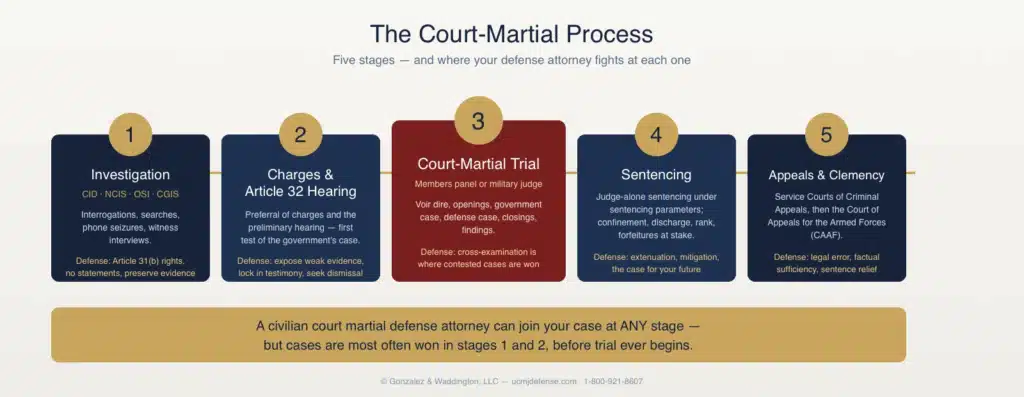
From the cases we defend, the work breaks into phases — and the earliest phase is where cases are most often won or lost.
Investigation defense. Before charges exist, CID, NCIS, OSI, or CGIS build the government’s case: interrogations, phone seizures, searches, witness interviews. A defense attorney’s job here is to stop you from handing the government its case — invoking your Article 31(b) rights, managing command contact, preserving evidence that helps you, and shaping the record before it hardens against you.
Preferral and referral. Charges are drafted and sworn, reviewed for legal sufficiency, and referred to a forum. Counsel litigates the charging decisions themselves here — multiplicity, unreasonable multiplication of charges, defective specifications — and engages with the convening authority or, for covered offenses, with special trial counsel.
Article 32 preliminary hearing. The Article 32 is the defense’s first structured look at the government’s evidence and the only pretrial proceeding where witnesses can be cross-examined under oath. Handled well, it exposes weak testimony, locks witnesses into statements they must live with at trial, and sometimes ends cases before they reach a courtroom.
Discovery, experts, and motions. Requesting the government’s file, compelling production of witnesses and evidence, obtaining funded defense experts in forensics and digital evidence, and litigating suppression, unlawful command influence, speedy trial, and evidentiary motions under M.R.E. 412, 413, and 513.
Trial. Contested courts-martial are won by cross-examination and preparation — by dismantling the government’s witnesses in front of the panel. This is where our firm’s identity lives: our partners have written the books military and civilian lawyers use to learn cross-examination, and we try cases the way those books teach.
Sentencing and appeal. If a case reaches findings, the fight continues — sentencing under the military’s judge-alone parameters, confinement credit, clemency, and appeals through the service Courts of Criminal Appeals and the U.S. Court of Appeals for the Armed Forces.
Why Hire a Civilian Court-Martial Defense Attorney Instead of Relying on JAG Alone?
Your detailed military defense counsel is free, and many are talented and dedicated. We say that honestly, because we were JAG attorneys ourselves. But there are structural realities every accused service member should weigh, and they are documented in the services’ own reports rather than invented by defense lawyers.
Caseload and experience level. The Air Force’s FY 2025 report describes a Trial Defense Division of 83 Area Defense Counsel serving a force of roughly 330,000. It also describes the career path plainly: new Area Defense Counsel “begin their defense careers by defending individual clients in matters such as nonjudicial punishment, and by usually acting as second-chair defense counsel on courts-martial while being supervised by a Senior Defense Counsel.” That is a sound training model. It is not the same thing as retaining a lawyer who has already tried dozens of contested cases of your type.
Resource constraints are real and reported. The same report notes that of eight planned defense investigator billets, only seven were filled, one was eliminated in a civilian-position reduction, and the Pacific district’s investigator billet went unfilled during a hiring freeze — leaving District 6 covered by investigators from other districts.
Rotation. Military defense counsel PCS. A case that runs eighteen months from investigation to verdict can outlast the counsel who started it. Civilian counsel stays on the case until it ends.
Independence. A civilian court-martial defense attorney answers to you alone — not to a chain of command, an efficiency report, or a career inside the same institution prosecuting you.
And hiring civilian counsel doesn’t cost you your military lawyer: under Article 38(b)(4) you keep your detailed counsel on the team, at no charge, alongside the attorney you chose.
Why Independence Matters: What the Courts Have Found
The independence point is not theoretical, and it is not something service members have to take on a defense lawyer’s word.
In its FY 2025 report to the Senate and House Armed Services Committees, the Navy described two cases — United States v. Draher and United States v. Negron — in which Marines were tried together on charges including involuntary manslaughter and negligent homicide arising from an altercation in Erbil, Iraq. On appeal, the Navy-Marine Corps Court of Criminal Appeals dismissed both cases with prejudice on the basis of unlawful command influence.
According to the report, the court found that a Colonel who oversaw the assignment process for Marine Corps judge advocates had told military defense attorneys that successfully defending their clients could jeopardize their future assignments and promotions. The court concluded the facts were indistinguishable from the Court of Appeals for the Armed Forces’ finding of actual unlawful command influence in United States v. Gilmet, 83 M.J. 398 (C.A.A.F. 2023), which arose from the same incident.
We want to be careful and fair about what this does and does not show. It does not show that military defense counsel are compromised — the overwhelming majority are ethical, committed advocates who fight hard for their clients, and the services have built genuine structural protections for defense independence, including separate reporting chains that bypass the local command. What it shows is that the pressure the system is designed to prevent is real enough that appellate courts have found it, twice, in recent years, and that Congress is told about it.
A civilian attorney has no assignment officer, no promotion board, and no career inside the institution prosecuting you. That is a structural difference, not a claim about anyone’s character.
What Cases Do Court-Martial Defense Attorneys Handle?
Gonzalez & Waddington defends the full range of UCMJ offenses, with deep contested-trial experience in the cases the military prosecutes hardest:
- Article 120 — rape and sexual assault, including alcohol and consent cases, and Articles 120b and 120c
- Article 128 and 128b — assault and domestic violence, including strangulation allegations
- CSAM possession and online sting operations, including entrapment and digital forensics defense
- Article 121 — larceny, BAH and travel fraud, and financial crime allegations
- Article 112a — wrongful drug use and distribution
- Article 134 sexual harassment, a covered offense since 1 January 2025
- Articles 86, 92, 133, and 134 — AWOL, orders violations, conduct unbecoming, and the general article
- Articles 118 and 119 — murder, manslaughter, and negligent homicide
- War crimes and combat-related prosecutions
- Classified information and national security cases
- Boards of Inquiry and administrative separation boards, GOMOR and letter of reprimand rebuttals, and Article 15 / NJP decisions
The complete offense library is in our UCMJ articles guide.
Representative Case Types
The following are composite descriptions of the kinds of cases court-martial defense attorneys handle and the legal issues they turn on. They are illustrative of case types, not accounts of specific clients, and no outcome is implied. Documented results from our contested cases appear on our case results page.
- The alcohol-and-consent Article 120 case. Two service members drink together; one reports sexual assault days or weeks later. There is no physical evidence and no independent witness. The case turns entirely on credibility, the reliability of intoxicated memory, the sequence of text messages before and after, and whether the government’s expert overstates what the science supports.
- The delayed-report case. An allegation surfaces months or years later, often during a divorce, a custody dispute, or an unrelated investigation. The defense issues are timeline reconstruction, prior inconsistent statements, and M.R.E. 412 and 513 litigation over the accuser’s records.
- The online sting. A service member responds to an adult-presenting profile on a dating application; the person is a law enforcement officer. The issues are entrapment, predisposition, the full unedited chat log rather than the excerpts in the report, and digital forensics on the device.
- The domestic violence case with a recanting witness. A spouse calls police, then declines to cooperate. The government proceeds on excited utterances, body camera footage, and Family Advocacy records. The battle is over confrontation, hearsay exceptions, and injury interpretation.
- The urinalysis case. A positive result on a random test. The defense examines chain of custody, laboratory accession and testing records, cutoff levels, innocent ingestion, and whether the government can prove knowing use.
- The BAH or travel voucher fraud case. Documentary from start to finish. The fight is over intent versus administrative error, the aggregate loss amount driving the sentencing exposure, and whether the government’s summary exhibits accurately reflect the underlying records.
- The case that follows a declination. Special trial counsel decline to prefer charges, or a panel acquits — and the command pivots to a separation board, where the burden drops to a preponderance and hearsay is admissible.
How to Choose a Court-Martial Defense Attorney
This is the question this page exists to answer, and most of the advice available online is useless because it is written to flatter whichever firm published it. Here is what actually distinguishes court-martial counsel, in rough order of importance.
1. Contested courts-martial tried to verdict — in your specific type of case
Not “cases handled.” Not “years of experience.” Not “clients served.” The number that matters is how many contested trials the lawyer has taken to a findings verdict, and how many of those involved charges like yours. A lawyer with two hundred guilty pleas and four contested trials has a different skill set than one with forty contested trials. Ask for the number. A lawyer who will not give you one is telling you something.
2. Military justice as a practice, not a sideline
Court-martial practice is a specialty. R.C.M. and M.R.E. practice, Article 32 strategy, panel selection and member challenges, the OSTC referral process, sentencing parameters, and post-trial procedure are not things a general criminal defense lawyer picks up between state court dockets. Ask what percentage of the firm’s caseload is military.
3. Willingness to actually try the case
Some lawyers advertise court-martial defense and resolve nearly everything by plea agreement. Plea negotiation is a legitimate and often correct strategy — but a lawyer the government knows will not try a case has no leverage in negotiating one. Ask directly: when did you last try a contested general court-martial to verdict?
4. Cross-examination as a demonstrated skill
Most serious courts-martial are credibility cases with no physical evidence. Cross-examination is not a personality trait; it is a technical discipline with a literature. Ask where the lawyer learned it and whether they teach or write about it.
5. Forensic and digital evidence capability
Modern military prosecutions run on phone extractions, browser history, DNA, toxicology, and metadata. Ask whether the lawyer has cross-examined a forensic examiner, whether they work with defense experts, and whether they know how to obtain government-funded expert assistance.
6. Who will actually be in the courtroom
Some firms are marketing operations that sign clients with a senior name and staff the trial with an associate you have never met. Ask, in writing, which named attorney will sit at counsel table and conduct the cross-examinations.
7. Global reach and willingness to travel
Courts-martial happen at Camp Humphreys, Ramstein, Kadena, Rota, Vicenza, and aboard ships. Ask whether travel is included in the fee and whether the lawyer has actually tried cases overseas — SOFA issues, host-nation parallel proceedings, and witness availability across time zones are real complications.
8. Cross-service experience
Army, Navy, Marine Corps, Air Force, Space Force, and Coast Guard practices differ in convening authority structure, defense organization, and local culture. A lawyer who has practiced across all six brings techniques from one service into another.
9. Coverage of the whole problem
A court-martial rarely arrives alone. There is usually an investigation before it and a separation board, clearance action, or reprimand after it. A lawyer who handles only the trial leaves you to fight the rest separately, often with inconsistent positions.
10. Bar standing and verifiable credentials
Check the bar admissions of every state claimed, look for public discipline history, and verify the credentials independently. Books, teaching positions, and media appearances should be findable outside the firm’s own website.
11. Fee clarity
You should know before you sign what is included, what triggers additional fees, whether appeals or separation boards are covered, and how travel is billed. Flat fees quoted after a real case assessment are generally clearer than hourly billing for this kind of work.
12. Candor in the first conversation
The best signal is often the least tangible. A lawyer who tells you the case is difficult, explains what the government has, and declines to predict an outcome is being straight with you. A lawyer who guarantees results in the first phone call is telling you they will say what closes the sale.
Questions to Ask Before You Retain Anyone
- How many contested courts-martial have you tried to verdict?
- How many involved charges like mine?
- When was your last contested general court-martial?
- What percentage of your practice is military justice?
- Which named attorney will conduct the cross-examinations at my trial?
- Have you tried cases in my branch? At an overseas installation?
- Have you litigated Article 32 hearings and unlawful command influence motions?
- How do you work with my detailed military defense counsel?
- What is the total fee, and what does it include?
- Does the fee cover the Article 32, motions practice, trial, sentencing, and appeal?
- How is travel handled?
- Do you use defense investigators and forensic experts, and who pays for them?
- What are the realistic worst-case and best-case outcomes here?
- What should I do — and not do — in the next seventy-two hours?
- What are your bar admissions, and has any been the subject of public discipline?
Warning Signs
- Guaranteed outcomes. No ethical lawyer promises an acquittal. Bar rules in every jurisdiction prohibit it.
- Pressure to sign immediately. Urgency about the case is appropriate. Urgency about the retainer is a sales tactic.
- Vagueness about trial experience. “Decades of experience” that never resolves into a number of contested trials.
- No named trial attorney. If the firm will not commit in writing to who tries the case, assume it is not the person on the homepage.
- Fees that keep expanding. Escalating charges for phases that were implied to be included.
- Disparaging your military counsel wholesale. A civilian lawyer whose pitch is that all JAGs are incompetent is not being accurate and will not work well with the counsel who stays on your team.
- No military practice. A well-regarded state criminal lawyer with no court-martial experience is the wrong tool, however good they are in their own forum.
Military Defense Counsel and Civilian Counsel Compared
| Detailed military defense counsel | Civilian court-martial attorney | |
|---|---|---|
| Cost | Free | Retained at your expense |
| Selection | Assigned to you | Chosen by you |
| Reports to | A defense chain of command within the service | You |
| Typical experience level | Often a junior judge advocate building toward lead counsel | Varies widely — verify contested trial numbers |
| Caseload | Substantial and assigned | Controlled by the firm |
| Continuity | Subject to PCS rotation | Stays through the case |
| Military justice knowledge | Trained and current in it daily | Depends entirely on the lawyer |
| Can you have both? | Yes — Article 38(b)(4) keeps detailed counsel on as associate counsel unless you excuse them. | |
The honest summary: a good military defense counsel plus an experienced civilian attorney is a stronger team than either one alone, and the statute is written to let you have exactly that.
What Does a Court-Martial Defense Attorney Cost?
Fees depend on the charges, the forum, and how far the case must go. A fully contested Article 120 general court-martial is a different undertaking than an Article 15 rebuttal or a separation board, and any firm quoting a number before understanding your case is guessing.
Structurally, most experienced court-martial firms use flat fees rather than hourly billing, quoted after a consultation, so you know the total cost before committing. What matters more than the headline number is the scope: whether it covers the investigation phase, the Article 32, motions practice, the trial itself, sentencing, clemency, and appeal — and how travel to your installation is handled. Ask for the scope in writing.
Two things are worth weighing against the fee. A federal conviction and punitive discharge cost a career, retirement, VA benefits, clearance eligibility, and in covered sexual offense cases, sex-offender registration. And an Article 120 conviction carries a mandatory minimum of dismissal or dishonorable discharge. That is the honest stakes assessment.
When Should You Hire a Court-Martial Defense Attorney?
The moment you learn you are under investigation — before any interview, and before you discuss the allegation with your command, your friends, or the complaining witness.
In the cases we defend, the government’s strongest evidence is very often something the accused said or did in the first days, trying to explain, apologize, or fix it. Consent to a phone search given in the first hour. A text message to the complaining witness that reads as an admission. A “clarifying” interview that becomes the government’s best exhibit. Silence plus counsel is not an admission of guilt; it is the statutory right the system expects you to use.
Hiring late is not fatal, and cases are defended successfully after charges are preferred. But the range of available outcomes narrows at every stage, and the widest range exists before you have said anything at all.
Who Are the Court-Martial Defense Attorneys at Gonzalez & Waddington?
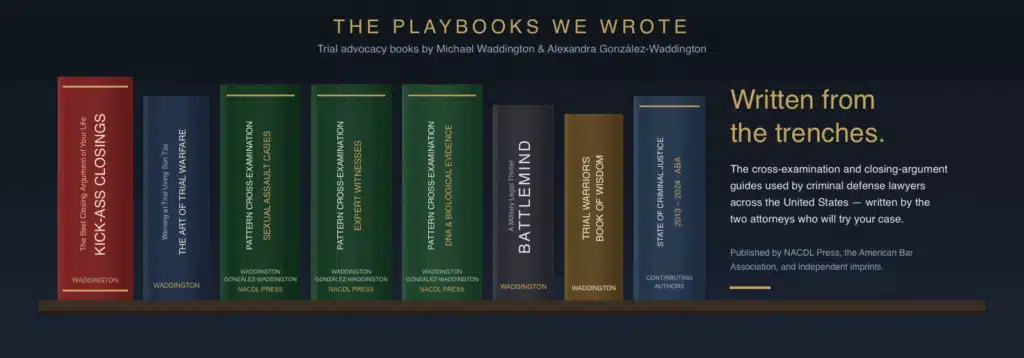
Michael Waddington is a former U.S. Army JAG officer (2001–2005) who has defended court-martial and war-crimes cases worldwide, including cases featured in the Academy Award–winning documentary Taxi to the Dark Side. He is the author of nine books on trial advocacy and military justice — including Kick-Ass Closings and The Art of Trial Warfare — an adjunct professor at Florida International University College of Law teaching the Law of Armed Conflict, a Life Member of the National Association of Criminal Defense Lawyers, and a Fellow of the American Board of Criminal Lawyers. He is licensed in Florida, Georgia, Pennsylvania, New Jersey, and South Carolina, and has provided legal commentary for CNN, 60 Minutes, and other national media.
Alexandra González-Waddington is a founding partner with more than two decades defending service members worldwide. A graduate of Temple University Beasley School of Law and its Integrated Trial Advocacy Program and a former public defender in Georgia’s Augusta Judicial Circuit, she is the author of six books on trial advocacy — including the NACDL Press Pattern Cross-Examination series on sexual assault cases, forensic experts, DNA, and digital evidence — and a contributing author to the American Bar Association’s The State of Criminal Justice from 2013 through 2024.
Between them: fifteen published books on how to try cases. When you hire this firm, the lawyers who wrote the cross-examination playbooks are the ones cross-examining the witnesses against you.
How Do Court-Martial Defense Attorneys Win Cases?
Every case is different, but from decades inside these courtrooms, contested courts-martial turn on a recognizable set of battles.
The credibility battle. Most serious courts-martial — especially Article 120 cases — rise or fall on witness credibility, not physical evidence. Methodical, pattern-driven cross-examination that exposes inconsistencies, motives, and gaps is the defense’s primary weapon, and it is the specific skill our partners teach and write about.
The forensic battle. Phone extractions, browser history, DNA, toxicology, and digital metadata anchor modern prosecutions — and government experts often claim more certainty than the science supports. Knowing how to cross-examine a forensic examiner is now as fundamental as knowing the rules of evidence.
The process battle. Unlawful command influence, defective investigations, suppression of statements taken in violation of Article 31(b), speedy trial under Article 10 and R.C.M. 707, and discovery violations can gut a prosecution before findings. These issues only help you if your attorney knows military procedure well enough to find them.
The panel battle. Members are selected by the convening authority, not drawn at random from a community. Voir dire, challenges for cause, implied bias, and the single peremptory challenge are a distinct discipline — and with conviction requiring only three-fourths, panel composition carries more weight than in a civilian trial.
The sentencing battle. For offenses committed on or after 28 December 2023, sentencing is by military judge alone under parameters and criteria established by Executive Order 14103, analogous to the federal sentencing guidelines. Sentencing advocacy is now a technical exercise in addition to a persuasive one.
The early-decision battle. Whether to make a statement, whether to accept or refuse NJP, how to respond at the Article 32 stage, whether to negotiate — the decisions made in the first weeks shape everything after. This is why calling counsel before talking to investigators matters more than any single trial tactic.
Representative outcomes from our contested cases are documented on our case results page.
Where We Practice
Gonzalez & Waddington defends service members worldwide, at installations across the United States and in Germany, Italy, the United Kingdom, Japan, Korea, Guam, Hawaii, and the Middle East. Because we are civilian counsel, we are not tied to a single installation, a single service, or a single chain of command. See the locations we serve.
Frequently Asked Questions About Court-Martial Defense Attorneys
Can a civilian attorney represent me at a court-martial anywhere in the world?
Yes. Article 38(b)(2), UCMJ gives every accused the right to be represented by civilian counsel of their own selection, and that right does not stop at the water’s edge. We defend cases at installations across the United States, Europe, Asia, and the Pacific.
Do I lose my free military lawyer if I hire a civilian attorney?
No. Article 38(b)(4) provides that detailed military counsel “shall act as associate counsel unless excused at the request of the accused.” Your military lawyer remains on your case at no cost, working alongside your civilian attorney. You gain a team — you give up nothing.
How much does a court-martial defense attorney cost?
Fees depend on the charges, the forum, and how far the case must go. Most experienced firms quote flat fees after a consultation so you know the full cost before you commit. Ask specifically whether the fee covers the Article 32, motions, trial, sentencing, appeal, and travel.
How do I know if a court-martial attorney is actually experienced?
Ask how many contested courts-martial they have tried to verdict, how many involved charges like yours, and when the last one was. “Years of experience” and “cases handled” include guilty pleas and administrative matters. Contested trials tried to verdict is the number that separates trial lawyers from case processors.
When should I hire a court-martial defense attorney?
The moment you learn you are under investigation — before any interview, and before you discuss the allegation with your command, your friends, or the complaining witness. The government’s strongest evidence is very often something the accused said in the first days trying to explain or fix it.
What are the three types of court-martial?
Summary, special, and general. A summary court-martial is a non-criminal forum with a single officer and limited punishment, and you may refuse it. A special court-martial can adjudge up to one year of confinement and a bad-conduct discharge. A general court-martial handles the most serious offenses and can adjudge the maximum punishment for the charged offense, including a dishonorable discharge.
Does a court-martial panel have to be unanimous to convict?
No. Article 52(a)(3), UCMJ requires the concurrence of at least three-fourths of the members present. On an eight-member general court-martial panel, six votes convict. There is no hung jury, and capital cases are the only ones requiring unanimity.
How many members sit on a court-martial panel?
Eight for a general court-martial, four for a special court-martial, and twelve in capital cases. After impanelment, a general court-martial may proceed with as few as six members.
What happens if I’m convicted at a court-martial?
Consequences can include confinement, a punitive discharge (bad-conduct or dishonorable, or dismissal for officers), reduction in rank, total forfeitures, and for covered sexual offenses, mandatory sex-offender registration. Rape and sexual assault convictions under Article 120 carry a mandatory minimum of dismissal or dishonorable discharge. A federal conviction follows you into civilian life — employment, licensing, benefits, and custody proceedings.
Can charges be defeated before trial?
Yes — cases can be resolved at the investigation stage, dismissed after a weak Article 32 showing, or withdrawn when suppression and unlawful-command-influence litigation cripples the government’s evidence. Not every case ends before trial, and no ethical lawyer promises that yours will, but the earlier the defense starts working, the more exits exist.
Who decides whether I get prosecuted now — my commander or the OSTC?
For covered offenses — including sexual assault, domestic violence, and since 1 January 2025, sexual harassment — the decision belongs to the Office of Special Trial Counsel, independent military prosecutors outside your chain of command. For other offenses, commanders retain disposition authority.
Do people actually get acquitted at courts-martial?
Yes. The Air Force reported 32 acquittals out of 137 general courts-martial in FY 2025, and 53 acquittals across all forums. Because “tried” includes guilty pleas, the acquittal rate among genuinely contested cases is higher still.
Can a court-martial conviction be appealed?
Yes. Appeals run to the service Court of Criminal Appeals under Article 66 and then to the U.S. Court of Appeals for the Armed Forces under Article 67, with discretionary review available at the Supreme Court. Service courts do reverse: the Air Force court found convictions clearly against the weight of the evidence in six cases in FY 2025.
What is an Article 32 preliminary hearing?
A pretrial hearing required before charges may be referred to a general court-martial. A preliminary hearing officer considers whether there is probable cause and recommends a disposition. It is the only pretrial proceeding where the defense can cross-examine witnesses under oath, which makes it a significant strategic opportunity.
Should I refuse an Article 15 and demand trial by court-martial?
Sometimes, but never without counsel first. Refusing NJP forces the command to either prefer charges or drop the matter, which can be a strong play when the evidence is weak, and a serious risk when it is not. It is one of the highest-stakes decisions in military justice and depends entirely on the facts.
Can I be court-martialed after leaving the military?
In limited circumstances, yes. Jurisdiction can extend to certain retirees receiving retired pay and to members of the reserve component in some statuses. Whether jurisdiction exists in a particular case is a fact-specific legal question worth having examined.
What is the difference between a court-martial and a separation board?
A court-martial is a federal criminal trial requiring proof beyond a reasonable doubt. An administrative separation board or Board of Inquiry decides retention and discharge characterization on a preponderance of the evidence, with relaxed evidence rules. An acquittal at court-martial does not prevent a separation board on the same conduct.
Can I hire a civilian lawyer for an Article 32 hearing?
Yes. Article 38(b)(1) extends the right to counsel expressly to preliminary hearings under Article 32. This is often the most valuable point in the case to bring civilian counsel in.
Authoritative Resources
- Joint Service Committee on Military Justice — Article 146a Annual Reports (each service’s report to Congress, including court-martial statistics)
- U.S. Court of Appeals for the Armed Forces (opinions and the military justice appellate docket)
- Manual for Courts-Martial and current military law publications
- 10 U.S.C. § 838 — Article 38, UCMJ (right to counsel)
Related Guides
- Military Investigation Rights – Article 31(b), Statements & Searches
- Command-Directed Investigation Defense Lawyers
- Boards of Inquiry & Administrative Separation Lawyers
- Letters of Reprimand and GOMOR Defense Lawyers
- Article 15 / Nonjudicial Punishment Defense
- UCMJ Offenses Library
- UCMJ Maximum Punishments Chart
- The Office of Special Trial Counsel Explained
Talk to a Court-Martial Defense Attorney Today
If you are under investigation, facing charges, or weighing an Article 15, the next conversation you have should be privileged. Call 1-800-921-8607 or text 954-799-4019 for a confidential consultation with Gonzalez & Waddington — court-martial defense attorneys defending service members in the Army, Navy, Air Force, Marine Corps, Space Force, and Coast Guard, worldwide.
Disclaimer: This page is for general information and does not create an attorney-client relationship. Every case depends on its facts, forum, and applicable law. Statistics are drawn from the services’ published fiscal year 2025 reports to Congress and describe system-wide data, not predictions about any individual case. Past results do not guarantee future outcomes.
Facing a court-martial or under investigation? Call 1-800-921-8607 or text 954-799-4019 for a confidential consultation before you speak to investigators or your command.