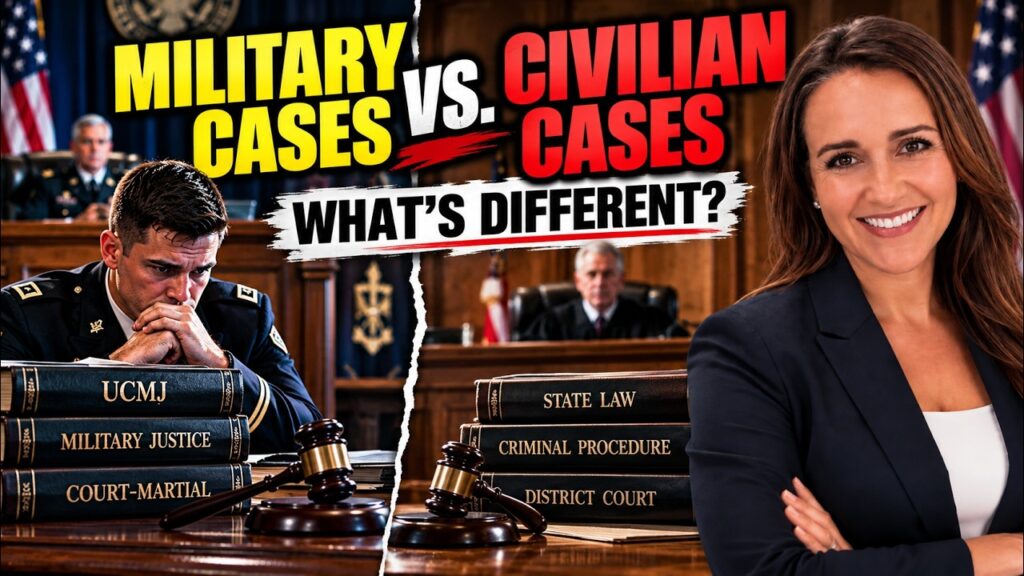
Short answer: Military defense cases differ from civilian criminal cases in almost every way that matters: the law that applies, who decides to prosecute, who sits on the jury, your rights, the rules of evidence, the punishments, and the administrative action that can follow even after an acquittal. Civilian military defense lawyer Alexandra González-Waddington of Gonzalez & Waddington explains each difference and why it should shape the lawyer you choose.
In this video, Alexandra González-Waddington explains the key differences between a court-martial and a civilian criminal case, and what they mean for your defense.
What law applies in a military criminal case?
Military cases are charged under the Uniform Code of Military Justice (UCMJ), not state or federal criminal codes. The UCMJ includes offenses that exist nowhere else, such as absence without leave, disrespect, failure to obey an order, fraternization, and conduct unbecoming an officer.
It also has Article 134, the general article, which covers conduct prejudicial to good order and discipline or service discrediting. And it has its own versions of familiar crimes: Article 120 for sexual offenses, Article 112a for drugs, and Article 128 for assault.
Who decides to prosecute a service member?
In a civilian case, an elected or appointed prosecutor decides whether to file charges. In the military, the decision has traditionally belonged to commanders, advised by a staff judge advocate, and the convening authority who refers a case to trial is a senior commander, not a lawyer.
Since December 2023, the Office of Special Trial Counsel decides whether to prosecute covered offenses, including most sexual assault cases. Because commanders still play a central role, unlawful command influence remains a constant issue that civilian courts never see.
How is a court-martial panel different from a civilian jury?
A civilian felony jury is usually twelve randomly selected citizens who must agree unanimously. A court-martial panel is made up of officers and, if an enlisted accused requests, enlisted members, chosen through a process run by the convening authority under Article 25, UCMJ.
A general court-martial in a non-capital case has eight members, and a conviction requires three-fourths of them to agree. Panel members are not your peers in the civilian sense. They are usually senior to you in rank.
Are your rights different in the military?
Some rights are stronger. Article 31(b), UCMJ, requires a rights warning before anyone subject to the UCMJ questions a suspect, whether or not the suspect is in custody, which is broader than Miranda. Discovery under Article 46 and Rule for Courts-Martial 701 is more open than in most civilian courts, and you receive a military defense lawyer at no cost regardless of income.
Some rights are weaker. There is no grand jury; the Article 32 preliminary hearing is the closest equivalent, and it is limited. There is no bail; pretrial confinement is ordered by a commander and reviewed by a military magistrate under R.C.M. 305.
Your commander can also authorize a search of your quarters or property on the installation under Military Rule of Evidence 315, without going to a judge.
How do military evidence rules and punishments differ?
The Military Rules of Evidence largely track the federal rules but add military provisions. Rule 412 limits evidence about an alleged victim’s sexual behavior, Rule 513 protects the alleged victim’s mental-health records, Rule 707 bars polygraph evidence entirely, and Rule 305 governs Article 31 warnings.
The punishments are different too. A court-martial can impose confinement, a punitive discharge that follows you for life, forfeiture of pay, and reduction to the lowest enlisted grade. A conviction for certain sexual offenses can require sex offender registration, and a federal conviction stays on your record.
What happens after a military case ends?
In the civilian world, an acquittal usually ends the matter. In the military, an acquittal can be followed by an administrative separation board on the same facts at a lower standard of proof, a general officer memorandum of reprimand, a security clearance review, or relief for cause.
Military cases also move on a different clock and map. Speedy-trial rules, including R.C.M. 707, keep cases moving, so a court-martial often goes from allegation to verdict in about a year, and it can happen anywhere the military operates: Germany, Korea, Japan, or aboard a ship.
That is why the choice of lawyer matters. A civilian criminal lawyer who has never tried a court-martial may not know the Manual for Courts-Martial, the panel selection rules, the sentencing procedure, or the administrative aftermath. Experienced state-court defenders have lost military cases because the system was unfamiliar.
What to do right now
- Invoke your Article 31(b) rights and do not answer investigators’ questions until you have talked to a lawyer.
- Meet with your detailed military defense counsel, who is free and knows your installation.
- If you hire a civilian lawyer, choose one who regularly tries courts-martial, not only civilian criminal cases.
- Ask any lawyer you consider how they will handle the administrative actions that can follow the criminal case.
- Preserve your own evidence, such as messages, photos, and names of witnesses, and share it only with your lawyer.
Key takeaways
- Military cases are charged under the UCMJ, which has offenses and procedures that civilian courts do not.
- Commanders, the convening authority, and the Office of Special Trial Counsel replace the civilian prosecutor’s role.
- A court-martial panel is chosen by the convening authority and convicts by a three-fourths vote, not a unanimous jury.
- Article 31(b) protections are broader than Miranda, but there is no grand jury and no bail.
- Even an acquittal can be followed by administrative action, so your defense must plan for both.
Frequently asked questions
Can a civilian criminal defense lawyer handle a court-martial?
Any licensed lawyer can appear as civilian counsel, but the court-martial system has its own rules, procedures, and culture. Ask how many contested courts-martial the lawyer has tried and how recently.
Is a court-martial conviction a federal conviction?
A conviction at a special or general court-martial is generally treated as a federal criminal conviction. It can affect employment, firearm rights, and professional licensing long after you leave the service.
What is the difference between Article 31(b) and Miranda?
Miranda applies only to custodial interrogation by law enforcement. Article 31(b) applies whenever a person subject to the UCMJ questions someone suspected of an offense, including a supervisor or commander, whether or not the suspect is in custody.
Can I be punished administratively after being found not guilty?
Yes. The military can pursue an administrative separation, a reprimand, or other adverse action based on the same facts, using a lower standard of proof than a court-martial requires.
Related questions
- How is Article 31 different from Miranda?
- Civilian military lawyer vs. JAG attorney: what should you know?
- What should you look for in a military defense lawyer?
Video transcript
Read the full transcript of this video
How do military defense cases differ from civilian criminal cases? In almost every way that matters. Who decides to prosecute, who sits on the jury, what the rules of evidence are, what the rights are, what the punishments are, and what happens to you administratively even if you win. A civilian criminal lawyer walking into a court-martial is in a foreign country. I’m Alexandra González-Waddington, civilian military defense lawyer and co-founder of Gonzalez & Waddington. Here are the differences and why they matter to how you choose a lawyer.
One, the code. Military cases are charged under the Uniform Code of Military Justice, not state or federal criminal law. The UCMJ has offenses that don’t exist anywhere else. Absence without leave, disrespect, failure to obey an order, fraternization, conduct unbecoming an officer, and the general article, Article 134, which covers conduct prejudicial to good order and discipline. And it has its own versions of the familiar ones. Article 120 for sexual offenses, Article 112a for drugs, Article 128 for assault.
Two, who prosecutes? In the civilian world, an elected or appointed prosecutor. In the military, historically the commander, advised by a staff judge advocate, and since December 20th, 2023 for covered offenses, the Office of Special Trial Counsel. The convening authority who refers the case is a general or admiral, not a lawyer, and command influence is a constant issue.
Three, the jury. A civilian jury is 12 random citizens who must be unanimous. A court-martial panel is eight officers or senior NCOs selected by the convening authority who convict by 3/4. They’re not your peers in the civilian sense. They’re your superiors.
Four, the rights. Some are stronger. Article 31 applies whether or not you’re in custody and binds your commander, which is broader than Miranda. Discovery under Article 46 and Rule 701 is more open than most civilian systems. You get a free lawyer regardless of income. Some are weaker. There’s no grand jury. The Article 32 is a preliminary hearing with limited rights. There’s no bail. Pretrial confinement is decided by a commander and reviewed by a magistrate. And your commander can order you to report, be searched under a search authorization they sign, and be restricted, all without a judge.
Five, the evidence. The military rules of evidence largely track the federal rules, but with military specific provisions. Rule 412, the rape shield rule, is applied strictly. Rule 513 protects the accuser’s mental health records. Rule 707 bars polygraphs entirely. Rule 305 governs Article 31 warnings, and command authorizations replace warrants for on-base searches.
Six, the punishments. A civilian conviction means jail, probation, or a fine. A court-martial conviction can mean confinement plus a punitive discharge that follows you for life, forfeiture of all pay, reduction to E-1, and for sexual offenses, registration. The discharge is the part civilians don’t understand. A bad conduct discharge is a federal conviction that also strips benefits.
Seven, the administrative shadow. In the civilian world, an acquittal ends it. In the military, an acquittal can be followed by a separation board on the same facts at a lower standard of proof, a GOMOR, a clearance revocation, or a relief for cause. The criminal case is one front. The career is the war.
Eight, the speed and the geography. A civilian case can take years. A court-martial usually runs a year from allegation to verdict, driven by a speedy trial rule. And it can happen anywhere the military is, Korea, Germany, a ship.
Nine, the lawyers. A civilian criminal lawyer who’s never tried a court-martial doesn’t know the Manual for Courts-Martial, the military rules of evidence, the Article 32 process, the panel selection rules, the sentencing procedure, or the administrative aftermath. Excellent civilian defense lawyers have lost military cases they’d have won in state court because they didn’t know the system.
So, how do military cases differ from civilian ones? A different code, a different prosecutor, a superior officer jury, different rights and evidence, punishments that include a discharge, and an administrative case that continues after the verdict. Hire a lawyer who knows that system. I’m Alexandra González-Waddington with Gonzalez & Waddington. We defend service members worldwide. You can learn more at ucmjdefense.com or call 1-800-921-8607 for a free, confidential consultation.
Talk to a military defense lawyer
Gonzalez & Waddington represents service members worldwide in courts-martial, investigations, and administrative separation boards, and travels to installations in the United States and overseas. Michael Waddington, a former Army JAG officer, has been a lawyer for over 25 years. Call 1-800-921-8607 or visit ucmjdefense.com for a confidential consultation.
This article is general information, not legal advice. Every case is different, and reading it does not create an attorney-client relationship.
Recent Blogs
- Do Civilian Military Lawyers Travel to Your Base?October 27, 2026
- Child Pornography Under Article 134: Penalties and DefensesOctober 27, 2026
- Article 120c UCMJ: Indecent Exposure and Viewing ExplainedOctober 27, 2026
- Expedited Transfer: What Happens to the Accused When the Accuser Moves?October 26, 2026
- What Counts as Retaliation Under Article 132, and How Do You Respond?October 26, 2026
- Accused of Hazing in the Military: What Do Marines and Soldiers Need to Know?October 26, 2026