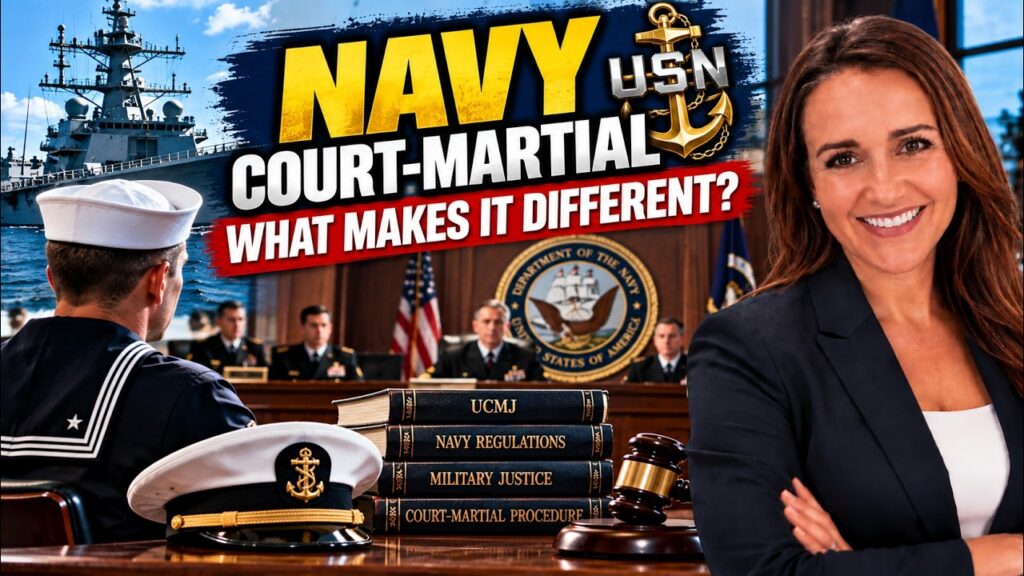
Short answer: Most Navy discipline never reaches a court-martial. Civilian military defense lawyer Alexandra González-Waddington of Gonzalez & Waddington explains that the Navy runs on captain’s mast, administrative separation, and the ship’s schedule, and a court-martial usually means the command wants a conviction rather than a quick departure. Knowing which track you are on is the first job.
In this video, Alexandra González-Waddington explains the fleet dynamic and the seven things that make a Navy court-martial different for Sailors.
How does the ship’s schedule affect a Navy case?
A Sailor’s commanding officer is often the ship’s captain, who can hold captain’s mast, start administrative separation, and sometimes convene a special court-martial. The captain’s priority is readiness and the deployment date.
Cases tend to be resolved on that timeline, which usually means fast and administrative. A Sailor with a problem three months before deployment is likely to be processed for separation before the ship leaves, so you need advice early.
Can a Sailor refuse captain’s mast?
It depends on where you are assigned. Nonjudicial punishment under Article 15 is the Navy’s workhorse, and if you are attached to or embarked in a vessel, you cannot refuse it. That is the vessel exception, and it covers Sailors assigned to a ship even while it is in the yard.
Ashore, you can refuse mast and demand trial by court-martial. Mast is not a criminal conviction, but mast for drugs means separation processing, and mast for a serious offense as a senior Sailor often leads to a board.
Who investigates and defends Sailors?
The Naval Criminal Investigative Service (NCIS) investigates serious Navy and Marine Corps cases. NCIS is a civilian federal agency with strong digital-forensics capability, and it usually builds its case before it asks for an interview. Invoke Article 31 and decline to talk.
Your detailed military defense counsel comes from the Navy’s Defense Service Offices, regional organizations staffed by Navy judge advocates. They are free and independent of your command, but caseloads are heavy and counsel may be assigned later than you would like, so contact them early. Many Sailors also hire civilian counsel to work alongside their detailed defense counsel.
How does a Navy court-martial work?
General courts-martial are convened by regional, fleet, or type commanders, and special courts-martial by the ship or shore command. Prosecutions run under the Manual of the Judge Advocate General (JAGMAN, JAGINST 5800.7), and Article 120 sexual assault and other covered offenses are handled by the Office of Special Trial Counsel rather than the commander. Trials are held at regional courtrooms such as Norfolk, San Diego, Jacksonville, Bremerton, and Yokosuka.
Panels draw from officers and, when an enlisted accused requests it, enlisted members, often including chiefs. Chiefs know berthing, the barracks, and the liberty port, and they have firm views about what a Sailor should have done. Convictions are reviewed by the Navy-Marine Corps Court of Criminal Appeals and then the Court of Appeals for the Armed Forces.
What evidence matters in a shipboard case?
Cases that arise on a ship involve evidence civilians never see: berthing logs, quarterdeck logs, watch bills, shipboard camera systems, and dozens of witnesses who all live together. Shipboard Article 120 and hazing cases often turn on that evidence.
That evidence can disappear fast when the ship gets underway or crews rotate. Your lawyer needs to know what to request and to request it early.
What happens on the administrative track?
Administrative separation under the Naval Military Personnel Manual (MILPERSMAN 1910 series) is fast and common. If you have six or more years of service or face an other-than-honorable characterization, you are entitled to an administrative board; otherwise it is usually a notification procedure.
The Navy also uses detachment for cause for senior Sailors and chiefs, which can end a career without a hearing. Recurring case types include nuclear and submarine cases with Personnel Reliability Program consequences, Naval Special Warfare cases, recruit and “A” school cases at Great Lakes and Pensacola, overseas liberty incidents with SOFA issues, and Article 112a drug cases from fleet urinalysis, which produce more separations than any other offense.
What to do right now
- Do not answer questions from NCIS, your chain of command, or your chief about the allegation. Invoke Article 31 and ask for a lawyer.
- Do not consent to a search of your phone, rack, car, or home.
- Find out whether you are attached to a vessel, because that decides whether you can refuse mast.
- Contact the Defense Service Office and talk to a civilian military defense lawyer before mast, a board, or charges.
- Ask your lawyer to preserve shipboard evidence such as logs, watch bills, and video before it is lost.
- Never waive an administrative board without legal advice.
Key takeaways
- Most Navy discipline ends at captain’s mast or administrative separation, not court-martial.
- Sailors attached to or embarked in a vessel cannot refuse mast; ashore, they can demand trial.
- NCIS usually builds its case before asking for an interview, so decline and get a lawyer.
- Navy panels can include chiefs, and shipboard evidence must be preserved early.
- Six or more years of service or a proposed OTH means you are entitled to a separation board.
Frequently asked questions
Is captain’s mast a criminal conviction?
No. Mast is nonjudicial punishment, not a criminal conviction. It can still lead to reduction in rank, loss of pay, and separation processing, especially for drug offenses.
Can I hire a civilian lawyer for a Navy court-martial?
Yes. You keep your free detailed defense counsel from the Defense Service Office and can add a civilian military defense lawyer at your own expense. The civilian lawyer works with your detailed counsel as one team.
Where are Navy courts-martial held?
Most are tried at regional courtrooms in fleet concentration areas such as Norfolk, San Diego, Jacksonville, Bremerton, and Yokosuka. Your case may be heard far from your ship or command.
What is detachment for cause?
Detachment for cause is an administrative removal of a Sailor, usually a senior enlisted member or officer, from an assignment for misconduct or substandard performance. It can end a career without a court-martial, so it deserves a written response prepared with a lawyer.
Related questions
- Navy court-martial lawyer for Sailors
- What should I expect at a captain’s mast hearing?
- What should I do if NCIS says I am a suspect?
Video transcript
Read the full transcript of this video
What do sailors need to know about a Navy court-martial? That most Navy discipline never reaches one. The Navy runs on captain’s mast, administrative separation, and the ship’s schedule. And the court-martial is what happens when the command wants a conviction rather than a departure. Understanding which track you’re on is the first job. I’m Alexandra González-Waddington, civilian military defense lawyer and co-founder of Gonzalez & Waddington. We’ve defended sailors from Norfolk to Yokosuka. And here’s what’s distinctly Navy about the system.
First, the fleet dynamic. A sailor’s commanding officer is the ship’s captain. And on a ship, the captain is the convening authority for mast, the initiator of separation, and often the special court-martial convening authority. The captain’s priority is the ship’s readiness and its deployment date. Cases get resolved on that timeline, which means fast, and usually administratively. A sailor with a problem 3 months before deployment is likely to be separated before the ship leaves.
Second, captain’s mast. Non-judicial punishment under Article 15 is the Navy’s workhorse. If you’re attached to or embarked in a vessel, you cannot refuse it. That’s the vessel exception, and it covers sailors assigned to a ship even in the yard. Ashore, you can refuse and demand trial. Mast isn’t a conviction. But a mast for drugs means separation processing. And a mast for a serious offense as a senior sailor means a board.
Third, the investigators and the defense. NCIS investigates Navy and Marine Corps cases. It’s a civilian federal agency with strong digital forensics capability and a preference for building the case before the interview. Your detailed defense counsel comes from the Defense Service Offices, Regional organizations with experienced attorneys, but a heavy caseload, and the DSO lawyer is often assigned late.
Fourth, the court-martial itself. Navy courts-martial are convened by the regional commander, the fleet, or a type commander for general courts, and by the ship or shore command for specials. Trials are held at the regional courtrooms: Norfolk, San Diego, Jacksonville, Bremerton, Yokosuka. Panels draw from a mix of officers, and for enlisted accused who request it, chiefs and senior enlisted. And navy chiefs on a panel are a distinct factor. They know the barracks, the berthing, and the liberty port, and they have strong views about what a sailor should have done.
Fifth, the shipboard evidence. Cases arising on a ship involve evidence civilians never see. Berthing logs, quarterdeck logs, watch bills, ship’s camera systems, and a hundred witnesses who all live together. Shipboard Article 120 and hazing cases turn on that evidence, and a lawyer who has worked those cases knows what to request.
Sixth, the administrative track. Administrative separation under the Navy’s Military Personnel Manual is fast and common. A sailor with 6 years or facing an other than honorable characterization gets a board. Otherwise, it’s notification and out. The Navy also uses detachment for cause for senior sailors and chiefs, which ends careers without a hearing.
Seventh, the specifics that recur. Nuclear and submarine cases with personnel reliability program consequences. Naval special warfare cases with intense command interest. Recruit and A school cases at Great Lakes and Pensacola. Liberty port incidents overseas with SOFA issues. And the constant Article 112a drug cases from fleet urinalysis, which produce more separations than any other offense.
So, what do sailors need to know about a Navy court-martial? That mast and separation are the usual outcomes. That the ship schedule drives everything. That NCIS builds before it asks. And that a lawyer who knows the fleet is defending a different case. I’m Alexandra González-Waddington with Gonzalez & Waddington. We defend service members worldwide. You can learn more at ucmjdefense.com or call 1-800-921-8607 for a free confidential consultation.
Talk to a military defense lawyer
Gonzalez & Waddington represents Airmen, Guardians, Sailors, Marines, Coast Guardsmen, and Soldiers worldwide in courts-martial, investigations, and administrative separation boards. Michael Waddington, a former Army JAG officer, has been a lawyer for over 25 years. Call 1-800-921-8607 or visit ucmjdefense.com for a confidential consultation.
This article is general information, not legal advice. Every case is different, and reading it does not create an attorney-client relationship.
Recent Blogs
- Do Civilian Military Lawyers Travel to Your Base?October 27, 2026
- Child Pornography Under Article 134: Penalties and DefensesOctober 27, 2026
- Article 120c UCMJ: Indecent Exposure and Viewing ExplainedOctober 27, 2026
- Expedited Transfer: What Happens to the Accused When the Accuser Moves?October 26, 2026
- What Counts as Retaliation Under Article 132, and How Do You Respond?October 26, 2026
- Accused of Hazing in the Military: What Do Marines and Soldiers Need to Know?October 26, 2026