If you’re a service member at Fort Stewart and find yourself under investigation, there is one move that matters more than any other: say nothing. Your first call must be to an experienced civilian defense attorney. Do not talk to investigators, your command, or even your buddies about what’s going on. The single most powerful tool you have to protect your career and your future is your right to remain silent.
Your First Call When Facing a Fort Stewart Investigation
The moment a Criminal Investigation Division (CID) agent or someone from your command tells you you’re a suspect, your world shrinks. It feels like the walls are closing in. Your gut instinct will be to talk your way out of it—to explain, clarify, and fix the "misunderstanding."
This is a trap.
Think of it like this: an investigation is a minefield. Every word you utter without a lawyer is a step you take completely blindfolded. Investigators are trained professionals, and their one and only job is to build a case against you. Anything you say can be twisted, stripped of its context, and handed to the prosecution as ammunition.
Invoke Your Article 31 Rights Immediately
Your most powerful shield is Article 31 of the UCMJ. This gives you the right to remain silent and the right to an attorney. You must state it clearly, without hesitation.
"I invoke my right to remain silent under Article 31. I will not answer any questions, and I want to speak with a lawyer."
Once you say those words, all questioning has to stop. It’s not an admission of guilt. It's you asserting the rights you're guaranteed under both military and constitutional law. Trying to be "helpful" or cooperative at this stage almost never ends well. It just helps the government nail its case shut.
Why Speaking Is a Strategic Mistake
The urge to clear your name is natural. But giving in to it is a catastrophic mistake. Fort Stewart investigators aren't there to hear your side of things; they are there to collect evidence to be used against you.
Speaking without a lawyer leads to common, predictable disasters:
- Providing a "Sworn Statement": This locks you into one version of the story before you even know what evidence they have. It’s like playing poker but showing your hand after the first card is dealt.
- Inadvertent Confessions: You might admit to something that seems totally harmless, only to find out it’s the missing piece of the prosecutor’s puzzle.
- Contradicting Yourself: When you're under pressure, it's easy to misremember small details. Investigators will seize on these innocent slip-ups to paint you as a liar.
Your silence isn't a weakness; it's your biggest strategic advantage. It forces the government to prove its case without your help. It gives your Fort Stewart military defense lawyers a clean slate to mount the strongest possible defense. You can learn more about these critical first moves by reading our guide on immediate actions to take during military investigations.
That first phone call to a seasoned civilian attorney—before you talk to anyone else—is the most important decision you can make for your freedom and your military career.
Navigating The Fort Stewart Military Justice System
The military’s justice system isn’t like anything you see on TV. It runs on its own rulebook, the Uniform Code of Military Justice (UCMJ), and it moves with a speed and force that can catch any soldier at Fort Stewart off guard.
When an accusation lands, it kicks off a chain reaction that can feel like an ambush. This is not a civilian courtroom. It’s a unique battlefield where your rank, your freedom, and your entire future are at stake.
The first step to defending yourself is understanding the terrain. Knowledge is power, and knowing the process replaces the fear of the unknown with a clear roadmap. Most cases don't start in a courtroom with a judge and jury; they start quietly, with an allegation that ignites a formal investigation.
The Path From Allegation To Potential Court-Martial
It all begins with a single accusation. It could be from a fellow soldier, a civilian, or a command-directed sweep like a mass urinalysis. Once an allegation of serious misconduct hits the command’s desk, it’s almost always handed over to an investigative agency like the Criminal Investigation Division (CID).
The CID investigation is where the war is often won or lost. Agents are trained to gather evidence, interview anyone and everyone, and, most importantly, interrogate you. As we’ve said before, this is the precise moment you must shut your mouth, invoke your rights, and call a lawyer. The CID will package their findings into a report and send it straight up your chain of command.
Based on that report, your commander makes a call. This decision is a massive fork in the road.
The commander’s choice determines whether your career gets torpedoed by an administrative action or if you’ll have to fight for your life at a court-martial. A seasoned Fort Stewart military defense attorney can get in front of the command at this critical juncture, often steering that decision away from disaster.
From this point, the path splits. Your command might try to handle it at a lower level, or they might "prefer" charges—the military’s version of a formal indictment.
Understanding Charges And The Article 32 Hearing
If the command prefers charges, you’ll be formally notified. For the most serious offenses—those heading toward a General Court-Martial—the next stop is a preliminary hearing under Article 32 of the UCMJ.
Think of the Article 32 hearing as a dress rehearsal for the trial, but one where your defense team gets to poke holes in the government’s case before it even starts. It’s a critical opportunity to:
- Cross-examine the prosecution's key witnesses under oath.
- Get a full look at every piece of evidence they have against you.
- Pinpoint the weaknesses and outright flaws in their arguments.
A sharp defense lawyer uses this hearing to expose a sloppy investigation or biased testimony. A strong performance here can convince the hearing officer to recommend that the charges be dismissed, reduced, or never sent to trial at all.
Administrative Actions: The Other UCMJ Threat
Not every case ends up in a courtroom. Commanders at Fort Stewart frequently use administrative tools to punish soldiers, and make no mistake—these actions can be just as fatal to a military career. People often dismiss them as "just paperwork," but that paperwork can end your service and take away every benefit you’ve earned.
Common administrative weapons include:
- Nonjudicial Punishment (NJP) or Article 15: This is a low-level disciplinary hearing where your commander acts as judge and jury. They can bust you in rank, take your pay, and give you extra duty.
- General Officer Memorandum of Reprimand (GOMOR): A formal, career-killing letter of condemnation that gets permanently stamped into your official military personnel file (OMPF).
- Administrative Separation Board (AdSep or "Chapter Board"): A formal board hearing to decide if you should be kicked out of the Army and what characterization of service you’ll get (Honorable, General, or a brand of shame like Other Than Honorable).
Losing at a separation board can mean losing your GI Bill, VA home loan eligibility, and any chance at a decent civilian job. Fighting these actions requires the same level of strategic defense as a court-martial. For the 30,000+ personnel at Fort Stewart, civilian military defense lawyers are a vital lifeline. The best legal teams include former Army JAGs with decades of experience defending soldiers at Georgia’s major installations—Fort Stewart, Fort Eisenhower, and Fort Moore—who know how to dismantle Article 15s and win separation boards. Always review a lawyer's credentials and actual case history to find counsel with proven experience.
Protecting Your Rights Under The UCMJ
When you’re under investigation as a service member, the Uniform Code of Military Justice (UCMJ) gives you a set of powerful rights. These aren’t just legal suggestions; they are your shields, designed to protect your career, your rank, and your freedom. But a shield is worthless if you don't know when or how to raise it.
Investigators are trained to exploit what you don’t know. They count on your hesitation. The moment you understand and assert your rights—especially with an experienced Fort Stewart military defense lawyer in your corner—is the moment you start to regain control.
The Cornerstone: Your Right Under Article 31
The single most critical right you have is found in Article 31 of the UCMJ. Think of it as the military’s version of Miranda Rights, but with even stronger protections. It grants you the absolute right to remain silent and the right to have an attorney.
Your words are the raw materials the government needs to build a case against you. If you refuse to provide them, you starve their case from the start. Invoking your Article 31 rights is like cutting off their primary supply line. You must say it clearly and without ambiguity: "I am invoking my rights under Article 31, and I want a lawyer." That’s it. Stop talking.
This diagram shows the general path from an allegation to a potential court-martial.
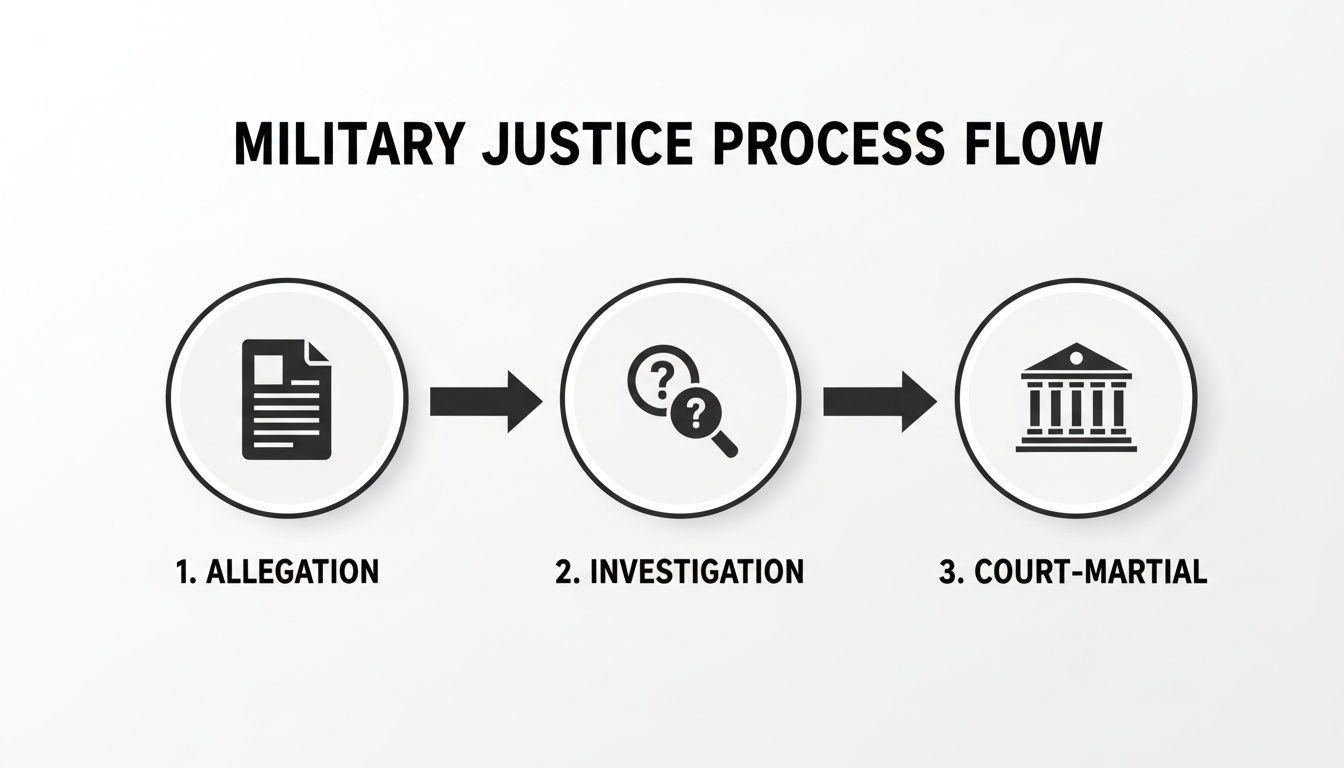
The investigation phase is where the battle is often won or lost. Asserting your rights here can stop a case from ever reaching a courtroom.
Your silence forces CID, NCIS, or OSI to build their case on external evidence alone, which is often much harder than getting a confession. You can see a full breakdown of these protections in our guide on Article 31 of the UCMJ. Use this right immediately and without hesitation.
Your Right To An Attorney: Civilian vs. Military
The UCMJ guarantees you access to a lawyer. You’ll be offered a free, detailed military attorney from the Trial Defense Service (TDS). These JAG officers are often sharp and dedicated, but you also have the right to hire a civilian military defense attorney at your own expense.
This is a critical strategic decision. A civilian lawyer works for one person: you. They operate completely outside the military chain of command and its unspoken pressures. They bring an independent perspective and resources that can make the difference between a conviction and an acquittal.
Your right to an attorney isn't just about having someone with you in court. It's about having a strategist in your corner from day one, guiding your moves and building a defense long before any charges are even preferred.
Challenging Searches And Seizures
The Fourth Amendment and military rules of evidence are supposed to protect you from unreasonable searches of your person, your phone, or your barracks room. But on a military post like Fort Stewart, these rules get complicated. They are not the same as in the civilian world.
For instance, commanders can authorize searches in situations where a civilian judge would demand a warrant. Concepts like "implied consent" get stretched, especially in on-post DUI stops. While a federal court on post might not follow Georgia’s exact DUI procedures, the core principle is the same: the search must have been lawful.
An aggressive defense lawyer will attack every angle of how the government got its evidence:
- Was the search authorization legitimate?
- Did investigators search beyond the scope they were given?
- Were you tricked or pressured into "consenting" to a search?
If evidence was taken illegally, your lawyer can file a motion to suppress it. If that motion succeeds, the evidence is thrown out and can never be used against you. Suppressing key evidence can gut the prosecution's entire case, often forcing a complete dismissal before you ever see the inside of a courtroom.
Common Allegations And Defense Strategies
The sheer size and operational tempo at Fort Stewart mean that its soldiers face a staggering range of UCMJ allegations. But an accusation is not a conviction. Every charge from the government has a countermove, and a powerful, strategic defense starts by understanding the specific allegation and finding the weak points in the prosecutor’s case.
A seasoned Fort Stewart military defense lawyer doesn’t just play defense; they go on the attack. They hunt for holes in the evidence, expose the accuser's motives, tear down a sloppy investigation, and build a powerful counter-narrative for the panel. An accusation is just the opening shot, not the end of the fight.
Defending Against Article 120 Sexual Assault Allegations
Few allegations are as devastating as those under Article 120 (Sexual Assault). A conviction means mandatory prison time, sex offender registration for life, and the complete loss of your career and benefits. These cases often boil down to a “he said, she said” scenario, where everything hinges on who the panel finds more believable.
Your defense can't just be a simple denial. It has to be an aggressive campaign to dismantle the accuser's story and the government's entire case.
- Independent Investigation: A private civilian defense firm does what the government won't—hire its own investigators to dig up the text messages, social media posts, and overlooked witnesses that contradict the official story.
- Challenging Credibility: A skilled attorney will meticulously dissect every statement the accuser has ever made, looking for inconsistencies, contradictions, and clear motives to lie, like jealousy, revenge, or a way to get out of trouble for their own misconduct.
- Forensic Evidence Analysis: If there’s physical evidence, your lawyer must bring in their own forensic experts to challenge the government’s interpretation. Often, this reveals alternative explanations that create powerful reasonable doubt.
In a fight this serious, your attorney’s power to run a truly independent investigation is everything. It’s about finding the truth the government doesn't want the jury to see.
Drug Offenses, Larceny, And Fraud
Beyond sexual assault, soldiers at Fort Stewart face a constant barrage of other serious charges. Each one demands a unique defense tailored to exploit the prosecution's specific vulnerabilities.
Charges for drug use (Article 112a), usually triggered by a positive urinalysis, are a major threat. The defense here is brutally technical. It means scrutinizing every single step of the collection and testing process, from the observer in the latrine to the technicians in the lab. A single break in the chain of custody or a procedural error can be enough to get the entire result thrown out.
An accusation is just the government's theory of what happened. An effective defense strategy is a counter-narrative, backed by evidence, that shows the panel a different, more plausible version of events—one that establishes reasonable doubt.
Larceny, theft, and financial crimes like Basic Allowance for Housing (BAH fraud) are also all too common. Here, the entire case often rests on intent. The government has to prove you intended to steal or defraud them, not that you simply made a mistake on a form or were forgetful. A sharp lawyer can frame the situation as a simple administrative error, not a criminal act, often forcing the command to drop the charges or handle them administratively.
The Power Of An Aggressive Defense
Fort Stewart, established in January 1941, is the largest U.S. Army post east of the Mississippi River and the proud home of the 3rd Infantry Division. For the soldiers here facing UCMJ allegations—from sexual assault to BAH fraud—the stakes couldn’t be higher. This is where civilian military defense lawyers from firms like Gonzalez & Waddington bring battle-tested expertise into the courtroom.
The value of an experienced civilian attorney is not just anecdotal; it is supported by hard data. Below, we break down the typical impact seen in serious UCMJ cases.
Defense Counsel Impact On Serious UCMJ Cases
This table illustrates the significant difference experienced civilian defense counsel can make in the outcomes of serious UCMJ allegations, based on Department of Defense data and case analyses.
| Case Aspect | Without Specialized Civilian Counsel | With Specialized Civilian Counsel (e.g., Gonzalez & Waddington) |
|---|---|---|
| Pre-Trial Strategy | Often reactive; relies on government's evidence. Limited resources for independent investigation. | Proactive; files aggressive pre-trial motions to suppress evidence. Conducts independent investigations to find new evidence. |
| Evidence Challenges | Accepts government's forensic reports at face value. May miss subtle procedural errors. | Hires own experts (forensic, digital, etc.) to challenge the government's interpretation and expose flaws. |
| Case Outcome | Higher likelihood of conviction at trial or accepting an unfavorable plea deal. | Significantly higher rates of acquittal, dismissal, or negotiation to lesser, non-felony charges. |
| Sentence Severity | Often results in standard or harsher sentences, including confinement, BCD, and sex offender registration. | Arguments from seasoned counsel often lead to dramatically reduced sentences, administrative separation, or no punishment. |
These statistics, which you can explore further in official reports to understand the data behind court-martial outcomes, underscore the immense value of aggressive, specialized representation.
Protecting your rights under the UCMJ requires a deep knowledge of the military justice system, which connects to understanding the broader defense and security sectors. A real defense isn't passive. It means filing motions to throw out illegally obtained evidence, fighting to block an accuser's biased statements, and deploying expert witnesses—from toxicologists to digital forensics specialists—to dismantle the government’s narrative.
This approach shows the command and the prosecutor that you will not be a pushover. It signals that they are in for a serious fight, a dynamic that can change the entire trajectory of your case.
Why A Civilian Defense Lawyer Is A Smart Investment
When you’re accused of a crime in the military, the system will give you a free lawyer from the Trial Defense Service (TDS). These JAG officers are almost always dedicated and mean well, but they work inside a system that’s designed to work against them—and by extension, against you.
Choosing who represents you is one of the most critical decisions you will ever make.

Think about it like this. For a surgery that could end your career and change your life, who would you trust? The on-call hospital resident, or a world-renowned specialist you picked yourself? The resident is probably capable, but the specialist brings a level of experience, focus, and resources that exist on a completely different level.
A private civilian military defense lawyer is that specialist. Their only mission is your defense. Their only loyalty is to you.
Accountability and Undivided Loyalty
The single biggest advantage of hiring private counsel is freedom from the chain of command. Your TDS lawyer, for all their good intentions, is still a uniformed officer. They exist in the same military machine that is trying to convict you and are subject to the same performance reviews and promotion boards as every other officer at Fort Stewart.
A civilian attorney works completely outside that structure. They have no commander to impress, no fitness report to stress over, and zero fear of burning bridges by taking an aggressive, even confrontational, stance against the government’s case. Their professional reputation is built on exactly one thing: winning for you.
A civilian defense firm's loyalty is never divided. There are no competing interests, no internal military politics, and no question about who they work for. This singular focus creates a powerful advocate whose only objective is your acquittal and the preservation of your future.
This independence isn’t just a theory; it translates into a real, aggressive defense from day one. You can see a full breakdown in our in-depth comparison of civilian military defense attorneys vs. detailed military counsel.
Superior Resources and Financial Investment
Defending a serious UCMJ case costs money. Things like independent investigations, expert witnesses, and forensic analysis are expensive, but they are absolutely essential for tearing apart a prosecutor's case. TDS offices, being government-funded, often run on a shoestring budget. They may not have the money to hire the top-tier digital forensics expert you need to win.
A private firm like Gonzalez & Waddington invests its own funds into your defense. We can and will:
- Hire Independent Investigators: These are often former federal agents who find the witnesses and evidence that CID or NCIS either missed or chose to ignore.
- Retain Leading Experts: We bring in nationally recognized authorities on DNA, computer forensics, false confessions, or any other niche field your case demands.
- Fund a Battle-Tested Team: You aren’t just getting one lawyer. You get an entire firm and support staff focused on building your case and managing every single detail.
This financial firepower lets your defense team fight the government on equal footing, challenging their evidence with credible experts and powerful counter-evidence.
The Advantage Of Specialized Experience
Many of the top Fort Stewart military defense lawyers in private practice are former JAGs. They have spent years inside the system—first as prosecutors or defense counsel—and now use that insider knowledge for the exclusive benefit of their clients.
They know the players, they know the local procedures, and they know the government's playbook because they used to run it.
This specialized experience is priceless. A civilian attorney who only handles military law understands the deep nuances of the UCMJ and the unique culture at an installation like Fort Stewart. They have litigated hundreds of cases just like yours and know which strategies lead to acquittals, dismissals, or significantly reduced charges.
When your career, your freedom, and your honor are on the line, investing in a specialized, independent, and well-resourced civilian defense lawyer isn't just an expense—it is a critical investment in your future.
Your Fort Stewart Military Justice Questions Answered
When you're under investigation at Fort Stewart, you're hit with a flood of urgent questions. The answers you get from your chain of command or barracks lawyers are often wrong and can be catastrophic. We've defended soldiers in your exact shoes for decades. Here is the straight talk you need to hear.
Can I Really Afford A Civilian Defense Lawyer?
This is the first question every soldier asks. The cost can seem like a mountain, but you're asking the wrong question. The right question is: Can you afford not to?
A court-martial conviction, a bad paper discharge like an Other Than Honorable (OTH), or even a career-ending GOMOR will cost you infinitely more. Let's talk real numbers and real consequences:
- Loss of Military Pay and Allowances: Your income stops, often immediately.
- Loss of Retirement: A decade or more of service, gone. Your vested retirement pay disappears.
- Loss of All Veteran Benefits: This isn't just a talking point. It means no GI Bill (worth tens of thousands), no VA home loan, and no access to VA healthcare for the rest of your life.
- Drastically Reduced Civilian Earning Potential: A federal conviction or a bad discharge makes finding a decent job on the outside incredibly difficult.
Hiring a top-tier Fort Stewart military defense lawyer isn't an expense. It's an investment in salvaging your entire future. Reputable firms have payment plans and will work with your family to make a real defense possible. The cost of an acquittal is nothing compared to the lifetime cost of a conviction.
What Are The Real Consequences Of A Positive Urinalysis?
A "hot" urinalysis for drug use under Article 112a is something your command will treat as a slam-dunk case. Don't believe it. While the consequences are swift and severe—usually mandatory administrative separation leading to an OTH discharge—the case itself is often surprisingly weak.
A positive test result is not the end of your career. It's the beginning of the fight.
Winning these cases isn't about some long-shot technicality; it's the standard playbook. We don't attack you, we attack the process.
The entire urinalysis process, from the moment you're told to report to the moment a lab prints the result, is a long chain of procedures. A single broken link—an observer who messes up, a sample that's mishandled, a paperwork error—can make the entire test result inadmissible in court.
An experienced lawyer knows exactly where to find those broken links. We demand every single piece of paper and scrutinize every step to find the error that destroys the government's only piece of evidence against you.
Can I Fight And Win Against A GOMOR Or Article 15?
Absolutely. Too many soldiers are bullied into accepting an Article 15 (NJP) or just rolling over for a General Officer Memorandum of Reprimand (GOMOR). They’re told it’s "just paperwork" or that fighting will only "make it worse." This is fundamentally bad advice.
Fighting is almost always your only real option. Accepting an Article 15 is a legal admission of guilt. A GOMOR that gets filed in your permanent AMHRR is a guaranteed career killer; it stops promotions cold and pushes you out the door.
When you rebut a GOMOR or turn down an Article 15 and demand a court-martial, you completely change the game. You force the command to prove its case. Faced with the reality of a real fight—where they need actual evidence and sworn testimony—commands often get cold feet. They frequently back down, withdraw the action, or reduce it to a minor, local slap on the wrist.
What If I Am Accused While Deployed Or TDY?
Getting accused of a crime while you're away from Fort Stewart—on a deployment, TDY, or out in the field—is incredibly isolating. The process is the same, but the logistics are a nightmare. Investigators know this and will use your isolation to pressure you into talking before you can get to a lawyer.
Your rights don't get left behind in Georgia. They travel with you. You always have the right to remain silent and the right to an attorney. You must invoke these rights immediately and contact a civilian military defense firm with global reach. With today's technology, we can provide secure, confidential representation from anywhere in the world, intervening with your command and investigators long before you ever set foot back at Fort Stewart.
When your career, freedom, and future are on the line, you need a law firm with a proven track record of winning. The team at Gonzalez & Waddington has defended service members at Fort Stewart and around the globe for decades. Don’t wait—protect your rights and contact us for a free consultation at https://ucmjdefense.com.