If you're a soldier at Fort Stewart, getting a knock on your door from CID or a call from your command about an investigation is a moment that can derail your entire life. It’s a terrifying, confusing blur. Your first instinct might be to explain yourself, to "clear things up."
Don't.
Think of an investigation as a minefield. One wrong step, one misplaced word, and your career, your freedom, and your family are at risk. Investigators are trained to get information, and anything you say—even with the best intentions—can and will be twisted and used to build a case against you.
Your only safe move is to stop talking and demand a lawyer. That's it. This isn't an admission of guilt; it's the single smartest strategic decision you can make.
Invoking Your Rights: The Only Words You Need to Say
You have powerful rights under Article 31 of the UCMJ. But they only work if you use them. Invoking your rights creates an immediate legal shield between you and the investigators.
You must be firm and crystal clear.
- What to Say: "I am invoking my right to remain silent, and I want a lawyer."
- What NOT to Do: Never agree to a "quick chat," give a "short statement," or consent to any search of your phone, car, or barracks room.
Once you say those magic words, all questioning has to stop until you have a lawyer present. This gives you the breathing room you need to get experienced Fort Stewart military defense lawyers in your corner to take control.
The table below breaks down the immediate do's and don'ts. Memorize them.
Immediate Actions When Contacted by Investigators at Fort Stewart
| Action (Do) | Mistake (Don't) | Why It Matters |
|---|---|---|
| Immediately state: "I am invoking my right to remain silent and I want a lawyer." | Try to "talk your way out of it" or explain the situation. | Investigators are not there to help you. Their only job is to gather evidence to use against you. |
| Remain completely silent after invoking your rights. | Answer "just a few simple questions" to seem cooperative. | Any statement, no matter how innocent, can be taken out of context to establish motive or opportunity. |
| Politely refuse any and all requests to search your phone, car, or home. | Give consent to a search to "prove you have nothing to hide." | Consenting to a search waives your Fourth Amendment rights, making any evidence found against you admissible. |
| Contact a civilian military defense lawyer immediately. | Wait for a free JAG to be appointed, which can take days or weeks. | The government's case starts now. A proactive defense needs to start now, not later. |
Following these steps isn't about being difficult; it's about being smart. It's the first move in a chess match where the stakes couldn't be higher.
For a deeper look into this critical phase, you can learn more about the immediate actions to take during a military investigation.
This simple protocol is your lifeline. It's not complicated, but it is absolute.
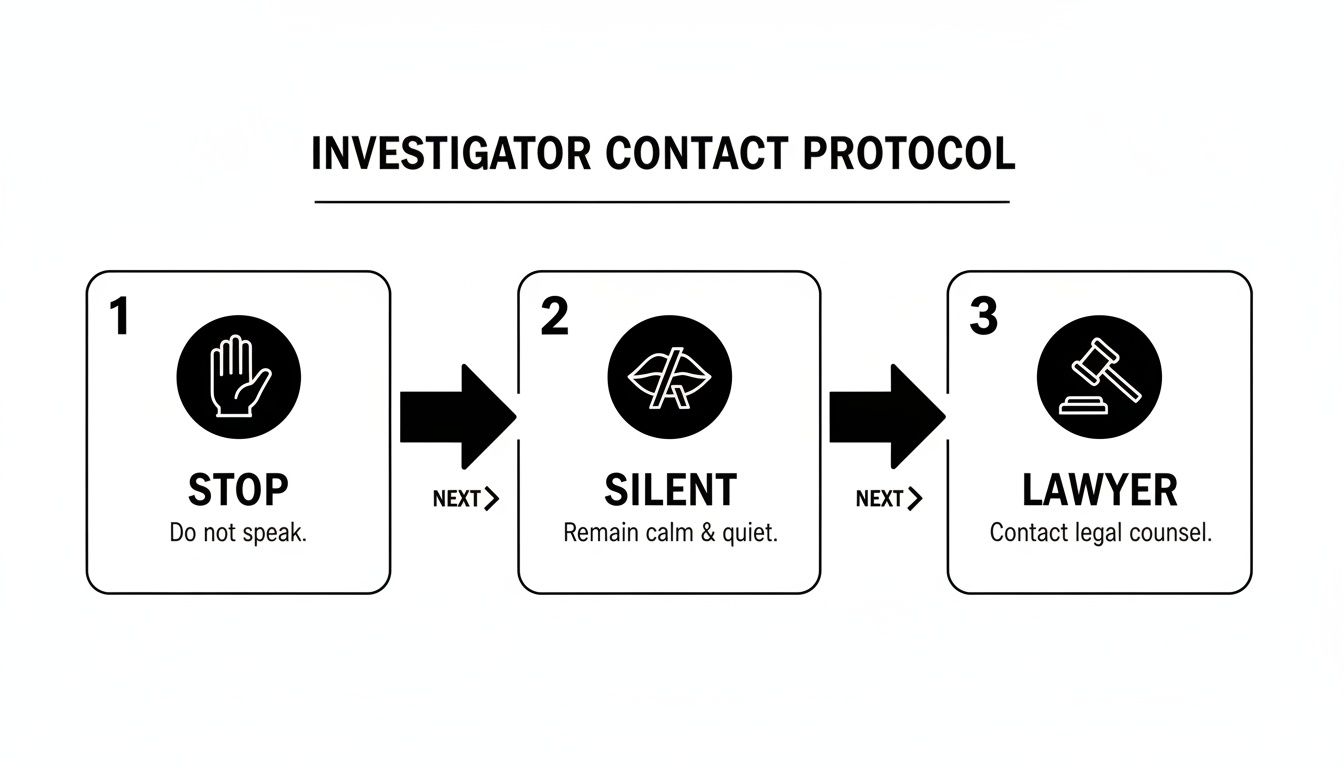
Stop talking. Stay silent. Get a lawyer. There is no other way.
The Stakes Are Higher Than Ever at Fort Stewart
Fort Stewart isn't just another Army post; it's the largest installation east of the Mississippi River, with a population of over 30,000 soldiers. That density makes it a hotbed for UCMJ actions.
Recent data from the Office of Special Trial Counsel shows a troubling trend. The Army reported a 15% spike in courts-martial referrals at major installations like Fort Stewart. Worse, allegations of sexual assault under Article 120 now make up a staggering 28% of all serious criminal cases.
Invoking your rights is not a sign of guilt—it is a sign of intelligence. It is the first and most crucial step in building a successful defense and protecting your military career from permanent damage.
With this kind of prosecutorial focus, you can't afford to be reactive. The moment an allegation surfaces, the government machine starts building its case against you. Hiring specialized civilian counsel right away is the only way to level the playing field and ensure someone is fighting for you from day one.
Civilian Counsel vs Appointed Military JAG
When you're facing an investigation or court-martial at Fort Stewart, the single most important decision you'll make is who will stand in your corner. It really boils down to two paths: accepting the appointed military lawyer from the Trial Defense Service (TDS) or hiring a civilian military defense attorney.
Think of it this way: your appointed JAG is like an urgent care doctor. They're dedicated, they work hard, and they handle a constant flow of different issues. But a specialized civilian firm, like Gonzalez & Waddington, is the top surgeon you'd find for a high-stakes, career-ending operation. They focus on one thing and one thing only—winning military cases.
Understanding Caseload and Experience
The biggest difference usually comes down to caseload and specialized experience. TDS attorneys are a vital part of military justice, providing legal help at no cost to you. The problem is, they are often junior officers buried under an avalanche of cases, sometimes trying to juggle dozens at once.
This crushing workload means they can only dedicate a sliver of time to any one case. They might only have a few hours to prep for a separation board or to sift through a mountain of evidence for a serious court-martial. They mean well, but the operational tempo they face makes it almost impossible to give your case the deep-dive attention it absolutely needs to win.
On the flip side, top-tier Fort Stewart military defense lawyers in private practice deliberately keep their caseloads small. This isn't a business model; it's a war-fighting strategy. It allows them to pour hundreds of hours into a single defense, tracking down every witness, challenging every piece of evidence, and fighting every possible legal battle. To get a better feel for this, you can explore our guide comparing civilian counsel to detailed military lawyers.
Choosing your legal team is a critical decision. Here's a straightforward look at how these two options stack up when your career, freedom, and future are on the line.
Civilian Defense Attorney vs. Appointed Military Counsel (TDS)
| Feature | Civilian Military Defense Lawyer (e.g., Gonzalez & Waddington) | Appointed Military Defense (TDS) |
|---|---|---|
| Caseload | Intentionally limited to focus all resources on your case. | Extremely high, often juggling dozens of cases simultaneously. |
| Experience | Specialists who exclusively practice military defense, often with decades of experience. | Varies widely; often junior officers gaining experience on the job. |
| Resources | Independent funding for private investigators, forensic experts, and legal research. | Limited by military budgets; getting funds for experts can be difficult. |
| Independence | Completely independent from the chain of command. Their only loyalty is to you. | Part of the military system; may face perceived or real pressure not to "rock the boat." |
| Your Choice | You choose and hire the lawyer with the specific experience and track record you want. | A lawyer is assigned to you; you have no say in their experience level or fit. |
| Cost | You pay for their representation. | No cost to the service member. |
While appointed counsel is a fundamental right, the table makes it clear why so many service members facing serious jeopardy choose to invest in a private, specialized defense.
Resources and Independence
Another game-changer is the massive advantage in resources and total independence a private firm brings to the fight. An appointed TDS lawyer works within the military's system and its budget constraints. It can be a bureaucratic nightmare for them to get funding approved for the very things that could prove your innocence, like independent investigators or world-class forensic experts.
A civilian defense firm, however, answers to no one but you and invests its own resources to build the most powerful defense imaginable. This includes:
- Hiring Private Investigators: To find the witnesses and dig up the evidence that CID, NCIS, or OSI conveniently missed or ignored.
- Retaining Leading Experts: To dismantle the prosecution's case by challenging their DNA, computer forensics, or medical findings.
- Funding Aggressive Motion Practice: Filing a barrage of legal motions to get illegally seized evidence thrown out before a jury ever sees it.
The greatest weapon civilian counsel brings is absolute independence. They work for you. Period. They are completely outside the military chain of command and have zero fear of angering a general or a commander to aggressively defend your rights.
This freedom from command influence—whether real or just perceived—is a massive strategic advantage. Your civilian attorney's loyalty is never divided, and their strategy is built around one goal: getting the best possible result for you.
A Stark Reality at Fort Stewart
The military justice machine at Fort Stewart is known for its efficiency, but that efficiency usually works for the prosecution. While the Staff Judge Advocate (SJA) office at Fort Stewart-Hunter Army Airfield has won awards for its legal work, the numbers tell a different story for the accused. Conviction rates in contested courts-martial at the base have hovered at a staggering 89% between 2015-2025.
This brutal statistic is exactly why 68% of accused soldiers are now choosing to hire civilian counsel for a fighting chance. You can find more military justice statistics about Fort Stewart on military-defenseattorney.com. When your entire future is on the line, having a specialized, well-resourced, and fiercely independent advocate isn't a luxury—it's a necessity.
Building a Winning Military Defense Strategy

Winning a military case isn't about sitting back and reacting. It’s about going on the offensive. A truly effective defense is an aggressive, meticulously planned campaign designed to systematically take apart the government's case before it ever sees the inside of a courtroom.
While your detailed military counsel is often forced to play defense with the cards they're dealt, a top-tier civilian team works to rig the game in your favor from day one. This isn't one move; it's a series of calculated steps, starting the moment you’re accused and continuing long after a verdict. For a soldier at Fort Stewart, understanding this playbook is the first step to seizing back control of your life and career.
Proactive Pre-Charge Intervention
The best way to win at court-martial is to make sure one never happens. That window of time when you are “under investigation” is the single most important phase of your case. It's here that experienced Fort Stewart military defense lawyers can intervene directly, getting in the faces of CID, OSI, or NCIS and challenging the command’s narrative.
The objective is simple: expose the weaknesses in the case before the government locks in its story. This isn't a polite conversation; it's an attack.
- We present the exculpatory evidence investigators conveniently “missed.”
- We get sworn statements from witnesses who poke holes in the accuser’s claims.
- We put them on notice for every procedural error and rights violation they committed.
By hitting the case hard and early, a skilled attorney can often demonstrate to command that their evidence is flimsy and their case is a loser. This pressure can get the investigation dropped entirely, saving your career before it's ever formally on the line.
Independent Investigation and Motion Practice
Never, ever trust the government to find evidence of your innocence. They won't. The foundation of a real defense is a private, independent investigation funded and directed by your legal team. We hire our own investigators—often retired federal agents who know the government’s playbook—to find the truth. They re-interview every witness, track down new ones, and find the facts the government chose to ignore.
At the same time, we launch a legal blitzkrieg known as motion practice. Think of these as pre-trial battles fought to shape the battlefield. Your lawyer will file aggressive motions to:
- Suppress Evidence: Get any illegally obtained statement or piece of evidence thrown out. If they violated your rights, they don't get to use what they found.
- Challenge Experts: Disqualify the government’s so-called experts if their science is junk or their methods are flawed.
- Compel Discovery: Force the prosecutor to hand over the evidence they are legally required to but are trying to hide.
A single successful motion can detonate the government's entire case. Forcing the court to suppress a coerced confession or a bogus lab result can leave the prosecution with nothing, forcing a complete dismissal of the charges.
This two-front war—independent investigation on the ground and aggressive motions in court—ensures that if a trial happens, the government is facing a completely different, much weaker case than the one they started with. We dictate the terms, not them.
Trial, Sentencing, and Appeals
If the government still pushes forward to a court-martial, all our preparation pays off. By then, we’ve built a powerful story of innocence for the panel, prepared you for every question, and designed a cross-examination strategy to destroy the credibility of the prosecution's witnesses. The goal isn’t just to create “reasonable doubt.” It's to prove your innocence and make the government's story look like the fiction it is.
But we always plan for the worst. Even if a panel gets it wrong, the fight is far from over. A great defense lawyer has already prepared a powerful sentencing case, ready to present mitigating evidence to secure the most lenient outcome. After that, the battle shifts to the appeals process, where we hunt for legal errors made by the judge or prosecutor that can get the entire conviction thrown out. A winning strategy prepares for every single contingency.
Common UCMJ Charges at Fort Stewart
The Uniform Code of Military Justice isn't just a book of rules. For a soldier at Fort Stewart, it’s a minefield. The intense operational tempo of the 3rd Infantry Division and the sheer number of soldiers packed into one place create a pressure cooker environment where specific accusations pop up again and again.
These aren't just charge sheets; they are career-enders. An allegation alone, even a false one, can haunt you for the rest of your life. That’s why you need Fort Stewart military defense lawyers who have seen these exact charges before and know precisely how to dismantle them.
Article 120 Sexual Assault
No other charge carries the same destructive power as an Article 120 allegation. At a huge post like Fort Stewart, these cases are common, and prosecutors pursue them with a vengeance. These accusations often explode from a simple misunderstanding, a night of regret, or a relationship that ended badly.
The fallout is catastrophic: a federal sex offense conviction, mandatory lifetime sex offender registration, a dishonorable discharge, and a long prison sentence.
Defending against an Article 120 charge demands an immediate, all-out counter-attack. We launch a full-scale investigation into the accuser’s history, pull apart every text message and social media post, and attack the flawed, biased interview techniques CID agents rely on. The mission is to expose the lies, the ulterior motives, and the complete lack of credible evidence until the government's case falls apart.
Article 112a Drug Offenses
The military’s zero-tolerance drug policy is absolute. A positive urinalysis—a "hot UA"—feels like a slam dunk for the prosecution. At Fort Stewart, soldiers are constantly hit with Article 112a charges for use, possession, or distribution, often stemming from random testing or sting operations.
But a positive test is not an automatic conviction. A world-class defense attacks the science and the procedure, not just the accusation.
- Destroying the Chain of Custody: Was your sample perfectly handled from the moment it left your body until it hit the lab? Any mistake, any gap, can get the result thrown out.
- Challenging the Lab Itself: Are the lab’s methods even reliable? We bring in our own forensic toxicologists to hunt for errors and contamination that the government hopes you’ll never see.
- Proving Innocent Ingestion: Can we show that you unknowingly consumed the substance? It’s a tough fight, but it’s a fight we know how to win.
A drug charge isn't just about your career now; it's about your future. It can bar you from federal jobs and strip you of your benefits forever. A real defense lawyer fights the court-martial and the administrative separation board that inevitably follows.
Article 128 Assault
Assault charges at Fort Stewart can ignite from anything—a bar fight in Hinesville or a heated argument in post housing. Under Article 128, even the threat of harm can land you in a court-martial. These cases are almost always a mess of conflicting stories and minimal evidence, but the command’s first move is always to protect the alleged victim, leaving you to prove your innocence.
The only way to win an assault case is to hijack the narrative. We work to prove self-defense, expose the “victim” as the real aggressor, or show the entire incident was a fabrication. Our own investigation is key, finding the witnesses the MPs ignored and digging up the facts that blow holes in the official story.
Article 92 Failure to Obey an Order
Article 92 is the military’s favorite catch-all charge, and that’s what makes it so dangerous. It can be used for anything from breaking a no-contact order to having a messy room. Commanders love it because it’s broad enough to punish almost any behavior they don't like.
Don’t mistake it for a slap on the wrist. An Article 92 conviction means a federal criminal record, jail time, and a punitive discharge. The defense strategy is to prove the order wasn't lawful in the first place, that you never actually violated it, or that you were never properly made aware of it. We force the command to justify its own actions.
Fighting Career-Ending Administrative Actions
Not every threat to your military career comes from a courtroom. In fact, some of the most lethal dangers are disguised as simple paperwork. At Fort Stewart, commanders often use administrative actions to force a soldier out without the hassle and burden of proof required for a court-martial.
These actions—things like a General Officer Memorandum of Reprimand (GOMOR), an Article 15, or a notice of administrative separation—can feel less threatening than criminal charges. That’s a dangerous mistake. They are often strategic moves designed to permanently poison your record, kill your chances for promotion, and kick you out of the service with a bad discharge.
More Than Just Paperwork
Don't think of a GOMOR as a slap on the wrist. Think of it as a career-ending weapon. Once that piece of paper gets filed in your permanent record, your Army Military Human Resource Record (AMHRR), it’s a stain that follows you forever. It will stop you from getting promoted, prevent you from re-enlisting, and often triggers a separation board aimed at ending your time in service.
These paper-based attacks demand the exact same aggressive defense as a court-martial. A powerful, well-crafted rebuttal to a GOMOR or a fierce fight at a separation board can be the only thing standing between you and an abrupt, dishonorable end to your career. You need Fort Stewart military defense lawyers who know how to fight on this unique battlefield.
An administrative action is not a minor correction; it is a calculated maneuver designed to remove you from the military. Treating it as anything less than a full-blown fight is a critical error that will cost you your career, your benefits, and your honor.
To win, you need more than a good argument. You need a strategy built on a deep knowledge of military regulations to systematically dismantle the command’s case against you.
The Power of a Strong Rebuttal
When you get hit with a GOMOR, you have one chance to fire back: your rebuttal. This is your shot to tell your side of the story and convince the general officer to either scrap the reprimand entirely or file it "locally" instead of permanently. A locally filed GOMOR gets shredded after a certain period, neutralizing its power to kill your career.
A winning rebuttal isn't just a letter saying "I didn't do it." A skilled military defense attorney builds a comprehensive defense package that includes:
- Sworn Statements: Affidavits from witnesses who back up your version of events and can speak to your character.
- Hard Evidence: A collection of documents, text messages, timelines, and other concrete proof that blows holes in the allegations.
- Character Letters: Powerful letters of support from respected leaders, NCOs, and peers who can vouch for your value as a soldier.
The goal isn't just to argue your case. It's to present such an overwhelming mountain of evidence that it becomes impossible for the command to justify permanent, career-ending action.
Winning at Separation Boards
If a GOMOR or some other alleged misconduct pushes you in front of an administrative separation board, the stakes get even higher. This board holds the power to decide whether you continue serving or get kicked out, very possibly with an Other Than Honorable (OTH) discharge. An OTH can strip you of your G.I. Bill and other VA benefits, branding you for life.
Your lawyer's job is to transform that board hearing into a real fight. We treat it like a mini-trial, aggressively cross-examining the government's witnesses, presenting our own evidence, and making a powerful case for your retention. Winning here isn't just about avoiding a bad piece of paper; it’s about saving your entire military career. For a more detailed breakdown, you can read our survival guide on administrative separation boards. Your service record is worth the fight.
Why Fort Stewart Soldiers Choose Gonzalez & Waddington
When your career is on the line, the lawyer you choose isn't just a decision—it's everything. For soldiers at Fort Stewart facing a court-martial or a career-ending administrative separation, this is a hard truth that demands a battle-tested defense.
This is exactly why soldiers from the 3rd Infantry Division and other units call us. Our firm isn't some general practice that decided to dabble in military law. We're a team of former military JAGs who have spent our entire careers doing one thing: defending American service members. We know the system at Fort Stewart because we’ve lived it from the inside.
Fierce Defenders in Your Corner
Choosing Gonzalez & Waddington means you're not just hiring a lawyer. You're bringing in a legal team that gets the unique pressures and command politics of a major installation like Fort Stewart. We have a long and verifiable track record of winning acquittals in the most serious cases, including the career-destroying Article 120 allegations that are all too common.
Our success isn't an accident. It’s the result of an aggressive, proactive defense that starts the moment you hire us.
We don't just give legal advice. We become your champion, the one person who will stand between you and the full weight of the government's prosecution machine. From that first phone call until your name is cleared, we are right there with you.
Our value is built on a foundation of action and proven results:
- Battle-Tested Insiders: As former military prosecutors and defense counsel, we know the government’s playbook and, more importantly, how to tear it apart. We anticipate their moves before they make them.
- Unwavering Focus: We treat your case like our own career is on the line. That means direct communication with you and relentless work to dismantle the prosecution’s case, piece by piece.
- A Public Record of Winning: Our history of successful outcomes at Fort Stewart and military bases around the globe isn’t a secret. It speaks for itself.
Don't try to fight this alone. Your future is worth defending with the most experienced Fort Stewart military defense lawyers you can find. Contact Gonzalez & Waddington for a confidential case evaluation and take the first real step toward protecting your career and your freedom.
Frequently Asked Questions About Military Defense
When you’re staring down an investigation at Fort Stewart, the questions and the fear can be suffocating. The unknown is a powerful enemy. We've heard every question imaginable from soldiers in your exact position, and this is where we give you the straight, no-BS answers. It's time to get some clarity and start fighting back.
Can I Really Afford a Civilian Defense Lawyer
This is always the first question, and it's a practical one. Let’s reframe it. The real question is: can you afford a conviction?
Let's do the math. A federal conviction isn't just a slap on the wrist. It’s a career-ending event that can trigger a punitive discharge (like a Dishonorable or Bad-Conduct Discharge), a permanent criminal record, a total loss of your retirement and VA benefits, and even lifetime sex offender registration. The financial fallout over a lifetime easily climbs into the millions in lost pay and benefits.
A top-tier defense isn't an expense; it’s an investment in salvaging your entire future. When you weigh the cost of elite representation against the catastrophic, lifelong consequences of a conviction, it's a small price to pay for your freedom, career, and honor.
An aggressive defense from experienced Fort Stewart military defense lawyers can dismantle a case before it ever gets to trial, secure a full acquittal, or protect your career. The return on that investment is getting your life back.
Will Hiring a Civilian Lawyer Anger My Command
This is a persistent myth, and it's 100% false. A professional command doesn't get "angry" when a soldier exercises their constitutional rights. In fact, hiring a serious civilian attorney sends the exact opposite message.
It signals that you're taking the allegations with the gravity they deserve. It shows you're being proactive and mature about a major problem—qualities any good commander respects. Bringing in outside counsel professionalizes the entire situation and ensures every communication is handled by the book, legally and correctly.
Your command expects you to build a defense. Choosing the strongest possible advocate isn't defiance; it's a sign of intelligence.
What if I Already Talked to Investigators
This happens all the time. Soldiers trying to be helpful or clear their own name walk into an interview with CID, NCIS, or OSI without realizing the danger. If you’ve already given a statement, do not panic. The fight is far from over.
While it's not the ideal starting point, it's a situation we handle constantly. The second you hire an experienced military defense lawyer, they go into damage control mode. Immediately.
Here’s what happens next:
- Invoke Your Rights: Your lawyer formally notifies investigators that you are represented. All questioning stops, period. They are legally required to go through your attorney from that point forward.
- Contextualize Your Statement: Your words were likely twisted or taken out of context. A good lawyer works to frame your statement in its proper light, explaining ambiguities and highlighting how investigators manipulated what you said.
- Attack the Interrogation: A skilled attorney will scrutinize the legality of the interrogation itself. Were you coerced? Were your rights glossed over? If there were any violations, we file motions to get your entire statement thrown out of court.
Even if you’ve already talked, you haven't lost. But you have to act now. An expert attorney can neutralize the damage and build the powerful defense you need.
The stakes are just too high to face the military justice system on your own. The team at Gonzalez & Waddington is made up of former military JAGs who have built their careers on one thing: defending service members. If you're under investigation at Fort Stewart, take the first step. Protect yourself. Learn more and contact us today for a confidential consultation.