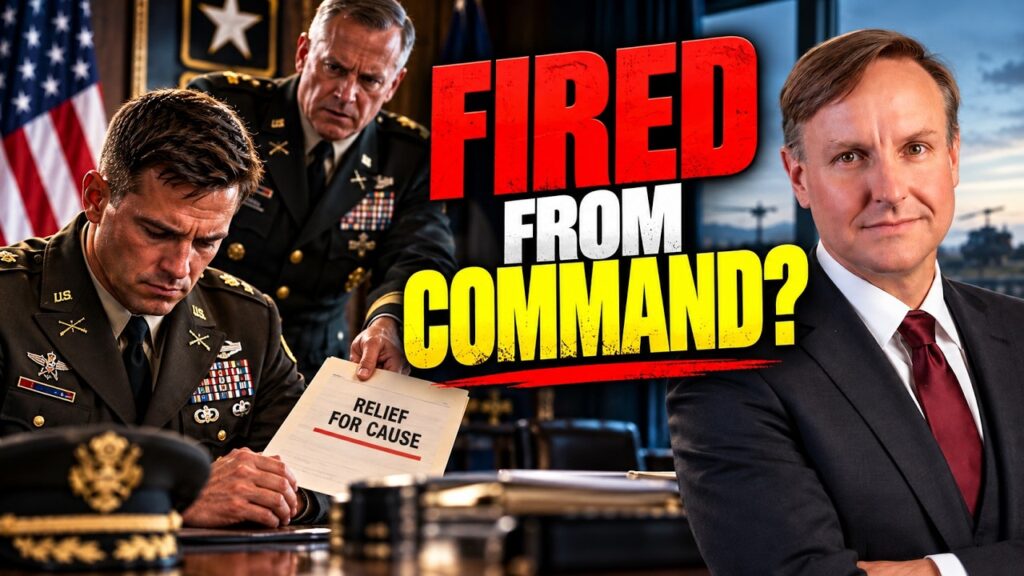
Short answer: Relief for cause means your commander has removed you from a leadership position because they lost confidence in you. Civilian military defense lawyer Michael Waddington of Gonzalez & Waddington advises that the response that matters most is not to the relief itself but to the relief-for-cause evaluation that follows, because that report is what ends careers.
In this video, Michael Waddington explains what a relief for cause is, what comes with it, and how to fight both the relief and the evaluation.
What does relief for cause mean in the military?
Under AR 600-20, a commander can relieve a subordinate leader for cause when the commander decides the leader has failed to meet the standards of the position. The basis can be misconduct, poor performance, or a simple loss of confidence.
A relief is a command decision, not a legal finding. It can happen the same day an allegation surfaces. The relieving commander must counsel you and document the basis, and in the Army a general officer reviews the relief, but in practice you are removed first and the paperwork follows.
What happens after you are relieved for cause?
For officers, a relief triggers a relief-for-cause OER under AR 623-3. It is a referred report with the relief noted, and it goes into your permanent record and in front of every promotion board. NCOs receive a relief-for-cause NCOER with the same effect.
A relief often comes with a GOMOR on the same facts, a flag, and sometimes reassignment away from your unit. There is also the informal cost: everyone in the unit knows.
Can you fight the relief decision?
Yes. You can submit a rebuttal to the relieving commander and to the general officer who reviews the relief. Argue that the basis is wrong, that the investigation behind it was flawed, or that the standard for relief was not met.
Reliefs are sometimes reversed at that review, especially when the underlying AR 15-6 investigation is weak. The rebuttal is worth doing, and it has to be done fast.
How do you respond to a relief-for-cause OER or NCOER?
This is the real fight. Because a relief-for-cause evaluation is a referred report, AR 623-3 entitles you to see it before it is filed and to submit comments that are attached to it.
Those comments are your permanent answer, read by every board that reads the report. Keep them factual, professional, focused on the substance, and within the length the rules allow.
A response that answers the facts with documents attached changes how a board reads the report. A response that sounds bitter confirms it. Treat the referred-report response as a legal document, even though it looks like a personnel form.
Can a relief-for-cause evaluation be removed later?
Yes, but the standard is high. If the report is inaccurate or unjust, you can appeal to the Army Special Review Board through the Evaluation Appeals Branch, or in the Air Force to the Evaluation Reports Appeal Board.
You must show a material error or injustice by clear and convincing evidence. Your referred-report response, and the evidence you gathered for it, becomes the foundation of that appeal.
What to do right now
- Get the relief memorandum and the investigation it is based on, such as the AR 15-6 report.
- Request the general officer review in writing and submit a rebuttal to it.
- Start preparing your referred-report response now, before the evaluation arrives; the suspense to respond is short.
- Gather your prior evaluations, your counseling record, the unit’s results under your leadership, and statements from peers and subordinates.
- Have a civilian military defense lawyer review every written response before you submit it.
Key takeaways
- Relief for cause is a command decision based on misconduct, poor performance, or loss of confidence.
- You can rebut the relief to the relieving commander and the reviewing general officer.
- The relief-for-cause OER or NCOER under AR 623-3 is the document that ends careers, so your response to it matters most.
- A relief often comes with a GOMOR and a flag, which need their own responses.
- An evaluation appeal requires clear and convincing evidence, so build the record now.
Frequently asked questions
Is relief for cause the same as punishment?
No. Relief for cause is an administrative command action, not punishment under the UCMJ. But it often comes with other actions, such as a GOMOR, a flag, or an investigation that can lead to separation.
Do I get to see my relief-for-cause OER before it is filed?
Yes. A relief-for-cause evaluation is a referred report, so you must be shown it and given the chance to submit comments. Those comments stay attached to the report permanently.
Can I still be promoted after a relief for cause?
It is difficult, because every promotion board will see the report. A strong, documented response to the referred report, or a successful appeal that removes it, gives you the best chance.
How long do I have to respond?
The suspense for a referred-report response is short, often days rather than weeks. Check the deadline on your notification and get help before it starts running.
Related questions
- How do I challenge a negative evaluation report?
- How do I write a GOMOR rebuttal?
- What happens if I am ordered to show cause for retention?
Video transcript
Read the full transcript of this video
What does relief for cause mean, and how do you respond? It means you’ve been removed from a leadership position because your commander lost confidence in you. And the response that matters isn’t to the relief itself, it’s to the relief for cause evaluation that follows because that document is what ends careers. I’m Michael Waddington, civilian military defense lawyer and co-founder of Gonzalez & Waddington. Relief is one of the most damaging things that can happen to a leader, and it’s also one of the most challengeable. Here’s how it works.
First, what it is. Under AR 600-20, a commander can relieve a subordinate leader for cause when the commander determines that the leader has failed through misconduct, poor performance, or loss of confidence to meet the standards of the position. The relief is a command decision, not a legal one. It can happen the same day as an allegation. In the Army, the regulation requires review by a general officer before a relief is final. And the relieving commander has to counsel the relieved leader and document the basis. But in practice, the removal happens first and the paperwork follows.
Second, what comes with it? For officers, a relief for cause OER under AR 623-3, a referred report with the relief noted. That goes in your permanent record and to every promotion board. For NCOs, a relief for cause NCOER, the same. Often, a general officer memorandum of reprimand on the same facts. Often, a flag. Sometimes, reassignment away from the unit. And the informal consequence? Everyone knows.
Third, the two things you can fight.
One, the relief decision. You can submit a rebuttal to the relieving commander and to the general officer who reviews it, arguing that the basis is wrong, that the investigation was flawed, or that the standard wasn’t met. Reliefs are occasionally reversed at that review, especially when the underlying 15-6 is weak. It’s worth doing and it has to be done fast.
Two, the evaluation. This is the real fight. The Relief for Cause OER or NCOER is a referred report, which means under AR 623-3, you’re entitled to see it before it’s filed and to submit comments that are attached to it. Those comments are your permanent response, read by every board that reads the report. They have to be careful, factual, professional, addressed to the substance, and no longer than the rules allow. A referred report response that argues the facts with documents attached changes how a board reads the report. One that reads as bitter confirms it.
Fourth, after it’s filed. If the evaluation is inaccurate or unjust, an appeal to the Evaluation Appeals Board or the Air Force’s ERAB can amend or remove it, but the standard is high. Clear and convincing evidence of a material error or injustice. Your rebuttal to the referred report and the evidence you gathered for it is the foundation of that appeal.
Fifth, what to do now? One, get the relief memorandum and the investigation it’s based on. Two, request the general officer review in writing and submit a rebuttal to it. Three, prepare for the referred report before it arrives. The suspense to respond is short. Four, gather the documents. Your prior evaluations, the counseling record, the unit’s results under your leadership, statements from peers and subordinates who’ll say what the 15-6 didn’t. Five, get a lawyer because the referred report response is a legal document masquerading as a personnel form.
So, relief for cause. What does it mean and how do you respond? Removal for loss of confidence. And you respond to the review and, above all, to the evaluation that follows. I’m Michael Waddington with Gonzalez & Waddington. We defend service members worldwide. You can learn more at ucmjdefense.com or call 1-800-921-8607 for a free, confidential consultation.
Talk to a military defense lawyer
Gonzalez & Waddington represents service members worldwide in courts-martial, sexual assault investigations, administrative separation boards, security clearance matters, and other UCMJ actions. Michael Waddington, a former Army JAG officer, has been a lawyer for over 25 years. Call 1-800-921-8607 or visit ucmjdefense.com for a confidential consultation.
This article is general information, not legal advice. Every case is different, and reading it does not create an attorney-client relationship.
Recent Blogs
- Do Civilian Military Lawyers Travel to Your Base?October 27, 2026
- Child Pornography Under Article 134: Penalties and DefensesOctober 27, 2026
- Article 120c UCMJ: Indecent Exposure and Viewing ExplainedOctober 27, 2026
- Expedited Transfer: What Happens to the Accused When the Accuser Moves?October 26, 2026
- What Counts as Retaliation Under Article 132, and How Do You Respond?October 26, 2026
- Accused of Hazing in the Military: What Do Marines and Soldiers Need to Know?October 26, 2026