Short answer: A court-martial plea agreement is a written deal in which you plead guilty to some or all charges in exchange for limits on your sentence or other concessions from the government. Civilian military defense lawyer Michael Waddington of Gonzalez & Waddington explains that you should take one only when the evidence against you is strong, the deal meaningfully reduces your exposure, and your lawyer has tested the government’s case first.
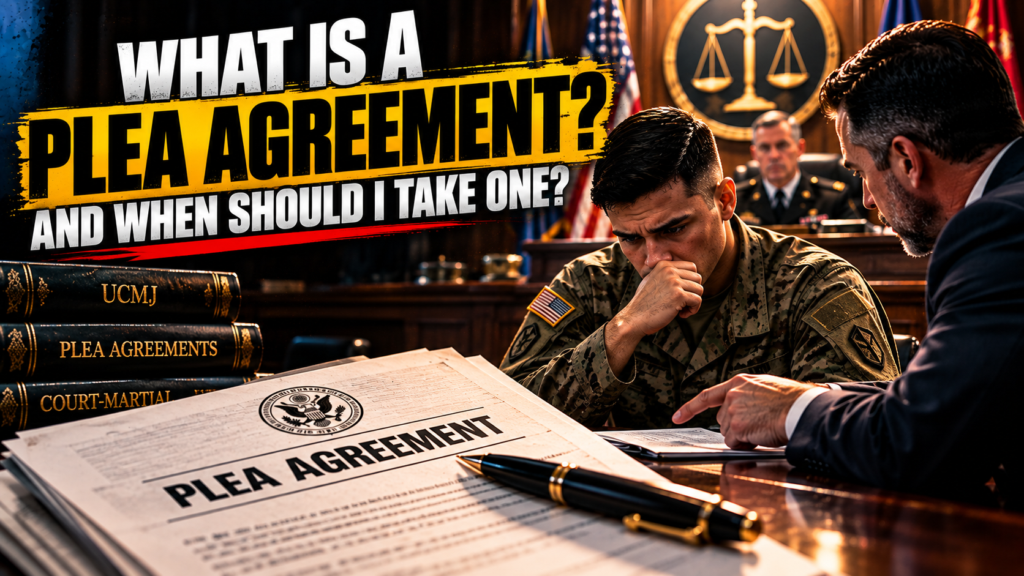
In this video, Michael Waddington explains how court-martial plea agreements work, what you give up by pleading guilty, and the four conditions to check before you take a deal.
What is a plea agreement in a court-martial?
A plea agreement is a contract between you and the convening authority, or the Office of Special Trial Counsel for covered offenses, under Article 53a of the Uniform Code of Military Justice (UCMJ) and Rule for Courts-Martial 705. You agree to plead guilty to specific charges. In return, the government agrees to something of value.
That can be a sentence cap, a sentence range, a specific sentence, dismissal of other charges, or referral to a lower-level court. If the military judge accepts the agreement, the judge must sentence within its terms.
For cases referred on or after January 1, 2019, these deals are called plea agreements and can set a minimum and a maximum punishment. Older pretrial agreements worked differently, so be careful with anything written about the old rules.
What does pleading guilty at a court-martial require?
Before accepting a guilty plea, the military judge conducts a providence inquiry under Rule for Courts-Martial 910. You must explain under oath, in your own words, what you did and why it was a crime.
If you cannot or will not do that, the judge rejects the plea. There is no Alford plea in the military, so you cannot plead guilty while maintaining your innocence. If you did not do it, no deal changes that.
What do you give up when you take a plea agreement?
A guilty plea waives your right to a trial, to confront the witnesses against you, and to challenge most of the government’s evidence. It also limits many issues you could raise on appeal.
A plea agreement caps the sentence, not the consequences. A guilty plea to a covered sexual offense can still require sex offender registration, and a conviction at a special or general court-martial is a federal conviction.
When should you take a plea agreement?
Check four conditions before you sign:
- The evidence is strong. Not because the prosecutor says so, but because your lawyer has read the discovery, evaluated the witnesses, and worked through the suppression issues.
- The deal is real. A cap at the maximum is not a deal. A deal that moves a case from a general to a special court-martial, removes a charge that requires registration, or protects a retirement is.
- The timing is right. Offers change. Early offers are often worse than what is available after a strong Article 32 preliminary hearing or a successful motion.
- You can say it. If you cannot honestly tell the judge what you did, you cannot plead guilty, and your lawyer should not be negotiating toward it.
When should you not take a plea agreement?
Do not take a deal when the government’s case has a weakness your lawyer has not finished exploiting. Do not take one when it fails to change the consequence that matters most to you, such as a discharge, registration, or loss of retirement.
And do not take one out of exhaustion. Months of waiting wear people down, and that pressure works in the government’s favor. The best plea agreements are negotiated when the government believes it might lose at trial.
How do sentencing parameters affect a plea agreement?
For offenses committed after December 27, 2023, the military judge sentences under sentencing parameters and criteria that set ranges for most offenses. A plea agreement can still set a sentence range or a specific sentence, and your lawyer should compare the offer against the parameter range that would likely apply after a conviction at trial.
What to do right now
- Do not accept or reject a plea offer until your lawyer has reviewed all of the discovery.
- Ask your lawyer for a written comparison of the deal against the maximum punishment and the likely sentence after trial.
- List the consequences that matter most to you, such as discharge, registration, confinement, and retirement.
- Do not discuss the facts of the case or a possible guilty plea with anyone except your lawyer.
- Prepare mitigation now, including evaluations, awards, and character letters, because it matters whether you plead or go to trial.
Key takeaways
- A plea agreement trades a guilty plea for limits on your sentence or other concessions under Article 53a and Rule for Courts-Martial 705.
- You must admit under oath what you did, and the military has no Alford plea.
- A plea agreement caps the sentence but does not erase consequences like registration or a federal conviction.
- Take a deal only when the evidence is strong, the deal is real, the timing is right, and you can honestly admit the offense.
- Early offers are often not the best offers.
Video transcript
Transcript of the video “Court-Martial Plea Agreements Explained | When Should You Take a Deal?,” with Michael Waddington of Gonzalez & Waddington.
Read the full transcript of this video
What is a plea agreement in a court-martial, and when should you take one? It’s a written contract with the convening authority where you plead guilty to some or all charges in exchange for a limit on your sentence. And you should take one only when the evidence against you is strong, the deal meaningfully reduces your exposure, and your lawyer has tested the government’s case first. I’m Michael Waddington, civilian military defense lawyer and co-founder of Gonzalez & Waddington. Plea agreements resolve most courts-martial, and most of them are taken too early. Here’s how they work and how to think about them.
First, the mechanics. Under Rule for Courts-Martial 705, you and the convening authority (or the special trial counsel, for covered offenses) sign an agreement. You agree to plead guilty to specified charges. In return, the government agrees to something: a sentence cap, a sentence range, dismissal of other charges, referral to a lower court, or a specific sentence. Since 2019, the agreement can set a minimum and maximum, or a fixed sentence, and the judge is bound by it if the judge accepts the plea. Before 2019, these were called pretrial agreements and worked differently, so ignore anything older than that.
Second, what pleading guilty actually requires. At a court-martial, the judge conducts a providence inquiry under Rule 910. You have to explain, in your own words and under oath, exactly what you did and why it’s a crime. If you can’t or won’t, the judge rejects the plea. There’s no Alford plea; no pleading guilty while maintaining innocence. That matters. If you didn’t do it, you can’t plead to it, and no deal changes that.
Third, what you give up. A plea waives your right to a trial, to confront the witnesses, to challenge the evidence, and to most appeals. A guilty plea to a covered sexual offense still means sex offender registration. A guilty plea at a special or general court-martial still means a federal conviction, with or without a punitive discharge. The cap limits the sentence. It doesn’t limit the consequences.
Now, when to take one. Four conditions.
One, the evidence is strong. Not “the prosecutor says it’s strong.” Your lawyer has read the discovery, evaluated the witnesses, and run the suppression issues. If the phone gets suppressed, or the accuser’s story falls apart at the Article 32, the deal you were offered last month is the wrong deal now.
Two, the deal is real. A cap at the maximum isn’t a deal. A cap that drops a general court-martial to a special with no discharge, or takes registration off the table by dropping the covered charge, or protects a retirement, is.
Three, the timing is right. The government’s offers move. Early offers are often worse than what’s available after a strong Article 32 or a successful motion. The best plea agreements are negotiated from a position where the government believes it might lose.
Four, you can say it. If you can’t tell the judge what you did, you can’t plead, and your lawyer shouldn’t be negotiating toward it.
When not to take one: when the government’s case has a hole your lawyer hasn’t finished exploiting; when the deal doesn’t change the consequence that matters most to you; or when you’re taking it out of exhaustion rather than judgment. Exhaustion is a strategy the government counts on.
At Gonzalez & Waddington, we negotiate plea agreements in a large share of our cases, and almost none of them in the first month. The best deal comes after the government sees what a trial would cost them.
So, what is a plea agreement, and when should you take one? It’s a contract that caps your sentence in exchange for a guilty plea, and you take it when the evidence is strong, the deal is real, the timing is right, and you can honestly say you did it. I’m Michael Waddington with Gonzalez & Waddington. We defend service members worldwide. You can learn more at ucmjdefense.com or call 1-800-921-8607 for a free, confidential consultation.
Frequently asked questions
Is the military judge bound by a plea agreement?
If the judge accepts the plea agreement, the judge must sentence within its limits. If the judge finds the agreement improper or your plea not provident, the judge can reject it, and the case can proceed to trial.
Can I withdraw from a plea agreement?
Under Rule for Courts-Martial 705, you can generally withdraw from a plea agreement before the judge accepts your guilty plea. The convening authority can also withdraw in limited situations, such as when you fail to meet a material term.
Is a plea agreement the same as a pretrial agreement?
They are related but not the same. Pretrial agreements governed older cases, while plea agreements under Article 53a apply to cases referred on or after January 1, 2019, and can bind the judge to a sentence range.
Can a plea agreement keep me from being discharged?
Sometimes. A plea agreement can move a case to a lower court or include a term that limits or rules out a punitive discharge. Your command may still pursue administrative separation afterward, so ask your lawyer about that risk.
Related questions
- How long a general court-martial takes from allegation to verdict
- Whether to choose a military judge alone or a panel of members
- Why to hire a civilian lawyer before charges are filed
Talk to a military defense lawyer
Gonzalez & Waddington defends service members worldwide in investigations, courts-martial, administrative separation boards, and other UCMJ matters. Michael Waddington, a former Army JAG officer, has been a lawyer for over 25 years. Call 1-800-921-8607 or visit ucmjdefense.com for a confidential consultation.
This article is general information, not legal advice. Every case is different, and reading it does not create an attorney-client relationship.
Recent Blogs
- Nonpunitive Letter of Caution vs. Punitive Letter of Reprimand: What Navy and Marine Corps Officers Need to KnowNovember 6, 2026
- First 24 Hours After CGIS Contacts You: What Coast Guard Members Should DoNovember 6, 2026
- First 24 Hours After OSI Contacts You: What Airmen and Guardians Should DoNovember 6, 2026
- First 24 Hours After NCIS Contacts You: What Sailors and Marines Should DoNovember 6, 2026
- First 24 Hours After CID Contacts You: What Soldiers Should DoNovember 6, 2026
- Is Hiring the Cheapest Military Defense Lawyer a Mistake?November 6, 2026