Military Investigation Defense • Gonzalez & Waddington
Civilian Military Defense Lawyer for an NCIS Investigation
Gonzalez & Waddington is a civilian military defense firm, founded by Michael Waddington and Alexandra Gonzalez-Waddington, that has defended service members at courts-martial and in UCMJ matters worldwide for more than two decades.
Quick answer
If NCIS identifies you as a suspect, advises you of rights, asks for an interview, or seeks access to a phone or account, treat each request as consequential. Do not guess at your status or make an immediate statement to appear cooperative. Preserve evidence, understand Article 31(b), and obtain case-specific advice before waiving rights or consenting to searches.
What it means when NCIS contacts you
A call from NCIS can be witness outreach, evidence collection, or the beginning of a suspect interview. Do not infer your status from an agent’s tone or from a statement that the meeting is “just to get your side.” Ask enough logistical questions to know who is contacting you and why, but do not begin discussing facts before deciding whether you should be represented.
For a Sailor or Marine, the investigation may affect far more than a future court-martial. The same investigative record can influence command action, clearance decisions, nonjudicial punishment, administrative separation, officer elimination, promotion, assignments, and titling or indexing. That is why the investigation stage deserves its own defense strategy.
Article 31(b) is the starting point for suspect questioning
Article 31(b), UCMJ requires that a person subject to the UCMJ who interrogates or requests a statement from an accused or suspect first identify the nature of the accusation, advise that the person does not have to make a statement, and warn that any statement may be used as evidence at a court-martial. Military Rule of Evidence 305 adds the rules governing warnings, waiver, counsel, and admissibility. These protections are broader in important respects than the civilian shorthand people associate with Miranda.
If you invoke counsel and silence, do so clearly. A lawyer can then determine what the allegation appears to be, whether a voluntary statement has any strategic value, and whether a written or limited communication is preferable to an open-ended interrogation. There are cases in which defense counsel affirmatively provides evidence or information; that is very different from an unprepared suspect sitting for questioning.
Interviews, phones, consent searches, and credentials are separate decisions
An interview request is one decision. A request to unlock a phone, provide a passcode, sign a consent form, surrender an account, identify a device, or permit a search is another. Do not treat them as one package merely because an agent presents them during the same meeting. Search authority can come from consent, a search authorization, or another lawful basis, and the legal analysis can be highly fact specific. Before voluntarily expanding government access to digital evidence, obtain case-specific advice.
Preserve the defense before the evidence changes
Early defense work is not limited to telling a client to remain silent. Messages disappear, apps update, cloud accounts roll over, surveillance video is overwritten, witnesses transfer, memories change, and phones are replaced. Preserve potentially relevant texts, photographs, call logs, social-media records, receipts, travel records, location information, medical records, and names of witnesses. Do not delete, edit, manufacture, coach, or conceal evidence. A defensible preservation plan protects both favorable evidence and its authenticity.
For digital evidence, screenshots may be useful for orientation but are not always the best final proof. Native files, full message threads, export data, metadata, and forensic images can become important. Serious cases often require counsel to decide early whether a defense digital-forensics expert should preserve or analyze devices before the government theory hardens.
What experienced investigation counsel should actually do
Investigation representation should be active but disciplined. Counsel can establish contact with agents or prosecutors, determine what requests are pending, preserve defense evidence, identify witnesses, advise on search and interview issues, assess whether experts are needed, and prepare for the possible next forum. Counsel cannot lawfully obstruct investigators, instruct witnesses to lie, or guarantee that charges will not be preferred.
The objective is to improve decision quality. Sometimes the best move is silence and preservation. Sometimes counsel can provide a document, objective record, or narrow factual clarification that changes how an allegation is evaluated. The timing and method matter because premature disclosure can reveal the defense theory before the government has committed to its own.
Navy and Marine Corps-specific context matters
The UCMJ rights framework is common across the armed forces, but the agency, defense organization, prosecution structure, command culture, and administrative consequences differ by service. A lawyer handling a NCIS matter should understand how a criminal investigation can hand off to the applicable trial counsel or Special Trial Counsel system and how the same record can later appear in a service-specific adverse action.
What the first consultation should accomplish
A useful investigation consultation is not a sales call built around fear. Counsel should identify the alleged offense, the investigating agency, whether the member is a witness or suspect, what rights advisement or search request has occurred, what evidence must be preserved, what deadlines or command restrictions exist, and which government actor is likely to make the next decision. The lawyer should also identify what is not yet known. That gap analysis matters because early certainty can be dangerous when the investigative file is still developing.
Before ending the consultation, the service member should understand the immediate do-not-do list, the preservation plan, who will communicate with investigators, and what event will trigger the next defense decision. That creates a disciplined process instead of reacting to every phone call or rumor from the command.
Why trial experience matters before trial exists
Gonzalez & Waddington, LLC is a civilian military defense firm representing U.S. service members worldwide. Michael Waddington is a former Army JAG prosecutor, Trial Defense Counsel, and Senior Defense Counsel with more than 25 years in military criminal defense and more than 200 contested trials. His work includes books and teaching on cross-examination, digital forensics, forensic evidence, and trial advocacy. Alexandra Gonzalez-Waddington is a founding partner with more than two decades of criminal and military defense experience and is an author or co-author of books addressing sexual-assault defense, digital forensics, DNA evidence, and courtroom advocacy.
Investigation-stage decisions should be made by asking what the evidence will look like if the matter later becomes an Article 15, administrative separation, Board of Inquiry, or court-martial. The value of experienced defense counsel is not a promise that an investigation will disappear. It is the ability to protect rights, preserve favorable evidence, identify factual and forensic weaknesses, communicate strategically when appropriate, and avoid creating evidence that did not previously exist.
How to evaluate counsel during an investigation
| Question | Why it matters |
|---|---|
| Has the lawyer handled cases at the investigation stage? | Pre-charge work is different from entering after a charge sheet already exists. |
| Does counsel try serious courts-martial? | Early decisions should be made with the eventual trial record in mind. |
| Can counsel evaluate digital and forensic evidence? | Phones, cloud data, medical evidence, DNA, toxicology, and expert issues frequently shape serious UCMJ cases. |
| Who will actually handle the case? | The client should know whether senior counsel or an associate will make the strategic decisions. |
| Does the lawyer understand the service and agency involved? | CID, NCIS, OSI, and CGIS operate in different service environments even though the UCMJ rights framework overlaps. |
| Can the lawyer work with detailed military counsel? | If charges follow, an integrated defense team is usually more useful than competing strategies. |
Related ucmjdefense.com authority guides
- Military Investigation Defense Lawyers — the investigation-cluster hub for CID, NCIS, OSI, and CGIS
- Military Investigation Rights — Article 31, searches, titling, indexing, and investigation consequences
- Under Military Investigation: Should You Talk? — a direct guide to interrogation decisions
- Pretrial Stages of a Court-Martial — how an investigation can progress toward charges and referral
Primary authorities
Verify current law in Article 31, UCMJ (10 U.S.C. § 831), the current Manual for Courts-Martial including M.R.E. 305, and agency/service policies applicable to the investigation. For the charging sequence, see the firm’s pretrial stages guide and preferral and referral guide.
Frequently asked questions
Do I have to talk to NCIS?
A suspect should not assume they must answer substantive investigative questions. Article 31 and M.R.E. 305 provide important protections; get advice before deciding whether to make a statement.
Can NCIS search my phone?
Investigators may seek consent or lawful search authority. Do not confuse a request for consent with an order or authorization; obtain advice before voluntarily granting access.
What if agents say they only need to clear up a few details?
Small details can become admissions, timeline commitments, or impeachment material. Decide whether to speak after counsel understands the allegation and investigative posture.
Can a case hurt me even if no court-martial charges are filed?
Yes. Investigative records can have administrative, clearance, career, titling, or indexing consequences depending on the facts and disposition.
When should I hire civilian counsel?
The highest-value time for advice is often before an interview, consent search, device access, or evidence-production decision becomes irreversible.
Speak with a civilian military defense lawyer before making an irreversible decision
If you are under investigation, the useful consultation is one that starts with the actual allegation, your status, what investigators have requested, what evidence exists, and what deadlines are approaching. Gonzalez & Waddington represents service members worldwide in serious UCMJ investigations and courts-martial.
Call 1-800-921-8607 or text 954-799-4019 to request a consultation.
Speak with a civilian military defense lawyer
For a confidential consultation with Gonzalez & Waddington, call 1-800-921-8607 or text 954-799-4019.
Additional guidance
Table of Contents
- The Phone Call That Changes Everything
- Understanding the Threat What an NCIS Investigation Really Is
- Your Rights Under Investigation and How to Use Them
- The NCIS Investigation Timeline From First Contact to Charges
- Strategic Defense How a Civilian Lawyer Fights NCIS
- The 7 Most Common Mistakes That Can Destroy Your Case
- Why Service Members Worldwide Hire Gonzalez & Waddington
- Frequently Asked Questions About NCIS Investigations
- Can I refuse to speak to NCIS?
- Do I need a lawyer before I am charged under the UCMJ?
- Is a civilian military defense lawyer for NCIS different from a military lawyer?
- Can I keep my military lawyer if I hire civilian counsel?
- What if NCIS already took my phone?
- Can NCIS use my texts, apps, and online activity?
- Should I contact the accuser to clear things up?
- Will an NCIS investigation end my career even without a court-martial?
- When should I contact Gonzalez & Waddington?
The Phone Call That Changes Everything
An NCIS agent doesn't call because things are casual. By the time your phone rings, or your supervisor tells you to report somewhere, investigators may already have witness statements, command input, device requests, and a working theory of the case.
Your job in that moment is simple. Stop talking. Start protecting yourself.
The pressure is real because NCIS cases often carry more than criminal exposure. They can trigger loss of security clearance, no-contact orders, suspension from duties, adverse paperwork, administrative separation, and long-term damage to your military record even before charges are preferred.
The first move matters
If an agent says they “just want your side,” understand what that usually means. They want a statement they can compare against texts, metadata, witness interviews, and later forensic extractions. If your memory is imperfect, if you guess, or if you try to be helpful, they may treat normal human inconsistency as consciousness of guilt.
Practical rule: If NCIS contacts you, invoke your rights immediately and ask for counsel. Don't try to sound cooperative by volunteering facts.
A civilian military defense lawyer for NCIS steps in before the damage spreads. Counsel controls communications, stops informal “clarifying” calls, protects you during search and seizure issues, and starts building a pre-charge defense before the government hardens its theory.
What works and what doesn't
| Response | Likely effect |
|---|---|
| Invoking silence and counsel | Preserves options and limits avoidable self-incrimination |
| Trying to explain everything | Gives investigators statements they can test, dissect, and use |
| Asking command for legal advice about the facts | Creates risk because command lawyers don't defend the accused |
| Getting defense counsel involved early | Allows immediate strategy on evidence, witnesses, and communications |
Fear makes people talk. Strategy makes them stop.
NCIS is not a neutral fact finder
Under Department of the Navy authority, NCIS has exclusive jurisdiction for liaison with federal, state, local, and foreign law enforcement agencies, and its investigations can lead directly to UCMJ charges under Article 120 or other serious offenses, which is why early defense strategy matters so much (militaryjusticeattorneys.com on NCIS investigation authority).
That means your case may not stay inside your unit. NCIS can coordinate outside the command, outside the installation, and outside the country. A service member who thinks, “This is just an internal misunderstanding,” is often already behind.
For a broader look at that process, this page on NCIS investigations and defense strategy outlines how quickly a case can move from allegation to formal military action.
What cases NCIS builds
NCIS commonly appears in allegations that commands treat as high-visibility and high-risk:
- Article 120 and related sex offense allegations
- Domestic violence and assault cases
- Fraud and computer-related allegations
- Homicide and other major felony accusations
- Digital evidence cases involving phones, apps, and cloud accounts
The asymmetry is the problem. Agents can interview witnesses one by one, compare stories, and shape a narrative before you ever know what was said. They can request devices. They can pursue records. They can revisit people after your name is attached to an allegation.
NCIS is building a case. If your defense starts after preferred charges, the government has already spent months organizing its version of events.
What works against that imbalance is not outrage and not blind faith in the truth. What works is an early, disciplined defense that treats every witness, message, screenshot, search, and timeline issue as potential evidence.
What Article 31b means in practice
Under Article 31(b), service members must be advised of the right to remain silent, the right to counsel, and protection against self-incrimination before interrogation by NCIS or other military investigators, and statements taken without that advisement are inadmissible in court-martial proceedings (Griffin Law Defense on the role of military defense counsel).
That protection is powerful, but it isn't self-executing in the way many might expect. Investigators may still try to keep you talking. They may frame the conversation as informal. They may say they just need to “clear this up.” They may suggest a lawyer makes you look guilty.
For a focused discussion of the rule itself, see this explanation of Article 31 rights under the UCMJ.
What to say and what not to say
Use simple language. Don't negotiate. Don't add context.
Say this:
- “I am invoking my right to remain silent.”
- “I want a lawyer.”
- “I will not answer questions without counsel present.”
Don't say this:
- “I didn't do anything, but…”
- “I can explain.”
- “Off the record…”
- “Can I just tell you one thing?”
Asking for a lawyer is not an admission. It is the moment you stop helping the government build its timeline.
Another important protection sits alongside Article 31. According to ucmjdefense.com, counsel representing NCIS suspects should immediately assert the right to counsel under Mil. R. Crim. P. 305(d), and the same source states that service members who waive counsel before Article 32 hearings face a 78% higher probability of adverse Article 120 outcomes.
That is why rights are not abstract. They are tactical tools. The right words, used immediately, can shut down an interview that would otherwise become the cornerstone of the prosecution.
The NCIS Investigation Timeline From First Contact to Charges
Most NCIS subjects see only a small piece of the case at a time. They get a call, a request to come in, a rumor from the shop, or notice that a phone may be seized. The investigation itself often unfolds in parallel, out of sight.
What happens before you ever see the report
A typical timeline often looks like this:
Initial allegation or report
Someone makes a complaint. That may be a service member, civilian, spouse, former partner, chain of command, or outside agency.Preliminary assessment
Agents decide whether the allegation justifies more formal investigative steps. They start identifying witnesses, records, communications, and possible digital evidence.Witness interviews
NCIS usually talks to other people before talking to the subject. That gives agents a draft theory before they ever hear from you.Evidence collection
This may include phones, laptops, app data, screenshots, room searches, entry logs, video, key card data, and medical or administrative records.Subject interview
This is often the one remembered. It is usually not the first step for investigators. It is often one of the last major collection steps before they decide how strong the case is.Report to command and prosecutors
NCIS presents a finished product. By then, the wording, sequence, and framing of facts matter a lot.
What defense counsel should be doing at each stage
Defense work doesn't begin at preferral. It begins as soon as the service member learns there may be an allegation.
At the earliest stage, counsel should identify the allegation source, preserve favorable communications, locate witnesses before memories drift, and stop uncontrolled client statements. If there is a device issue, defense counsel should evaluate consent, scope, seizure circumstances, and what exculpatory data may exist on the same device.
During witness development, a parallel defense investigation matters. NCIS interviews are rarely the full picture. A seasoned civilian military defense lawyer for NCIS looks for omitted context, motive to exaggerate, prior inconsistent statements, timeline gaps, and digital records that contradict an accusation.
When interrogation pressure starts, the lawyer's role is to control communication and avoid a preventable confession or a partial statement that prosecutors later present as shifting stories. In many serious cases, the smart move is not “tell them the truth.” The smart move is “say nothing and let your lawyer build the truth with evidence.”
Your timeline is not the government's timeline unless someone forces the record to include the missing facts.
If charges become a real possibility, defense counsel should already have a theory of the case, witness impeachment material, and a digital-evidence roadmap. Waiting until then is often too late to recover deleted app history, surveillance retention windows, or favorable witness memory.
Where NCIS cases often break down
Experienced court-martial attorneys look for recurring flaws.
One-sided interviews
Agents may test the allegation with witnesses who reinforce it, then minimize or delay interviews that complicate it.Confirmation bias
Once investigators settle on a theory, they may interpret neutral facts through that lens. A normal text becomes coded intent. A memory gap becomes deception.Digital context gaps
A screenshot is not a full conversation. A selected message thread may omit timing, prior exchanges, edits, deletions by others, or app-generated artifacts.Chain of custody and extraction problems
Cell phone cases often turn on who handled the device, how it was imaged, what was missed, and whether the extraction reflects the full data set.Improper interrogation tactics
Pressure, minimization, implied promises, or rights problems can create statements that look powerful on paper but are vulnerable in litigation.
A trial-focused defense also pays attention to evidentiary issues that can shape the entire fight. Depending on the allegation, MRE 412, 404(b), 608, and 613 can become major battlegrounds, especially where credibility, prior statements, motive, and impeachment are central.
The digital battlefield changed
One of the most overlooked threats in modern NCIS cases is AI usage. Recent defense data shows military investigators now subpoena ChatGPT and AI search logs to build probable cause and knowledge timelines, and a 2025 NCIS case study used AI search trails to prove intent in a computer fraud case (video discussion of AI search logs in military defense).
That changes defense advice in a practical way. If you think you're helping yourself by asking an AI tool legal, tactical, or accusation-specific questions after an incident, you may be creating evidence the government later reframes as planning, consciousness of guilt, or technical knowledge.
For families comparing defense approaches across systems, this article offering guidance for federal defense in Texas is useful because it explains the value of actual trial experience, issue spotting, and strategic case assessment. Those same ideas matter in military cases, especially where digital evidence drives the narrative.
The strongest defense teams don't just react to evidence. They test where the evidence came from, what is missing, how it was framed, and whether the timeline actually holds together.
That is where pre-charge work changes outcomes. Not every bad allegation becomes a charge sheet. Some cases weaken when the defense gets to the data first, preserves context, and exposes the holes.
The 7 Most Common Mistakes That Can Destroy Your Case
Most service members don't damage their cases because they are reckless. They do it because they are scared and trying to look innocent. NCIS investigations punish that instinct.
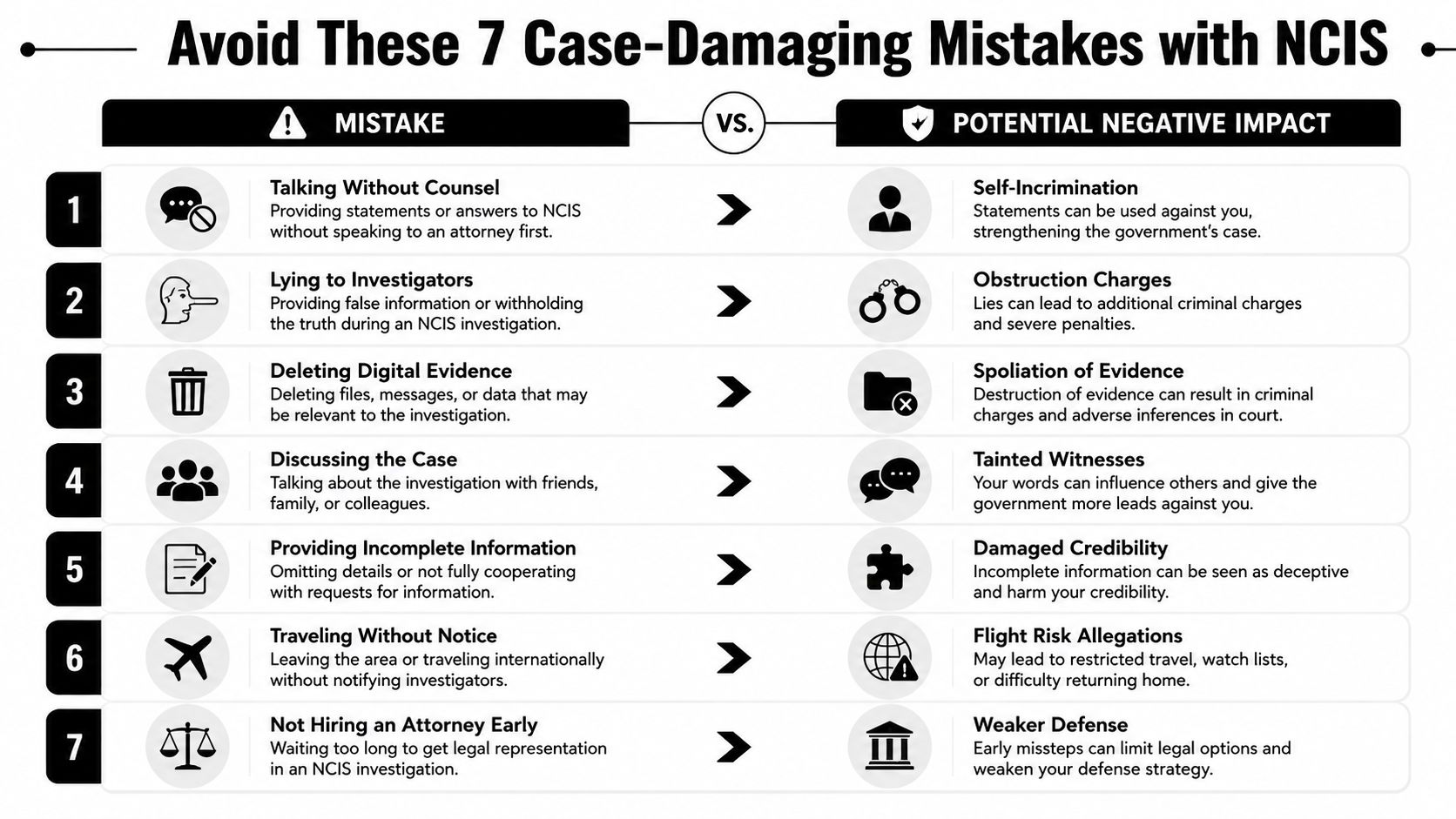
Talking without counsel
This is still the biggest mistake. People think truth will save them. Unstructured talking usually gives investigators statements to attack.Trying to explain things to command
Your chain of command is managing mission risk and discipline. It is not your defense team.Consenting to broad searches
Phones and laptops contain more than the issue under investigation. Consent can open doors that were not otherwise available.Deleting messages or app content
Deletion can look like consciousness of guilt, and it may destroy context that helps the defense.Contacting the accuser or key witnesses
Even a message meant to apologize, reconcile, or “clear things up” can become an intimidation allegation or obstruction argument.Waiting for charges
By then, witnesses have been shaped, records have been summarized, and exculpatory material may be harder to recover.Assuming innocence is enough
Truth matters. But truth without preservation, investigation, preparation, and strategy is not a defense plan.
A short reality check
| Mistake | Why it hurts |
|---|---|
| Volunteering details | Creates impeachment material and narrows future defenses |
| Cleaning up your phone | Risks spoliation arguments and loss of favorable context |
| Relying on rumors about the case | Keeps you reactive instead of strategic |
| Hiring general criminal counsel with no military trial depth | Misses UCMJ-specific procedure, command dynamics, and court-martial strategy |
A disciplined response is boring by design. Stay silent. Preserve evidence. Follow counsel. Keep your circle tight.
Why Service Members Worldwide Hire Gonzalez & Waddington
In a serious NCIS case, the primary value of civilian defense counsel is independence, focus, and early intervention. A dedicated military criminal defense attorney is not answering to the command, not balancing prosecution obligations, and not limited to reacting after the government has already shaped the file.
Why early civilian defense changes leverage
Based on compiled 2025 data, less than 5% of U.S. Marines and Sailors who hired a civilian military defense lawyer while under NCIS investigation faced court-martial charges (military-defenseattorney.com reporting compiled NCIS defense data). That does not guarantee any result in any new case, but it strongly supports what experienced defense lawyers already know. Early, strategic intervention can change the direction of a case before it hardens.
For service members researching what defense counsel does beyond trial appearances, this article on protecting your record and license is a useful civilian-side explanation of how criminal defense work often starts long before the courtroom.
One option in this space is how Gonzalez & Waddington handles military investigations before charges are filed. The firm is a civilian military defense law practice representing service members worldwide in UCMJ litigation, court-martial defense, CID, NCIS, OSI, and CGIS investigations, Article 15 and NJP matters, administrative separation boards, Boards of Inquiry, and GOMOR rebuttals.
Why Service Members Worldwide Contact Gonzalez & Waddington
Michael Waddington is a former Army JAG who has served as prosecutor, Trial Defense Counsel, Senior Defense Counsel, Special Assistant U.S. Attorney, and Chief of Military Justice. Verified profile information states he has handled over 3,000 military cases across more than 25 years, with 51% of his practice focused exclusively on military law (Avvo profile for Michael Waddington).
The firm represents Army, Navy, Air Force, Marine Corps, Coast Guard, Space Force, active duty, Reserve, and National Guard members. Alexandra González-Waddington has defended service members facing sexual assault, violent crime, domestic violence, war crimes, and white-collar allegations. Their practice is built for serious UCMJ cases where trial readiness, digital evidence analysis, and pre-charge strategy matter.
Additional context
Yes. Service members should invoke the right to remain silent and ask for counsel. Don't try to “clarify a few things” first.
Additional context
Yes. Civilian counsel is independent from the command and is hired to defend you. Detailed military defense counsel can be important too, but civilian counsel often brings separate strategy, resources, and trial-focused perspective.
Additional context
Usually yes. In many cases, a service member has both detailed military defense counsel and retained civilian defense counsel.
Additional context
Do not try to fix the problem by talking. Tell your lawyer exactly what happened, whether you consented, what devices were taken, and what helpful data may exist on them.
When should I contact Gonzalez & Waddington?
Immediately after NCIS contact, or as soon as you suspect an allegation may be coming. Early silence and early strategy are often the difference between damage control and preventable disaster.
If you are under investigation, facing UCMJ charges, being questioned by CID, NCIS, OSI, or CGIS, or preparing for a court-martial, don't wait. Early action can change the direction of the case. Silence, strategy, evidence preservation, and the right defense plan matter. Contact Gonzalez & Waddington at 1-800-921-8607, text 954-799-4019, or visit ucmjdefense.com.
“This article is for general informational purposes only and does not create an attorney-client relationship. Every military case depends on the facts, evidence, command climate, service branch, forum, and applicable law. Past results do not guarantee future outcomes.”
Related: Article 31(b) Rights Overview
Related: Article 31(b) Rights Topic Cluster
Related: Military Investigation Interview? Don’t Talk Without a UCMJ Defense Lawyer
Video transcript
Transcript of the video “How Military Investigators Use AI in UCMJ Cases | Why You Need a Civilian Military Defense Lawyer,” with Michael Waddington of Gonzalez & Waddington.
Read the full transcript of this video
My name is Michael Waddington, and I’m a criminal defense lawyer. I’ve been practicing law for 25 years now. Today we’re going to have an informal discussion about AI (things like Grok, ChatGPT, Google Gemini, and all the other AI apps out there) and how they can impact a criminal investigation, both on the civilian side and in the military.
So, first things first: your AI chats can become evidence. I talk to people all the time and they say, “How can this become evidence? I thought they were private.” Well, AI chats aren’t necessarily private. By default, they’re not private. If law enforcement serves a subpoena or a search warrant, your AI search history can be recovered. It can be logged, and it will be analyzed. They’re going to look at not just what you asked, but how you asked it, when you asked it, how often, and in what sequence. What it does is create intent for investigators. They’re literally getting inside of your mind and looking at what you’re thinking and what you’re doing. This is the perfect way for them to prove intent. I’ll tell you what, AI is a great tool for law enforcement to prove crimes that require intent: what you’re thinking, what your plan is.
Now, AI doesn’t testify, obviously, but prosecutors use it to tell a story. They’ll bring in an investigator or some sort of digital expert who will help craft the story. And once that story forms of what you were looking at and what you were searching, it becomes very difficult to unwind.
Since AI came out, there’s one AI question that has sunk many people in criminal cases, and it’s a mistake that I see constantly. People under investigation like to go to AI, not necessarily to a lawyer at first. They log into ChatGPT and try to understand what they’re accused of. A lot of times that’s innocent enough, right? And they think it’s innocent. They’re just doing research. But to investigators, it looks like consciousness of guilt. The question itself isn’t illegal. It’s the timing and the follow-up questions that tend to hurt you. So context can turn curiosity into evidence. For example, if you’re looking up the maximum punishment for something and you haven’t actually been informed of the crime yet, that will be used to argue, “Hey, this guy knew what he was accused of. He knows what he did. He was trying to get ahead of the curve before his interrogation.” So I would caution you: reach out to a lawyer, and have the lawyer do that research and answer your questions for you.
Another thing: AI doesn’t forget. Everything you’re writing in there is being saved somewhere, in some warehouse or on your computer, and it can be recovered. Deleting your AI history does not mean it’s gone: logs, backups, metadata, timestamps. AI systems are designed to retain your data. They’re designed to learn from what people put into them. They’re large language models, LLMs; that’s what they call them. Meaning, they learn from what people type in there, so they retain it, whether it’s on your computer or on some server somewhere. Now, yes, there are certain exceptions, but I’m talking about the default ChatGPT, Grok, and those other services. Your searches don’t just get erased because you get rid of your phone. Investigators can try to recover your search history outside of your phone. For example, with ChatGPT, if you throw your phone in the river and don’t have it anymore, they can log in to your ChatGPT account and, in many cases, recover all your past searches. Whether they’re deleted or not, they can probably get them with enough digging. So if you think clearing your history is going to protect you, you’re behind the power curve.
Here’s something I never thought I would say: in a lot of cases, police don’t really need confessions anymore if they have AI. Modern investigations don’t rely on confessions as much as in the past. In the past, a confession was the gold standard, and it would be used to convict. But nowadays, many people don’t make statements and they don’t confess. AI and search history build the timeline even better than a confession, because people can lie in confessions. People can lie in interrogations. But the AI search history is there in black and white. It shows what you typed and searched. It goes to your intent. It shows what you knew and when you knew it. And that actually replaces an admission. You can’t claim it was a false confession, like people could in the past. So silence (asking for a lawyer and not talking to the police) doesn’t help if your digital footprint is already speaking for you.
Here’s something else that makes people upset, but it’s a fact: research by someone accused or suspected of a crime looks like planning, and that applies before and after. It applies to cases where the person is already under investigation, and to cases where someone searches and is later accused of a crime. When you start doing searches and research (looking up flights, hotels, or background research on what the laws are) before an alleged crime, that goes to show planning, motive, and intent. If you look up crimes, penalties, and procedures afterward, it looks like you’re preparing out of a consciousness of guilt.
Now, you may be saying, “What’s wrong with doing homework if I’m under investigation?” You have to understand the prosecutorial and investigative mindset. It’s very cynical. They think you did something if you’re under investigation, so everything you do that is consistent with their theory of guilt will be used against you. Get that into your mind: anything you say and do will be used against you to prove your guilt. If the searches escalate, if they repeat, if they happen right after the alleged crime, that’s even stronger evidence for the government. Nowadays, prosecutors don’t need you to say you planned anything. They’ll just present a digital forensics expert to prove everything they’re arguing. And again, it’s hard to argue with a computer printout or a computer search when you’re the one who typed it in.
I talk to prosecutors all the time. No, they’re not my sworn enemies. I have a lot of friends who are prosecutors, and I deal with them on a daily basis. Some are not my friends, and they’re not good. Some are actually good, hardworking people who are fair and ethical. And across the board, they all love AI data. I’ll tell you why. They talk about how it fills the gaps that juries care about, the gaps they couldn’t fill in the past: your intent, your motive, knowledge, opportunity. Those are all crucial things in a criminal case, where the standard is proof beyond a reasonable doubt. Prosecutors use AI searches to explain why something happened, and once the jury hears that narrative, it can stick, and you can end up convicted. So I’m warning you all: be careful what you type into your computer. It is a digital evidence collection machine. It’s the strongest evidence we see nowadays.
Let’s talk about another thing that comes up: curiosity versus intent. What if two people ask AI the same question? One walks away and nothing happens; the other gets charged with a crime. The difference isn’t just the question. It’s the surrounding facts. Do they actually believe you did something? If they do, they’re going to look at timing, repetition, and escalation, and then AI turns those gray areas into black-and-white stories. You may not get caught. You could do AI searches all day and night, and it could never end up in court. The only difference is if you get put under investigation and charged. So it’s better not to be writing things in there that could get you into trouble. If you have any questions, talk to a lawyer.
Another thing people don’t realize is that AI searches can easily create probable cause where, in the past, investigators would have needed other evidence to back it up. Now, AI doesn’t go out and arrest people. Not yet, unless you’ve seen a few of the movies out there about what we could expect in the future. As of now, there are no AI police officers roaming the streets as robots. But AI does create probable cause. When an AI search lines up with behavior and other suspicions, investigators can argue in a search warrant application that it’s enough to search a home, a device, and all of your accounts: your Gmail, your AI accounts. And once that door opens, the case starts to snowball very fast.
Here’s another thing most of you don’t know. A buddy of mine at jiu-jitsu who works for the FBI was explaining to me the predictive policing being used right now by state and federal law enforcement. It’s here. You know those old movies where AI would detect who would commit a crime in the future? We have things like that right now. It doesn’t predict what someone is actually going to do. It can’t read your mind. But law enforcement can flag risks using AI, especially in digital cases like CSAM and online stings. If you’re doing anything sketchy on the dark web, the FBI is all over that place. Whether it’s drugs, anything sexual, or anything shady, they have AI combing it: bots that interact with people, posing as children, super-smart AI systems that are not actually humans. There are armies of these AI systems out there doing predictive policing, looking for crime and predicting behavior. What they look for is behavioral patterns, escalation, and anomalies, things that stand out.
This is not science fiction. It’s happening right now. We had a few cases this year alone where officers got busted. They thought they bought illegal material online from a third-party source who got it from another third-party source, and boom, they get flagged by the FBI. NCIS or CID shows up, they get a warrant, and the guy is off to prison. It’s that simple in many cases using this AI. So you’re not smarter than AI, okay? Don’t commit crimes. If you are under investigation, get legal advice. Don’t go to AI and ask it more questions. Often you don’t even know you’re being investigated, and they have the investigation half done simply based on what you’re doing online and AI detection.
Now let me talk to you about something we call the silent witness: AI metadata. AI metadata is brutal. It’s devastating. It could exonerate you in some cases, but if you committed a crime, in many cases it’s going to be used to convict you. They use timestamps, device usage, frequency, and many hundreds of data points that I’m not going to list here, which AI can analyze. Then prosecutors and law enforcement produce really pretty reports that tie everything together and point the arrow straight at you. This data contradicts people’s stories, and they use it to impeach people all the time. If your story doesn’t match up word for word, they use AI and the metadata to destroy your credibility. You don’t even need to be lying for AI to hurt you. It just has to find minor flaws in your story and contradict them with concrete, black-and-white evidence.
“What if I get a lawyer? Can they erase my AI history?” The answer is no. That’s obstruction of justice. That’s multiple crimes. No ethical, legitimate lawyer is going to do that or tell you to do that. The truth is, once the evidence exists, no lawyer can undo it. We can try to explain it, suppress it, contextualize it, and fight over what it actually means, but you can’t make it disappear. Prevention matters more than cleanup. Any lawyer who tells you they’re going to take care of it and get rid of your AI search history is probably committing a crime, and you should look elsewhere, because you’re both going to end up in jail for obstruction of justice.
Asking AI is probably one of the dumbest things you can do if you actually committed a crime or may have committed a crime. Jurors don’t hear, “Oh, he was just asking it a couple of questions.” You can say that all you want, but what they’re going to hear is, “This person had a plan. They prepared for it.” Curiosity doesn’t sound innocent in court when the prosecutor spins it and pairs it with other evidence. You look like a guilty criminal. AI questions become a major puzzle piece, and prosecutors use them all the time to build a case and prove it beyond a reasonable doubt.
Another thing you don’t realize when you’re messing around with AI: when you combine law enforcement’s AI capabilities with your search history, even on the dark web, AI is linking you to people, usually criminals, whom you’ve never met, and you become guilty by association. I’ve seen massive webs that law enforcement has shown me, even in some of my cases, where they connect the dots between child sex traffickers or sex offenders who are interconnected all over the world (Russia, the Philippines, and the US), and they use it to pinpoint people and devices, down to serial numbers. It’s not just IP addresses anymore. They can get the data off your computer and pin it to your actual location, pin it to you. They don’t just do some half-hearted IP check anymore. They literally link that device to you. They look at writing styles and behavior patterns. So the fact that you’re using a burner phone is usually not enough. You shouldn’t be committing crimes; I always say that. But the point of me telling you this is that you can be linked to people you’ve never met and implicated by things you never did or knew about, just by association. If the data overlaps, it can often be used to get a search warrant, or at least probable cause. Guilt by algorithm is real.
Another thing: back in the day, people used to get away with crimes all the time. Before the internet, there were kidnappers and serial killers roaming around. I think there are fewer now, at least in the media, because nowadays they get busted, and they get busted fast: law enforcement can often find a needle in the haystack using AI. AI has basically solved a lot of the problems of old-school law enforcement: matching databases, scanning millions of posts, deciphering millions of usernames. AI can now narrow this down in seconds. The algorithms can narrow millions of people down to a handful of groups in seconds, and this is how cold cases are being solved very quickly nowadays. Things that could never be done in the past are being done now. So if you think you’re going to be out there committing crimes and outsmarting law enforcement and AI because you know a little about the dark web, or you’re some sort of hacker, think again. You’re going to get caught.
Another thing AI proves that is devastating is what you knew and when. Knowledge timelines kill defenses. If AI shows you searched for something weeks before an incident, your explanation after the fact looks rehearsed. They’re going to let you say it, and then they’re going to use it against you to show, “He lied in court. He lied to the investigators. He knew this all along.” Timing matters more than what you say.
Here’s another news flash for y’all: anonymous AI is a myth. It doesn’t exist. There are IP addresses, devices, accounts (like I talked about previously), recovery paths, serial numbers. They can trace you easily and get a warrant, even if you think you deleted the information, and even if it’s on your company’s network or your personal private network. I’ve seen them do amazing things with technology. All they need is probable cause for a judge to issue a warrant for pretty much everything in your house: all the devices you’ve ever used, all your accounts. And nowadays, with AI, tech companies are answering search warrants much more quickly. Back in the day, it took forever. Now I see warrant returns coming back fast with a tremendous amount of data, often incriminating data. So don’t go around assuming you’re anonymous.
Another thing you need to be aware of is that AI is helping investigators ask the right questions, not just of you, but of other witnesses. Interviews are changing. They’re not the sloppy ones I used to see in the past. In many cases, AI is telling investigators what to ask, how to apply psychological pressure, when to pressure you on certain points, and when stories don’t line up. They get your statement, your second statement, maybe your third statement if you talk three times, and compare them to other statements and other data they have. In a matter of seconds, they know who’s probably lying, or at a minimum where the inconsistencies are. So you’re not just talking to a human; you’re talking to an algorithm. And I’ll tell you what, many law enforcement agencies are feeding your statements, often in real time, into AI systems that transcribe them. They’re analyzing what you’re saying or not saying. They’re looking for inconsistencies. They’re generating follow-up questions with AI in real time, and the suspect doesn’t even know what’s happening. It’s pretty cool from a law enforcement perspective, but if you’re accused of a crime, you should be scared.
“What if I’m innocent?” Well, innocent people still match patterns. I’ve seen AI identify innocent people multiple times, especially when law enforcement doesn’t know how to interpret the results or isn’t careful. The thing is, AI doesn’t care if you’re innocent. It’s a machine. It cares whether you match a pattern. False positives happen, and once you’re flagged by law enforcement, you have to fight to get off that list. That’s another reason to get a lawyer to help you if you’re being falsely accused, you’re under investigation, and they’re using AI against you.
We now have a Fifth Amendment problem. AI creates self-incrimination without speaking. You don’t have to confess; your digital behavior has already told your story. This is a legal issue courts are going to have to grapple with, but as of now, a lot of what people type into AI is being admitted, because you’re not under arrest. It’s not a custodial interrogation. In most cases, you’re by yourself, typing things into your phone or computer. So the self-incrimination is real. It’s being used all the time to convict people, and they don’t even realize what’s happening until it’s too late.
The last thing I want to talk about is Reddit, other forums, and chat monitoring. The police are scanning Reddit with AI. I know that; I’ve seen it over and over again. Military law enforcement and federal law enforcement are using AI on Reddit every day. I just had a client who went to prison recently for things he was doing and saying online. He thought they were hidden and private, but he triggered a lot of flags. Law enforcement uses AI to scan for language patterns, emotional leakage, timelines, connections, and behavioral tells, among many other things. You don’t have to brag. Casual posts add up. Old posts will suddenly matter. Next thing you know, they have a warrant for all of your search history, even things you deleted from your devices or thought you deleted from the cloud, and you’re facing serious felony charges.
So, Reddit is not private, people. I don’t care if you think it’s a private chat or not; it is not private. Anything you say to anyone else through any digital means is not going to be considered private in many circumstances. The only exceptions would be what you tell your lawyer or your priest. Another thing with Reddit forums and chats: people are getting arrested over old posts, and prosecutors are using old posts to help convict people of crimes that happened weeks, months, or even years later. People think Reddit posts disappear into some void. It’s a public forum, people. Even the private ones aren’t really private. These posts don’t disappear, and AI can comb them and resurface years of content. It can cross-match accounts and build profiles. So even if you come up with multiple different profiles, different emails, different IPs, and think you’re slick, they are going to catch you using AI if you’re committing a crime. So don’t do it.
I’ve been seeing more and more people getting caught, with evidence from these forums, particularly Reddit, being used to prove intent, planning, and what we call 404(b) evidence: other bad acts, or other things you say on there. They can often use those to prove motive, intent, planning, and various other factors. Often it’s not from just one post; it’s from patterns. And AI loves patterns. That’s what it’s good at, and it’s getting better every day.
So those are just some tips on AI and what’s going on with AI and law enforcement. I’m Michael Waddington, criminal defense lawyer. If you have any questions, leave a comment. If you like our content, please click like and subscribe.
Recent Blogs
- Nonpunitive Letter of Caution vs. Punitive Letter of Reprimand: What Navy and Marine Corps Officers Need to KnowNovember 6, 2026
- First 24 Hours After CGIS Contacts You: What Coast Guard Members Should DoNovember 6, 2026
- First 24 Hours After OSI Contacts You: What Airmen and Guardians Should DoNovember 6, 2026
- First 24 Hours After NCIS Contacts You: What Sailors and Marines Should DoNovember 6, 2026
- First 24 Hours After CID Contacts You: What Soldiers Should DoNovember 6, 2026
- Is Hiring the Cheapest Military Defense Lawyer a Mistake?November 6, 2026