Short answer: Investigators rarely tell you that you can refuse a consent search, that refusing generally cannot be used against you, and that saying yes waives protections your lawyer could otherwise use. Civilian military defense lawyer Alexandra González-Waddington of Gonzalez & Waddington advises service members to say, “I do not consent to any search. I want a lawyer.”
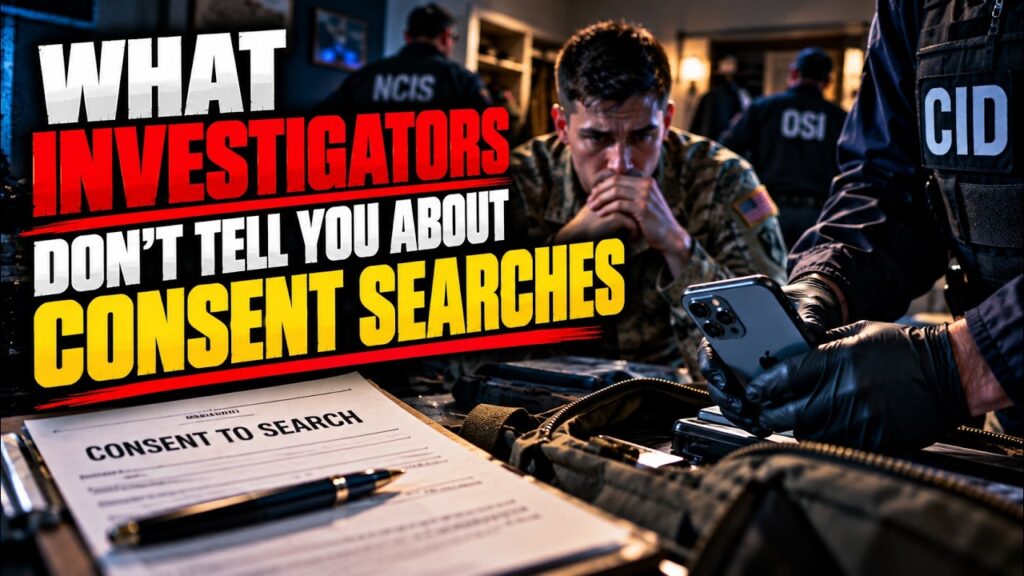
In this video, Alexandra González-Waddington explains why military investigators ask for consent, what they leave out, and exactly what to say when they ask.
Why do military investigators ask for consent to search?
To search your phone, car, barracks room, or body, investigators generally need a search authorization from a commander or military magistrate based on probable cause, under the Fourth Amendment and Military Rule of Evidence 315. Getting one takes time and creates a written record your lawyer can challenge.
Under Military Rule of Evidence 314(e), your voluntary consent replaces all of that. No probable cause and no authorization are needed. When an agent says, “Mind if we take a look?”, they are asking you to give up protections that would otherwise apply.
Can I refuse a consent search in the military?
Yes. Consent must be voluntary, and you are allowed to say no. You do not need to give a reason.
Say clearly: “I do not consent to any search.” Then stop talking and ask for a lawyer.
Can refusing a search be used against me?
Generally, no. Exercising your right to refuse a search is not evidence of guilt, just as asking for a lawyer is not.
Agents may suggest that refusing makes you look guilty. That is a pressure tactic, not the law.
Can I limit or take back my consent?
Yes. Under Military Rule of Evidence 314(e), consent can be limited in time, place, or property, and it can be withdrawn. For example, you could allow a look in a car trunk but not your phone, though the safer answer is still no to everything.
If you consented and change your mind, say out loud: “I withdraw my consent.” What investigators find after that, without another legal basis, may be challenged.
What else don’t investigators tell you about consent searches?
- “We’ll just get a warrant anyway” is a tactic. Maybe they will, maybe they won’t. If they could easily get a search authorization, they often would not need to ask, and an authorization can be challenged in ways your consent usually cannot.
- Consent obtained through deception may still count. Agents are allowed to mislead you about the evidence, and courts often still find the consent voluntary. Do not count on a lie saving you later.
- The form is the consent. If you are handed a consent-to-search form, signing it usually is the consent. Many people sign thinking it is only an acknowledgment.
- A roommate can consent to shared space. In the barracks, a roommate can consent to a search of common areas and their own property, but generally not your locked wall locker or your phone.
Is a health and welfare inspection the same as a consent search?
No. A commander can order an inspection of the unit under Military Rule of Evidence 313 without your consent, as long as it is a true inspection and not a disguised search aimed at you.
A consent search is different: the agent is asking because they need your permission. That is your moment to say no.
What to do right now
- If asked to consent to any search, say: “I do not consent to any search. I want a lawyer.”
- Do not sign any consent form, and read anything you are handed before signing anything at all.
- Do not physically resist or argue if investigators search anyway. Stay calm and repeat that you do not consent.
- If you already consented, say “I withdraw my consent” and tell your lawyer exactly what was searched.
- Write down who asked, what they said, and what they took, as soon as you can.
- Call a civilian military defense lawyer before answering any questions.
Key takeaways
- A consent search lets investigators skip probable cause and a search authorization.
- You can refuse a consent search, and refusing generally cannot be used as evidence of guilt.
- Under Military Rule of Evidence 314(e), consent can be limited and withdrawn.
- Signing a consent-to-search form usually is the consent, so do not sign it.
- Saying no keeps your lawyer’s ability to challenge the search later.
Frequently asked questions
Should I let CID or NCIS search my phone?
No. A phone holds years of messages, photos, and location data, and consent can give investigators access far beyond the allegation. Say you do not consent and contact a lawyer.
What if they search anyway after I say no?
Do not resist. Calmly repeat that you do not consent and let them proceed. Your lawyer can later challenge the search, which is only possible because you did not consent.
Can my commander order me to consent to a search?
Consent given under an order is not truly voluntary. A commander with authority can authorize a search based on probable cause, but that is a search authorization, not your consent. Do not agree to a search just because someone in your chain of command tells you to.
Does saying no make investigators more suspicious?
It might make them work harder, but that is their job. Refusing protects you, while consenting gives them evidence without any of the legal checks that protect you.
Related questions
- Should I consent to a CID or NCIS search of my phone?
- Do I have to talk to CID if they want to speak with me?
- How to invoke your Article 31 rights and what happens after
Video transcript
Read the full transcript of this video
What don’t investigators tell you about consent searches? That you can say no. That saying no can’t be used against you. And that saying yes is the one decision in the case your lawyer can never undo. I’m Alexandra González-Waddington, civilian military defense lawyer and co-founder of Gonzalez & Waddington. The consent search is the government’s favorite tool because it skips every legal requirement. And it works because nobody explains the rules to the person being asked. Here they are.
Start with why they ask. Under the Fourth Amendment and Military Rule of Evidence 315, to search your phone, your car, your barracks room, or your body, investigators need a search authorization from a commander or military magistrate based on probable cause. Getting one takes time, requires them to write down what they have, and creates a document your lawyer can attack. Under Military Rule of Evidence 314(e), your consent replaces all of that. No probable cause, no authorization, no paper trail, no suppression motion. When an agent says, “Mind if we take a look?” they’re asking you to waive the Fourth Amendment for them.
Here’s what they don’t tell you.
One, you can refuse. Consent has to be voluntary, and the law is clear that you’re allowed to say no. Say, “I do not consent to any search.” You don’t need a reason.
Two, refusing can’t be used against you. The prosecution can’t tell a panel that you declined a search, any more than they can say you declined to talk. Agents will suggest that refusing looks guilty. It’s legally irrelevant, and it’s strategically wrong.
Three, consent can be limited. If for some reason you decide to consent to something, you can limit it. You can look in the trunk, not the phone. Anything beyond the limit is an unlawful search, but the better answer is still no to everything.
Four, consent can be withdrawn. If you consented and change your mind, say, “I withdraw my consent.” out loud. Anything they find after that, without a separate basis, is suppressible. Agents rarely mention this.
Five, “We’ll just get a warrant anyway.” is a tactic. Maybe they will, maybe they won’t. If they could get one easily, they usually wouldn’t be asking. And a search authorization can be challenged. Your consent can’t.
Six, consent obtained by a lie can still count. Agents are allowed to deceive you about the evidence. Courts have been slow to find consent involuntary because of it. Don’t count on the lie saving you later. Count on saying no now.
Seven, the form matters. If they hand you a consent to search form, read every line before you sign, and understand that signing it is the consent. Many people sign thinking it’s an acknowledgement. It isn’t.
Eight, your roommate can consent to shared space. In a barracks room, a roommate can consent to a search of common areas and their own side. They cannot consent to your locked locker or your phone. Know which is which.
What to say in every situation. I do not consent to any search. I want a lawyer. Don’t physically resist if they search anyway. Don’t argue. Let your lawyer fight it later, which is only possible if you didn’t consent.
So, what don’t investigators tell you about consent searches? That the whole point is to get you to give up a right you’d keep if you understood it. Say no, say it clearly, and call us. I’m Alexandra González-Waddington with Gonzalez & Waddington. We defend service members worldwide. You can learn more at ucmjdefense.com or call 1-800-921-8607 for a free confidential consultation.
Talk to a military defense lawyer
Gonzalez & Waddington defends service members worldwide in investigations, courts-martial, administrative separation boards, and other UCMJ matters. Michael Waddington, a former Army JAG officer, has been a lawyer for over 25 years. Call 1-800-921-8607 or visit ucmjdefense.com for a confidential consultation.
This article is general information, not legal advice. Every case is different, and reading it does not create an attorney-client relationship.
Recent Blogs
- Child Pornography Under Article 134: Penalties and DefensesOctober 27, 2026
- Article 120c UCMJ: Indecent Exposure and Viewing ExplainedOctober 27, 2026
- Expedited Transfer: What Happens to the Accused When the Accuser Moves?October 26, 2026
- What Counts as Retaliation Under Article 132, and How Do You Respond?October 26, 2026
- Accused of Hazing in the Military: What Do Marines and Soldiers Need to Know?October 26, 2026
- What Are Space Force Guardians’ Rights Under the UCMJ?October 26, 2026