

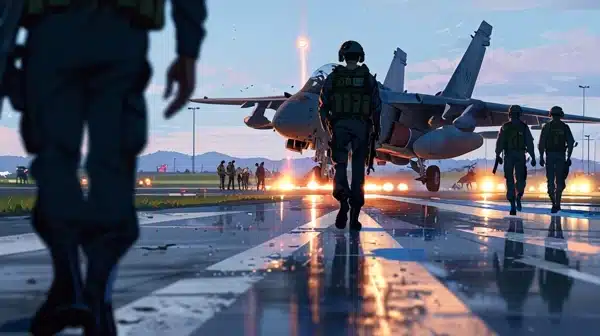
Yokota Air Base Japan | Military Legal Guide
Yokota Air Base is the premier U.S. airlift and logistics hub in the Indo-Pacific region. It is located in western Tokyo near Fussa, Akishima, Hamura, Tachikawa, Musashimurayama, Hachioji, Ome, Sayama, Tokyo, Yokota’s surrounding Kanto Plain communities, and the greater Tokyo metropolitan area.
Airmen and service members stationed at Yokota AB may face UCMJ investigations arising from:
- 374th Airlift Wing operations
- U.S. Forces Japan headquarters missions
- Fifth Air Force headquarters missions
- C-130J Super Hercules and C-12J operations
- Tactical air-land, airdrop, aeromedical evacuation, distinguished visitor airlift, and Indo-Pacific logistics missions
- Joint, bilateral, and host-nation coordination with Japanese authorities
- Off-base incidents in Fussa, Akishima, Tachikawa, Hamura, Hachioji, Tokyo, Shinjuku, Shibuya, Roppongi, and surrounding Japanese communities
- Japanese police contact, SOFA issues, train-station incidents, hotel allegations, dating-app encounters, domestic calls, digital evidence, and security clearance concerns
Civilian Court-Martial Attorneys for Yokota Air Base Service Members
Gonzalez & Waddington defends service members stationed at Yokota Air Base in serious UCMJ matters. We handle courts-martial, Article 15/NJP actions, letters of reprimand rebuttals, administrative separation boards, Boards of Inquiry, and security clearance matters.
An allegation can threaten your career before charges are preferred. This applies to Airmen, Soldiers, Sailors, Marines, Guardians, Coast Guardsmen, officers, NCOs, enlisted members, C-130J personnel, C-12J personnel, maintainers, aerial port personnel, Security Forces, medical personnel, logisticians, communications professionals, headquarters staff, and service members assigned to Yokota tenant organizations. Affected mission areas may include:
- 374th Airlift Wing
- 374th Operations Group
- 374th Maintenance Group
- 374th Mission Support Group
- 374th Medical Group
- Headquarters U.S. Forces Japan
- Headquarters Fifth Air Force
- U.S. Space Forces Japan and other joint or tenant organizations
Yokota is different from a routine Air Force base. It is an overseas logistics hub, a joint headquarters location, and a major U.S.-Japan defense coordination point near Tokyo. The base supports airlift, command and control, aeromedical movement, distinguished visitor transport, contingency response, and regional Indo-Pacific operations.
That changes the shape of a case. A Yokota matter may involve OSI, Security Forces, command witnesses, Japanese police reports, Japanese civilian witnesses, train-station or hotel records, local CCTV, phone extractions, LINE messages, WhatsApp messages, social media, base access logs, travel records, SOFA issues, translation issues, host-nation evidence, clearance paperwork, and command pressure inside a high-visibility overseas environment.
If you are accused of Article 120 sexual assault or any other UCMJ offense at or near Yokota Air Base, do not wait for the command’s theory to harden. This includes abusive sexual contact, domestic violence, assault, DUI-type misconduct, drug misconduct, fraud, larceny, false official statement, orders violations, harassment, stalking, threats, online misconduct, child exploitation, misuse of government systems, classified-information issues, and off-base misconduct involving Japanese authorities.
Call Gonzalez & Waddington at 1-800-921-8607 or text 954-799-4019 to request a confidential consultation with civilian military defense lawyers who defend service members worldwide.
Civilian Military Defense for Service Members at Yokota Air Base, Japan
Yokota Air Base is home to the 374th Airlift Wing. The official Yokota fact sheet describes Yokota as the premier logistics hub in the Indo-Pacific theater and states that the 374th Airlift Wing is the host unit responsible to the Fifth Air Force commander for C-130J and C-12J operations, including tactical air-land, airdrop, aeromedical, and distinguished visitor airlift. See the 374th Airlift Wing fact sheet.
Military OneSource states that Yokota Air Base serves as the host base for Headquarters U.S. Forces Japan and Fifth Air Force. It also describes Yokota as the premier logistics hub in the Indo-Pacific theater. See the Military OneSource Yokota AB Overview.
That mission matters in defense cases. Yokota personnel work in an overseas command environment with U.S. and Japanese interests. A case that begins as a local police report, dorm complaint, domestic call, hotel allegation, train-station incident, nightlife allegation, phone message, aircraft documentation issue, or command inquiry can quickly become a career-threatening matter involving OSI, command leadership, legal offices, security managers, Japanese authorities, translators, and administrative decision-makers.
A Yokota Air Base military defense lawyer must understand more than the basic court-martial process. The defense must account for the base’s Indo-Pacific airlift mission, U.S. Forces Japan headquarters role, the local Tokyo and western Tokyo setting, Japanese police evidence, SOFA issues, digital evidence, host-nation witnesses, travel records, clearance risk, and the speed with which command-driven investigations turn into Article 15s, letters of reprimand, administrative separation boards, Boards of Inquiry, clearance reviews, or courts-martial.
Yokota Air Base, the 374th Airlift Wing, U.S. Forces Japan & Fifth Air Force
Yokota Air Base is a major command and logistics location. It supports airlift throughout the Indo-Pacific and hosts key headquarters functions. The base is not just a flight-line installation. It is a command hub, logistics hub, bilateral coordination point, and mobility platform in one of the most densely populated regions in the world.
The 374th Airlift Wing mission creates unique legal risks. Cases may involve aircrew records, duty schedules, aircraft maintenance records, passenger movement, distinguished visitor support, aeromedical evacuation, operational timelines, and access records. Headquarters assignments may involve classified or sensitive information, command emails, staff work, security clearances, foreign contact reporting, and official communications.
For service members at Yokota, allegations involving dishonesty, alcohol misuse, drug use, domestic violence, sexual misconduct, digital misconduct, classified information, travel violations, or poor judgment can trigger immediate concerns about trust, reliability, access, mission suitability, and overseas assignment status.
Fussa, Tachikawa, Tokyo & the Local Japanese Setting
Yokota AB sits in western Tokyo near Fussa and other communities on the Kanto Plain. Service members may live on base or in nearby Japanese communities. They may travel by train, taxi, private vehicle, rideshare-style services, or organized transportation. They may spend time in Fussa, Tachikawa, Hachioji, Shinjuku, Shibuya, Roppongi, Yokohama, Camp Zama, Atsugi, or other areas around Tokyo and Kanagawa.
Local allegations may arise from:
- Japanese police contact in Fussa, Tachikawa, Tokyo, or nearby communities
- Alcohol-related incidents near train stations, bars, clubs, hotels, or restaurants
- Domestic calls in on-base or off-base housing
- Hotel, apartment, dormitory, or dating-app allegations
- Traffic accidents involving Japanese police, local roads, or base access
- Drug, prescription, customs, or urinalysis issues
- LINE, WhatsApp, Instagram, Snapchat, texts, emails, and phone extractions
- Security, access, foreign contact, or classified-information concerns
For defense purposes, local evidence matters. Japanese police reports, local CCTV, train records, hotel records, taxi records, restaurant receipts, bar receipts, phone location data, messages, photographs, medical records, base access records, and civilian witness statements may tell a different story from the first version given to command. Early defense work can preserve evidence before it disappears.
Japanese Police, SOFA Issues & Military Consequences Near Yokota Air Base
A service member at Yokota Air Base does not need to be convicted by Japanese authorities before military consequences begin. A single incident may trigger Japanese police contact, Security Forces involvement, an OSI investigation, a command-directed inquiry, a no-contact order, duty suspension, a letter of reprimand, Article 15/NJP, administrative separation, a Board of Inquiry, a clearance review, or a court-martial referral.
Cases near Yokota may involve Japanese police, Tokyo-area prosecutors, U.S. command authorities, Security Forces, OSI, translators, and host-nation liaison channels. A local matter may move on one track while the command separately evaluates discipline, retention, clearance eligibility, assignment suitability, and mission trust.
SOFA issues can affect where a case is handled, how evidence is obtained, how witnesses are contacted, and how the command responds. But SOFA issues do not eliminate UCMJ exposure. The military may still act under the UCMJ even when host-nation proceedings are pending, limited, or resolved.
The key point for a service member is practical: Japanese civilian consequences and U.S. military consequences are separate. A local dismissal does not automatically stop a letter of reprimand. A host-nation matter that does not result in prosecution can still lead to Article 15/NJP, separation, clearance review, or court-martial. A weak local report can still become a career-threatening military case if the defense fails to address both the host-nation record and the chain of command.
Special Legal Risks for Airlift, Headquarters, Security, Maintenance & Overseas Personnel
Yokota cases often involve the unique pressures of overseas airlift operations and command headquarters work. Service members may work with Japanese nationals, joint-service personnel, contractors, civilians, logistics units, medical personnel, aircrew, distinguished visitor support personnel, or headquarters staff.
Yokota mission-related cases may involve:
- C-130J and C-12J flight schedules and crew records
- Aircraft maintenance records, forms, tool control, and safety reporting
- Airdrop, tactical air-land, aeromedical evacuation, and distinguished visitor mission records
- Passenger movement, cargo documentation, and deployment paperwork
- Security Forces reports, gate logs, restricted-area access, and patrol records
- U.S. Forces Japan or Fifth Air Force staff emails and official communications
- Host-nation liaison records, Japanese police communications, and translation issues
- Government computer use, messaging systems, phone extractions, and digital records
A weak allegation can still create immediate consequences. An Airman may be removed from flying duties, pulled from maintenance duties, restricted from travel, removed from a sensitive billet, flagged for clearance review, or placed under command restrictions. Defense strategy must address both the legal allegation and the career damage that starts before trial.
How Local Yokota Air Base Incidents Become Military Legal Problems
The following examples are hypothetical. They are not claims about any actual case, business, command, or person. They illustrate how local facts can matter when a service member stationed at Yokota AB is accused of misconduct.
- Tokyo nightlife allegation: A service member spends the evening in Shinjuku, Shibuya, Roppongi, Tachikawa, or Fussa. A report later triggers Japanese police contact, command notification, and a UCMJ investigation.
- Hotel or dating-app allegation: A hotel stay, off-base apartment visit, dating-app encounter, or weekend trip leads to an Article 120 sexual assault or abusive sexual contact allegation involving LINE messages, phone location data, hotel records, taxi records, and competing accounts.
- Off-base domestic call: A family argument in on-base housing or an off-base residence leads to Japanese police contact, command involvement, a no-contact order, Family Advocacy involvement, and possible Article 128b domestic violence or administrative action.
- Train-station or public disturbance incident: An alcohol-related event near a train station, taxi stand, hotel, restaurant, or public area becomes a host-nation police matter and a military discipline issue.
- Airlift or maintenance issue: A maintainer, aircrew member, supervisor, or support Airman is accused of falsifying records, failing to follow technical guidance, mishandling equipment, violating safety procedures, or making a false statement during a safety-sensitive inquiry.
- Security or foreign-contact concern: A service member is accused of mishandling information, failing to report foreign contact, misusing a government system, violating access rules, or engaging in conduct that raises clearance concerns.
- Drug, customs, or urinalysis case: A member faces a positive urinalysis, prescription issue, suspected controlled substance allegation, customs issue, vehicle search, dorm search, or messages suggesting drug use.
- Digital evidence case: The government relies on LINE, WhatsApp, Instagram, Snapchat, texts, deleted messages, partial screenshots, photos, videos, metadata, location data, or a limited phone extraction. Early defense work can preserve context and expose incomplete evidence.
Military Law Issues for Service Members at Yokota Air Base
Yokota AB service members may face court-martial charges, Article 32 preliminary hearings, Article 15/NJP actions, letters of reprimand, administrative separation boards, Boards of Inquiry, command-directed investigations, clearance reviews, unfavorable information files, control roster actions, and other adverse administrative paperwork. The issue may begin with OSI, Security Forces, Japanese police, a commander’s inquiry, a SAPR report, a dormitory complaint, a spouse allegation, a host-nation report, a positive urinalysis, or an allegation from another member, civilian, family member, hotel witness, contractor, coworker, or dating partner.
Article 120 Sexual Assault & Abusive Sexual Contact
These allegations may involve dorm rooms, off-base apartments, hotels, parties, unit social events, alcohol, dating apps, delayed reports, LINE messages, texts, social media, phone extractions, taxi records, hotel security records, or civilian witnesses from Fussa, Tachikawa, Tokyo, Yokohama, Camp Zama, Atsugi, or other nearby areas. Cases often turn on consent, credibility, intoxication, timing, witness contamination, digital evidence, translation issues, and command assumptions.
Domestic Violence & Assault
These cases may involve Japanese police reports, Security Forces records, photographs, medical records, Family Advocacy records, text messages, no-contact orders, housing records, and firearms or weapons restrictions. Even if the local matter is reduced, dismissed, or unresolved, the command may still pursue a letter of reprimand, Article 15/NJP, separation, Board of Inquiry, or clearance action.
Drug & Alcohol Cases
A positive urinalysis, prescription issue, customs issue, suspected distribution allegation, public intoxication event, alcohol-related train-station incident, or dormitory misconduct may lead to investigation, adverse paperwork, or separation. For members in flying, maintenance, headquarters, security forces, medical, communications, command, or clearance-sensitive jobs, administrative consequences can move faster than the criminal process.
Fraud, Travel, False Statements, Cyber & Property Offenses
These allegations may involve government property, travel cards, TDY claims, OHA or housing questions, hotel records, aircraft maintenance documentation, government computers, digital messages, access logs, classified systems, or command-directed inquiries. The defense must evaluate whether the government can prove intent, whether records are complete, whether witnesses are reliable, and whether administrative mistakes are being framed as crimes.
If You're Investigated at Okinawa: What to Know First
Your rights in an OSI interview. Article 31(b) of the UCMJ gives you the right to know what you are suspected of and to remain silent, and you may ask for a lawyer before any questioning by the Air Force Office of Special Investigations (OSI). Declining to answer is not an admission. At Okinawa, as anywhere, the safest first step is to say you want to speak with counsel and then stop talking.
Titling can follow you. OSI can title you as the subject of an investigation, which indexes your name in the Defense Central Index of Investigations, on a low "credible information" standard. Titling is not a finding of guilt, but the record can surface in later background and security clearance checks even if no charges are ever brought.
Who decides whether you are charged. For covered offenses, including sexual assault, domestic violence, stalking, kidnapping, murder, child pornography and, since 2025, sexual harassment, the decision to prefer and refer charges belongs to an independent special trial counsel rather than your commander at Okinawa. For other offenses the command still decides. Which track a case is on shapes the defense from the first day.
Family and relationship allegations. Domestic violence is charged under Article 128b, and strangulation or suffocation can be charged as aggravated assault whether or not there is a mark. The hidden cost is the Lautenberg Amendment: a qualifying conviction bars possession of firearms and ammunition, which few military careers survive.
Drug and off-duty allegations overseas. Article 112a of the UCMJ applies to service members in Japan whatever local law allows, and host-nation authorities may also have jurisdiction under the Status of Forces Agreement. A positive urinalysis can still be challenged on chain of custody, testing and innocent ingestion.
BAH and allowance cases. An overpayment is a debt, not a crime. To convict under Article 121 (larceny) or Article 124 (frauds against the United States), the government must prove intent, and that is where many BAH cases fall apart once the paperwork history is reconstructed.
If you are under investigation at Okinawa, talk to a military defense lawyer before you make any statement. Call Gonzalez & Waddington at 1-800-921-8607.
Working Alongside Detailed Military Defense Counsel
A service member facing court-martial generally has the right to detailed military defense counsel. Civilian counsel does not replace that lawyer. Civilian counsel works alongside them.
At Yokota Air Base, civilian counsel may need to review evidence from many sources, including OSI reports, Security Forces records, Japanese police records, host-nation witness statements, translated documents, body-camera or local video if available, phone extractions, dorm witness statements, flight records, mission records, maintenance documentation, command emails, counseling records, medical records, hotel records, taxi records, train records, social media, protective order paperwork, urinalysis documents, clearance paperwork, and adverse administrative files.
Gonzalez & Waddington is a civilian military defense firm focused on military criminal defense and UCMJ litigation. We represent members of every branch — Army, Navy, Air Force, Marine Corps, Coast Guard, Space Force, Reserve, and National Guard. The firm defends courts-martial, Article 120/120b/120c cases, Article 128 and 128b assault and domestic violence cases, CSAM and online sting cases, investigations, Article 15/NJP actions, Boards of Inquiry, administrative separations, GOMOR and letter of reprimand rebuttals, clearance matters, and serious felony-level military cases.
Quick Answer: Military Defense Lawyers for Yokota Air Base
Service members stationed at Yokota Air Base can face military consequences from both on-base allegations and off-base incidents in Fussa, Tachikawa, Akishima, Hamura, Hachioji, Tokyo, Yokohama, and the surrounding Kanto region. A civilian military defense lawyer can work alongside detailed military counsel in courts-martial, Article 120 cases, Article 15/NJP matters, letters of reprimand, administrative separation boards, Boards of Inquiry, clearance matters, and command investigations. Because Yokota AB is home to the 374th Airlift Wing and hosts U.S. Forces Japan and Fifth Air Force headquarters, defense strategy should account for OSI involvement, Japanese police contact, SOFA issues, host-nation evidence, local CCTV, LINE and WhatsApp messages, base access records, airlift mission records, command pressure, clearance risk, and long-term military career consequences.
As a retired military officer, I know how serious the military justice system is and how much is at stake when a service member faces false allegations. When my brother-in-law found himself in that position, our family knew we needed an attorney with extensive experience in military law.
Prior results do not guarantee a similar outcome. Every case is different.
Yokota Air Base Military Defense FAQ
Can Japanese police involvement affect my U.S. military career at Yokota?
Can a hotel, dorm, Tokyo nightlife, or dating-app allegation become an Article 120 case?
Do Yokota service members need civilian military defense counsel if they already have military counsel?
Can Yokota commanders take action before Japanese authorities finish their review?
Can a Yokota service member face administrative separation even if Japanese authorities do not prosecute?
What evidence matters most in Yokota UCMJ cases?
OSI wants to interview me at Okinawa. Do I have to talk to them?
No. Article 31(b) of the UCMJ requires investigators to tell you what you are suspected of and that you have the right to remain silent, and you can ask for a lawyer before answering anything. An interview is evidence collection, and OSI can title you as a subject on a low "credible information" standard that can follow you into background and clearance checks even if the case is dropped. Politely decline, ask for counsel, and call a military defense lawyer before you say anything.
Why Choose Gonzalez & Waddington for Yokota Air Base Military Defense
Gonzalez & Waddington, LLC is a civilian military defense firm representing service members worldwide. The firm is led by Michael Waddington and Alexandra González-Waddington, a husband-and-wife defense team focused on military criminal defense, court-martial litigation, UCMJ investigations, separation boards, Boards of Inquiry, GOMOR and letter of reprimand rebuttals, Article 15/NJP matters, sexual assault defense, violent offense defense, and cyber and digital-evidence cases.
Michael Waddington
Michael Waddington is a former Army officer and former Army JAG. He served as an Army Trial Defense Counsel, Senior Defense Counsel, Army prosecutor, Special Assistant United States Attorney, and Chief of Military Justice. He has more than 25 years of military defense experience. He is licensed in Florida, Georgia, Pennsylvania, New Jersey, and South Carolina. He is admitted to all U.S. military trial courts worldwide.
Alexandra González-Waddington
Alexandra González-Waddington is a founding partner, former public defender, and experienced military defense lawyer licensed in Florida and Georgia. She is admitted to all U.S. military trial courts worldwide. She has defended service members in sexual assault, violent crime, war crimes, murder, classified-information, domestic violence, and white-collar cases. She co-tries the firm’s cases with Michael Waddington and is bilingual in English and Spanish.
The firm’s attorneys have defended service members in the United States, Germany, Italy, Spain, the United Kingdom, Japan, South Korea, Guam, the Middle East, Iraq, Afghanistan, and other deployed environments. For Yokota service members facing allegations involving Japanese police contact, SOFA issues, airlift operations, headquarters assignments, OSI investigations, local Japanese evidence, digital records, command pressure, classified duties, or serious UCMJ charges, that trial-focused background matters.
Talk to a Civilian Military Defense Lawyer Serving Yokota Air Base
If you are stationed at Yokota AB and are under investigation or facing command action, get legal guidance before making statements or submitting paperwork that may be used against you later. This includes situations where you are:
- Facing OSI, Security Forces, Japanese police, or command questioning
- Accused of Article 120 sexual assault
- Dealing with host-nation police contact, a public incident, or a civilian complaint
- Receiving an Article 15/NJP or fighting a letter of reprimand
- Preparing for an administrative separation board or Board of Inquiry
- Worried about security clearance, access, mission duties, overseas assignment status, or future assignments
Gonzalez & Waddington defends service members in serious military cases worldwide. The firm can work alongside detailed military counsel, review the evidence, preserve favorable information, prepare for command decisions, and build a strategy that accounts for the military case, Yokota’s overseas command environment, Japanese civilian evidence, SOFA issues, airlift mission records, digital evidence, operational pressures, and long-term consequences to your rank, clearance, retirement, and future.
Call Gonzalez & Waddington at 1-800-921-8607 or text 954-799-4019 to request a confidential consultation. No attorney can guarantee a result. The goal is to intervene early, protect your rights, and help you make informed decisions before the command or prosecution theory hardens.
Helpful Yokota Air Base & Japan Legal Resources
- Yokota Air Base Official Website
- 374th Airlift Wing Fact Sheet
- Military OneSource Yokota AB Overview
- Yokota AB Major Units
- U.S. Forces Japan
Related Military Legal Guides
- Japan Military Defense Lawyers
- Air Force Military Defense Lawyers
- Global Military Base Directory







