

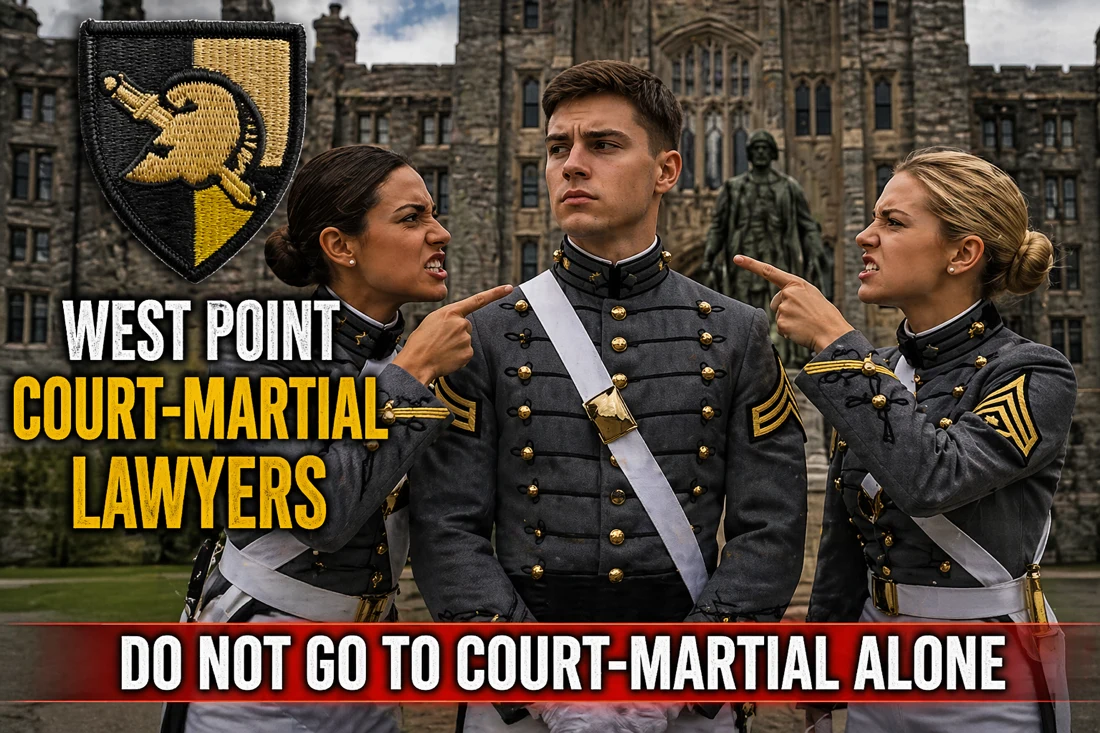
West Point Military Defense Lawyers | UCMJ & Court-Martial Defense
West Point, New York is not a conventional Army post. It is the United States Military Academy — a federal military installation, an elite academic institution, and a leadership pipeline for future Army officers on the Hudson River in Orange County.
Service members, cadets, faculty, staff, tactical officers, coaches, Soldiers, and military professionals at West Point may face UCMJ investigations tied to a wide range of situations, including:
- Cadet life, barracks conduct, and academic integrity
- Sexual assault allegations and alcohol incidents
- Off-post events in Highland Falls or Newburgh
- Social media and dating apps
- Army-Navy visibility and the academy’s demanding honor, discipline, and leadership culture
Civilian Court-Martial Attorneys for West Point Cadets & Service Members
Gonzalez & Waddington defends service members stationed at West Point in serious UCMJ matters. We handle court-martial cases, Article 15/NJP actions, GOMOR rebuttals, administrative separation actions, Boards of Inquiry, cadet-related misconduct cases, and security clearance matters.
An allegation can threaten your career, commission, clearance, academy status, reputation, and future long before charges are preferred. This applies to anyone assigned to West Point, including:
- Cadets and permanent-party Soldiers
- Officers, NCOs, instructors, and tactical officers
- Coaches and staff members
- The U.S. Army Garrison West Point and the Corps of Cadets
- The Brigade Tactical Department
West Point is different from a traditional Army installation. The academy’s mission involves officer development, academic performance, military discipline, physical training, ethical leadership, cadet chain-of-command responsibilities, Army values, and close institutional scrutiny.
That changes the shape of a case. A West Point matter may involve not only command witnesses and CID, but also cadets, TAC officers, faculty, coaches, roommates, teammates, academic records, honor-related allegations, barracks witnesses, digital evidence, phones, social media, security personnel, local New York law enforcement, and civilian witnesses from Highland Falls, Newburgh, Orange County, the Hudson Valley, or the New York City travel corridor.
If you are accused of any UCMJ offense at or near West Point, do not wait for the command’s theory to harden. This includes Article 120 sexual assault, abusive sexual contact, domestic violence, assault, hazing, harassment, fraternization, alcohol misconduct, drug misconduct, false official statement, honor-related misconduct, digital misconduct, stalking, and orders violations.
Call Gonzalez & Waddington at 1-800-921-8607 or text 954-799-4019 to request a confidential consultation with civilian military defense lawyers who defend service members worldwide.
Civilian Military Defense for Cadets & Service Members at West Point, New York
West Point is one of the most visible and consequential military institutions in the United States. The official mission of the United States Military Academy is to build, educate, train, and inspire the Corps of Cadets to become commissioned leaders of character committed to the Army Values and ready for service to the Army and the Nation. See the United States Military Academy. That mission creates a unique environment for military justice cases, because allegations at West Point are often evaluated through the lens of leadership, integrity, discipline, officer potential, institutional reputation, and future service.
A legal problem at West Point may affect more than a criminal case. It may affect a cadet’s ability to remain at the academy, graduate, receive a commission, preserve security clearance eligibility, continue in athletics, maintain leadership roles, avoid separation, or protect a future Army career. For permanent-party Soldiers, TAC officers, instructors, staff, and officers, an allegation may jeopardize evaluations, promotion, command trust, special assignment status, retirement, or long-term professional reputation.
West Point cases often move in a highly structured environment where witnesses live, study, train, work, and socialize in close proximity. A report can spread quickly through cadet companies, teams, academic departments, barracks, faculty circles, or chain-of-command channels. The defense must examine what actually happened, what was assumed, what was documented, what was ignored, and whether institutional pressure shaped the investigation before the evidence was fully tested.
Why West Point Is Different From Other Army Installations
West Point’s history gives it a special place in American military law and culture. The academy’s official history explains that President Thomas Jefferson signed legislation establishing the United States Military Academy on March 16, 1802, and that West Point’s earlier military significance came from its strategic position on the Hudson River during the Revolutionary War. See the West Point official history. The combination of history, prestige, academics, military training, athletics, and officer development makes West Point unlike a standard garrison or combat-arms installation.
The Corps of Cadets also operates differently from ordinary Army formations. West Point explains that cadets run day-to-day operations under the supervision of a professional military staff working for the Commandant of Cadets, and that this staff is known as the Brigade Tactical Department. See the U.S. Corps of Cadets. That structure matters in legal cases, because evidence may come from cadet leaders, roommates, teammates, company chains of command, tactical officers, faculty, coaches, and other professional staff.
A West Point investigation may involve a cadet barracks incident, an academic-integrity allegation, an honor-related issue, a sexual assault or abusive sexual contact allegation, a dating relationship, a team event, alcohol use, social media, electronic messages, travel to New York City, off-post conduct in Highland Falls or Newburgh, or a civilian police encounter in Orange County. The legal issue may begin as a conduct matter, command inquiry, cadet disciplinary issue, or local police report before escalating into UCMJ action or other career-threatening consequences.
West Point, Highland Falls, Newburgh, Orange County & the Hudson Valley
West Point sits in the Hudson Valley, on the west bank of the Hudson River, near Highland Falls and roughly north of New York City. The local geography matters because cadets and service members often move between the controlled academy environment and nearby civilian communities. Highland Falls is the village most closely associated with the academy. Newburgh, Cornwall, Fort Montgomery, Beacon, Poughkeepsie, and other Hudson Valley communities may also become relevant depending on where a witness lives, where an incident occurred, or where records are located.
Orange County’s official website describes the county as located about 40 miles from Manhattan, with transportation access and communities tied to the greater New York metropolitan region. See Orange County, New York. For defense cases, that means evidence and witnesses may come from an unusually broad area: Highland Falls apartments, Newburgh hotels, local restaurants, Hudson Valley roadways, rideshare records, train travel, airport travel, New York City weekends, or events involving cadets and civilians from outside the academy.
Local travel also matters. West Point’s visitor information identifies the Visitor Control Center at 2107 New South Post Road in Highland Falls and explains current visitor-control procedures for access to post. That controlled-access environment can affect witnesses, counsel, family members, investigators, and evidence collection. In some cases, where a person entered, exited, stayed, traveled, or communicated may become part of the factual timeline.
Because West Point is both a military installation and an academic institution, cases can be unusually personal. Witnesses may not be strangers — they may live in the same barracks, train on the same team, attend the same classes, serve in the same cadet chain of command, or share the same social circles. This proximity can create pressure, rumor, group assumptions, witness contamination, and rapid command reactions.
How Local Incidents Around West Point Become Military Legal Problems
The following examples are hypothetical. They are not claims about any actual case, business, or person. They illustrate how local facts can matter when a cadet, Soldier, officer, or service member at West Point is accused of misconduct.
- Alcohol incident in Highland Falls: A cadet or service member goes off post in Highland Falls, alcohol is involved, and a disagreement later becomes a command report, police contact, Article 15 matter, honor issue, separation concern, or court-martial investigation.
- Newburgh hotel allegation: A weekend event, hotel stay, dating-app encounter, or rideshare trip in or near Newburgh leads to an Article 120 sexual assault or abusive sexual contact allegation involving text messages, location data, civilian witnesses, and competing accounts.
- Cadet barracks allegation: A dispute or alleged misconduct in a cadet living area involves roommates, company leadership, alcohol, social media, conflicting witness statements, and immediate command scrutiny.
- Honor or false statement issue: A cadet, officer, or Soldier is accused of lying, failing to report, misrepresenting facts, mishandling academic work, or giving an incomplete statement during an investigation. What starts as a conduct or integrity issue may become a UCMJ or separation matter.
- Team, club, or athletic event allegation: A social event tied to a team, club, athletic activity, or cadet group produces allegations of hazing, harassment, assault, abusive sexual contact, alcohol misconduct, or retaliation.
- Domestic or relationship dispute: A service member living near West Point, Highland Falls, Cornwall, or Newburgh is involved in a relationship conflict that leads to a police report, protective order issue, no-contact order, firearm concern, command notification, or possible Article 128b domestic violence allegation.
- New York City travel incident: A cadet or Soldier travels to New York City for liberty, family events, athletics, or social plans. An allegation from that trip later follows the service member back to West Point through civilian records, digital evidence, witness statements, or command reporting.
- Digital evidence case: A case turns on texts, Snapchat, Instagram, photos, videos, location history, deleted messages, shared group chats, or partial phone extractions. Early defense action may be necessary to preserve favorable evidence before it is lost.
Military Law Issues for Cadets & Service Members at West Point
West Point cases may involve cadets, permanent-party Soldiers, officers, NCOs, instructors, coaches, faculty, tactical officers, staff, and service members assigned to the academy or garrison. The issue may begin with CID, military police, academy leadership, a tactical officer, a command inquiry, a cadet report, a local police department, a faculty complaint, a SHARP report, an athletic department concern, a protective order, or an allegation from another cadet, Soldier, civilian, spouse, or dating partner.
Article 120 Sexual Assault & Abusive Sexual Contact
These allegations may involve cadet rooms, hotels, team events, parties, off-post apartments, alcohol, dating apps, delayed reports, text messages, social media, phone extractions, rideshare records, or civilian witnesses. Cases often turn on credibility, consent, intoxication, timing, context, witness contamination, and digital evidence. A defense strategy must examine not only the accusation, but also the academy environment in which the allegation was made.
Domestic Violence & Assault
These allegations may involve Highland Falls, Newburgh, Orange County, nearby housing, civilian police reports, 911 calls, body-camera footage, photographs, medical records, protective order filings, and no-contact orders. Even when civilian authorities handle the local case, West Point leadership may separately consider restriction, adverse paperwork, separation, Board of Inquiry, or UCMJ action.
Hazing, Harassment, Fraternization & Leadership Allegations
These can be especially damaging in the academy environment. West Point’s mission is leadership development, which means an allegation may be treated not only as misconduct, but as evidence of poor judgment, lack of integrity, abuse of authority, failure of leadership, or unfitness for commission or continued service.
Drug & Alcohol Allegations
These may create both criminal and administrative consequences. A positive urinalysis, prescription issue, suspected distribution, underage drinking allegation, drunk-and-disorderly incident, or alcohol-related conduct report may affect cadet status, leadership roles, clearance eligibility, commissioning, promotion, evaluation, or continued service.
Under Investigation at West Point? Know These Rules First
Army CID wants to talk to you. An interview request from the Department of the Army Criminal Investigation Division (CID) at West Point is evidence collection, not a chance to clear things up. Article 31(b) of the UCMJ requires investigators to tell you what you are suspected of and that you have the right to remain silent before they question you, and you can ask for a lawyer before answering anything. Exercising those rights cannot be used as evidence against you.
Being titled is not the same as being charged. Investigators can title a service member and index the name in the Defense Central Index of Investigations on only "credible information." The case may go nowhere, yet the entry can resurface years later in background investigations and clearance reviews, so how the investigation is handled from the start matters.
Your commander may not be the one deciding. Covered offenses such as sexual assault, domestic violence, stalking, kidnapping, murder, child pornography and (since 2025) sexual harassment are now controlled by an independent Office of Special Trial Counsel, which decides whether charges are preferred and referred. Other allegations at West Point still go through the chain of command.
Domestic violence allegations. Article 128b covers violence against a spouse, intimate partner or family member, and an allegation of strangulation or suffocation can be charged as aggravated assault even without a visible injury. A qualifying conviction can also trigger the federal firearms ban under the Lautenberg Amendment, which can end a career that requires carrying a weapon.
Drug allegations. Marijuana may be legal for adults under New York law, but it remains prohibited for service members under Article 112a of the UCMJ, on post and off. A positive urinalysis is serious but contestable: the chain of custody, the testing process and innocent ingestion can all be challenged, and the government must prove the use was knowing and wrongful.
Pay and allowance allegations. BAH and other allowance cases are usually charged as larceny under Article 121 or as frauds against the United States under Article 124. An overpayment by itself is not a crime: the government must prove you intended to steal or defraud, and many of these cases begin as paperwork errors.
If you are under investigation at West Point, talk to a military defense lawyer before you make any statement. Call Gonzalez & Waddington at 1-800-921-8607.
How Civilian & Military Consequences Overlap Near West Point
A cadet or service member at West Point does not need to be convicted in civilian court before military consequences begin. A single incident may trigger a local police report, military police involvement, a CID investigation, a command inquiry, an academy disciplinary process, a no-contact order, a flag, suspension from duties, a clearance review, an administrative separation action, a Board of Inquiry, or a court-martial referral.
Off-post cases near West Point may involve local New York courts. The Town of Highlands Justice Court states that it adjudicates criminal, vehicle and traffic, landlord-tenant, civil, town code, village code, and environmental-law matters. See the Town of Highlands Justice Court. Incidents in or around Newburgh may involve city or town court systems, and more serious matters may move through county-level or state-level proceedings.
Federal jurisdiction may also matter. The U.S. District Court for the Southern District of New York states that it encompasses Orange County, along with several other counties, and hears cases in Manhattan, White Plains, and Poughkeepsie. See the Southern District of New York. Most West Point discipline remains within the UCMJ and the military chain of command, but some cases may involve federal property, federal investigations, federal court issues, or overlapping civilian and military exposure.
Working Alongside Detailed Military Defense Counsel
A cadet, Soldier, or service member facing court-martial generally has the right to detailed military defense counsel. Civilian counsel does not replace that lawyer — it works alongside them. Civilian counsel can bring an independent defense strategy, communicate with the family, conduct early investigation, prepare witnesses, review digital evidence, challenge weak assumptions, and help the accused understand both legal and career risks.
At West Point, civilian counsel may need to evaluate evidence from many sources, including CID reports, military police records, cadet witness statements, command emails, tactical officer notes, academic or honor records, athletic department communications, phone extractions, texts, group chats, social media, location data, hotel records, rideshare records, local police reports, protective order filings, 911 calls, body-camera footage, medical records, and digital records from multiple devices. The earlier counsel becomes involved, the better the chance of preserving evidence before it disappears.
Gonzalez & Waddington is a civilian military defense firm focused on military criminal defense and UCMJ litigation. We represent members of every branch — Army, Navy, Air Force, Marine Corps, Coast Guard, Space Force, Reserve, and National Guard. The firm defends courts-martial, Article 120/120b/120c cases, Article 128 and 128b assault and domestic violence cases, CSAM and online sting cases, investigations, Article 15/NJP actions, Boards of Inquiry, separations, GOMOR rebuttals, clearance matters, and serious felony-level military cases.
Quick Answer: Military Defense Lawyers for West Point
Cadets, Soldiers, officers, NCOs, faculty, staff, and service members at West Point can face military consequences from both on-post allegations and off-post incidents in Highland Falls, Newburgh, Orange County, the Hudson Valley, New York City, and nearby travel corridors. A civilian military defense lawyer can work alongside detailed military counsel in courts-martial, Article 120 cases, Article 15/NJP matters, GOMOR rebuttals, cadet misconduct cases, separations, Boards of Inquiry, clearance matters, and command investigations. Because West Point is both a military installation and the United States Military Academy, defense strategy should account for cadet status, commissioning risk, academic and honor issues, leadership scrutiny, digital evidence, local civilian court exposure, and long-term Army career consequences.
I hired Gonzalez & Waddington after I learned that I was under investigation by the Army for serious misconduct allegations. From the beginning, Michael and Alexandra were straightforward with me. They never promised a particular result or told me what I wanted to hear.
Prior results do not guarantee a similar outcome. Every case is different.
West Point Military Defense FAQ
Can a cadet at West Point hire a civilian military defense lawyer?
Yes. A West Point cadet may hire civilian defense counsel in addition to any detailed military defense counsel or assigned military legal support. Civilian counsel can help protect the cadet’s rights, review evidence, prepare for interviews, evaluate administrative consequences, and work with military counsel when a case involves UCMJ exposure.
Can an off-post incident in Highland Falls or Newburgh affect a cadet’s future at West Point?
Yes. An off-post incident can create both civilian and military consequences. A police report, protective order, DUI, assault allegation, sexual misconduct allegation, or alcohol-related incident may lead to academy discipline, command action, separation concerns, clearance review, or UCMJ action.
Can a hotel, dating-app, or weekend allegation become an Article 120 case at West Point?
Yes. An off-post allegation can still become a military sexual assault investigation if the accused is subject to the UCMJ. Hotels, apartments, rideshares, dating apps, social media, civilian witnesses, delayed reports, and phone extractions may all become central evidence in an Article 120 case.
Are West Point cases different from ordinary Army court-martial cases?
Often, yes. West Point cases may involve cadet status, commissioning risk, academic or honor issues, athletic or team dynamics, leadership evaluations, intense institutional scrutiny, and witnesses who live, train, study, and work in close proximity. Those factors can affect the speed and direction of the investigation.
Can a West Point officer or staff member face a Board of Inquiry after an allegation?
Yes. Officers assigned to West Point may face a Board of Inquiry or other elimination action after allegations involving misconduct, civilian arrest, domestic violence, sexual misconduct, fraternization, dishonesty, leadership failures, or conduct unbecoming. The response should address both the allegation and the officer’s full service record.
Can civilian charges be dismissed while West Point still takes action?
Yes. The military may pursue administrative action, a reprimand, separation, Board of Inquiry, clearance review, or UCMJ action even if civilian charges are dismissed, reduced, or unresolved. Military authorities often focus on judgment, reliability, leadership, integrity, and service suitability — not only criminal conviction.
Army CID wants to interview me at West Point. Do I have to talk to them?
No. Article 31(b) of the UCMJ requires investigators to tell you what you are suspected of and that you have the right to remain silent, and you can ask for a lawyer before answering anything. An interview is evidence collection, and Army CID can title you as a subject on a low "credible information" standard that can follow you into background and clearance checks even if the case is dropped. Politely decline, ask for counsel, and call a military defense lawyer before you say anything.
Why Choose Gonzalez & Waddington for West Point Military Defense
Gonzalez & Waddington, LLC is a civilian military defense firm representing service members worldwide. The firm is led by Michael Waddington and Alexandra González-Waddington, a husband-and-wife defense team focused on military criminal defense, court-martial litigation, UCMJ investigations, separation boards, Boards of Inquiry, GOMOR rebuttals, Article 15/NJP matters, sexual assault defense, violent offense defense, and cyber and digital-evidence cases.
Michael Waddington
Michael Waddington is a former Army officer and former Army JAG. He served as an Army Trial Defense Counsel, Senior Defense Counsel, Army prosecutor, Special Assistant United States Attorney, and Chief of Military Justice. He has more than 25 years of military defense experience, is licensed in Florida, Georgia, Pennsylvania, New Jersey, and South Carolina, and is admitted to all U.S. military trial courts worldwide.
Alexandra González-Waddington
Alexandra González-Waddington is a founding partner, former public defender, and experienced military defense lawyer licensed in Georgia and Florida. She is admitted to all U.S. military trial courts worldwide and has defended service members in sexual assault, violent crime, war crimes, murder, classified-information, domestic violence, and white-collar cases. She co-tries the firm’s cases with Michael Waddington and is bilingual in English and Spanish.
The firm’s attorneys have defended service members in the United States, Germany, Italy, Spain, the United Kingdom, Japan, South Korea, Guam, the Middle East, Iraq, Afghanistan, and other deployed environments. They have written and taught extensively on trial advocacy, cross-examination, sexual assault defense, digital evidence, DNA evidence, expert witnesses, and military justice. For West Point cadets, Soldiers, officers, and staff facing allegations involving credibility, digital evidence, command pressure, honor issues, local civilian court exposure, or serious UCMJ charges, that trial-focused background matters.
Talk to a Civilian Military Defense Lawyer Serving West Point
If you are stationed at West Point and are under investigation or facing command action, get legal guidance before making statements or submitting paperwork that may be used against you later. This includes situations where you are:
- Facing CID questioning
- Accused of Article 120 sexual assault
- Dealing with a DUI or civilian arrest
- Facing an honor-related allegation
- Receiving an Article 15 or fighting a GOMOR
- Preparing for separation action or a Board of Inquiry
- Worried about your security clearance
Gonzalez & Waddington defends service members in serious military cases worldwide. The firm can work alongside detailed military counsel, review the evidence, help preserve favorable information, prepare for command decisions, and build a strategy that accounts for the military case, the academy environment, the local New York courts, and the long-term consequences to your rank, commission, clearance, reputation, and future.
Call Gonzalez & Waddington at 1-800-921-8607 or text 954-799-4019 to request a confidential consultation. No attorney can guarantee a result. The goal is to intervene early, protect your rights, and help you make informed decisions before the command or prosecution theory hardens.
Helpful West Point & Hudson Valley Legal Resources
- United States Military Academy Official Website
- West Point Official History
- U.S. Corps of Cadets
- Town of Highlands Justice Court
- U.S. District Court for the Southern District of New York







