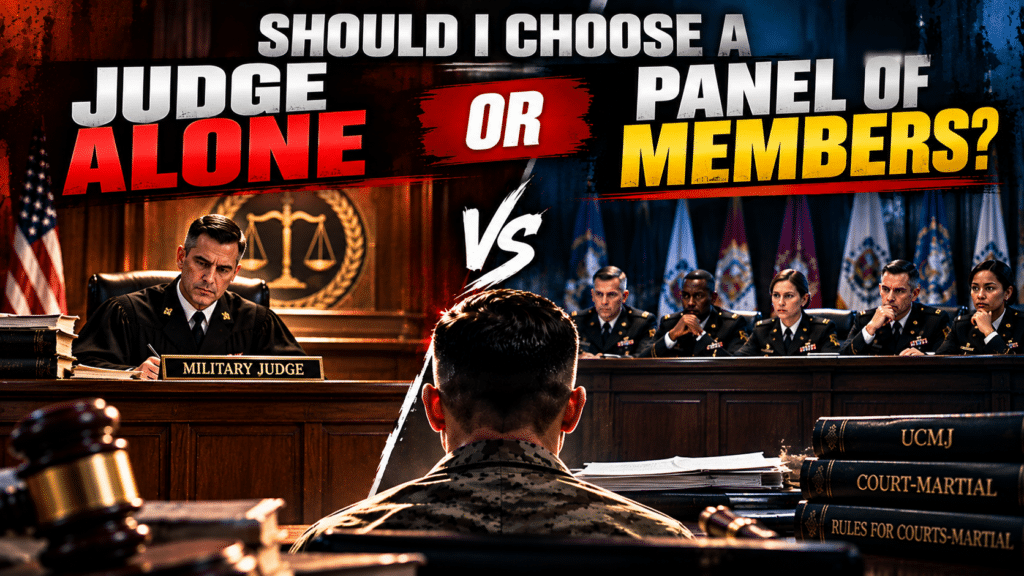
Short answer: It depends on your case, but the rule of thumb is to choose a panel of members when your defense turns on credibility and reasonable doubt, and a military judge alone when your defense turns on the law or technical evidence. Civilian military defense lawyer Michael Waddington of Gonzalez & Waddington explains that forum selection is one of the biggest strategic decisions in a court-martial, and the final choice is yours.
In this video, Michael Waddington explains how to decide between trial by military judge alone and trial by a panel of members at a court-martial.
What is the difference between a judge alone and a panel of members?
Under Article 16 of the Uniform Code of Military Justice (UCMJ) and Rule for Courts-Martial 903, you can usually elect trial by a military judge alone or by a panel of members, the military’s version of a jury. A general court-martial panel has eight members in a non-capital case, and a special court-martial panel has four.
Members are officers and, if you are enlisted and request it, at least one-third enlisted members. They are detailed under Article 25 from within the military, not drawn from the public like a civilian jury.
A conviction by members requires at least three-fourths of the panel to vote guilty, so six of eight at a general court-martial. That means three of eight votes for not guilty result in an acquittal on that charge.
When should I choose a panel of members?
Choose members when the case turns on whether a witness is believable. Examples include a sexual assault case that is one person’s word against another’s, a domestic case where the story changed several times, or an assault where self-defense is the question.
Members bring life experience, tend to be skeptical of stories that do not add up, and often take reasonable doubt seriously in a way that is hard to get from one judge who has heard it all. Members also respond to a service member with a strong record, a believable account, and a clear defense story.
When should I choose a military judge alone?
Choose a judge when the defense is legal. If the case will be won on a suppression motion, a jurisdiction issue, unlawful command influence, or an element the government cannot prove, a judge is trained to follow the law even when the facts are unpleasant.
A judge can also be the better choice when the evidence is ugly, such as graphic images or injuries that members may find hard to set aside. And a judge is often better at following complex evidence like digital forensics, DNA statistics, or dueling experts, where a panel may simply side with the more confident witness.
Who decides my sentence if I am convicted?
For offenses committed after December 27, 2023, the military judge decides the sentence in non-capital cases, whether a judge or members decided guilt. The judge sentences using sentencing parameters and criteria that set ranges for most offenses. For older offenses, you may still be able to elect sentencing by members, so ask your lawyer which rules apply to your case.
That means forum selection today is mainly a decision about who decides guilt or innocence. It should be weighed on the merits of your defense, not on a guess about sentencing.
Do I always get to choose?
No. If the convening authority refers your case to a judge-alone special court-martial under Article 16(c)(2)(A), you cannot request members. In that forum, the maximum punishment is six months of confinement with no punitive discharge.
Your election is made before trial, usually at or after arraignment, and once made it can be hard to change. It is your decision, made after advice from your lawyer.
Why does knowing the local judge matter?
Military judges have track records on suppression motions, sentencing, and how they handle cases like Article 120 sexual assault charges. A lawyer who has tried cases in front of that judge can give you advice that a lawyer without that experience cannot.
What to do right now
- Ask your lawyer to explain, in writing, whether your defense depends more on credibility or on legal and technical issues.
- Find out which military judge is assigned and what your lawyer knows about that judge’s record.
- Confirm which sentencing rules apply based on the date of your alleged offense.
- If you are enlisted, discuss whether to request enlisted representation on the panel.
- Do not make the election until discovery is reviewed and key motions are decided.
Key takeaways
- You can usually choose trial by a military judge alone or by a panel of members under Article 16 and Rule for Courts-Martial 903.
- Members are often the better choice when the case turns on credibility and reasonable doubt.
- A judge is often the better choice for legal defenses, ugly facts, and complex technical evidence.
- A conviction by members requires a three-fourths vote, so three of eight not-guilty votes at a general court-martial result in acquittal.
- For offenses after December 27, 2023, the military judge decides the sentence in non-capital cases.
Video transcript
Transcript of the video “Bench Trial vs Jury Trial: Which Should You Choose?,” with Michael Waddington of Gonzalez & Waddington.
Read the full transcript of this video
What are some of the benefits of having a judge alone in a military court-martial my name is michael waddington and i’m a criminal defense attorney one of the big benefits is judges are picked usually for their temperament so bottom line is the judge can look at a case that would otherwise get people very emotional and all upset and angry and look at it very dispassionately and just apply the facts to the law the problem with going with the judge alone is you have one person
There it’s the judge some judges or more prosecution friendly than others some judges are more defense friendly it really depends we like to go judge alone in cases where it’s a legal issue especially if it’s a legal issue that has a lot of drama going on in the background that the jury otherwise wouldn’t know let’s say some of the victims are very well known liars who have all this drama going on in the background and the jury might not get to hear that information but you
Could take it in front of a judge and get that information from the judge although the judge isn’t supposed to consider that information if it’s excluded but once they hear it you really can’t unring the bell.
Frequently asked questions
Is a court-martial panel the same as a jury?
Not exactly. A panel serves a similar role, but members are service members detailed under Article 25 rather than civilians selected at random from the community. Panel verdicts also need only three-fourths agreement, not a unanimous vote, except in capital cases.
Can I change my mind after choosing a judge or members?
Sometimes, but it is not guaranteed. Under Rule for Courts-Martial 903, the military judge may allow you to withdraw your election for good cause, and the timing matters. Treat the choice as final when you make it.
Can I request enlisted members on my panel?
Yes. If you are an enlisted accused, you can request that at least one-third of the panel be enlisted members. Whether that helps depends on the facts and the people likely to be detailed.
Is a judge-alone trial faster?
Often, yes. A judge-alone trial skips panel selection and instructions to members, so it is usually shorter. Speed should not drive the decision, though; the strength of your defense should.
Related questions
- What a court-martial plea agreement is and when to take one
- The differences between summary, special, and general courts-martial
- How long a general court-martial takes from allegation to verdict
Talk to a military defense lawyer
Gonzalez & Waddington defends service members worldwide in investigations, courts-martial, administrative separation boards, and other UCMJ matters. Michael Waddington, a former Army JAG officer, has been a lawyer for over 25 years. Call 1-800-921-8607 or visit ucmjdefense.com for a confidential consultation.
This article is general information, not legal advice. Every case is different, and reading it does not create an attorney-client relationship.
Recent Blogs
- Nonpunitive Letter of Caution vs. Punitive Letter of Reprimand: What Navy and Marine Corps Officers Need to KnowNovember 6, 2026
- First 24 Hours After CGIS Contacts You: What Coast Guard Members Should DoNovember 6, 2026
- First 24 Hours After OSI Contacts You: What Airmen and Guardians Should DoNovember 6, 2026
- First 24 Hours After NCIS Contacts You: What Sailors and Marines Should DoNovember 6, 2026
- First 24 Hours After CID Contacts You: What Soldiers Should DoNovember 6, 2026
- Is Hiring the Cheapest Military Defense Lawyer a Mistake?November 6, 2026