Gonzalez & Waddington is a civilian military defense firm, founded by Michael Waddington and Alexandra Gonzalez-Waddington, that has defended service members at courts-martial and in UCMJ matters worldwide for more than two decades.
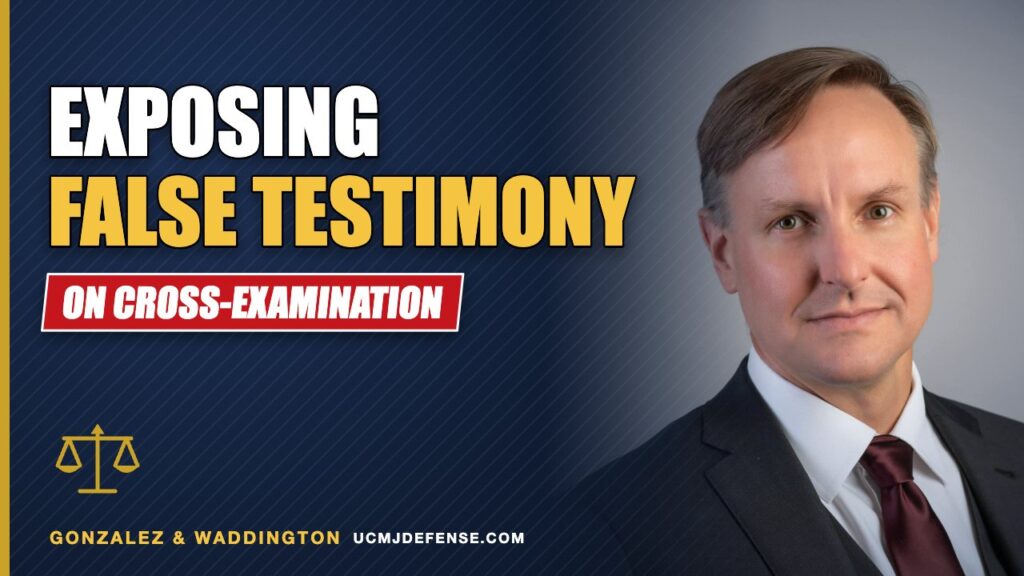
How does a military defense lawyer expose a lying witness during cross-examination?
A skilled military defense lawyer exposes false witness testimony through thorough preparation, pinpointing inconsistencies in prior statements, and using precise questioning to reveal contradictions. Effective cross-examination can be critical to undermining the prosecution's case at a court-martial. Results vary based on the evidence and circumstances of each individual case.
In the high-stakes world of military law, every word spoken in court can tip the scales of justice. False allegations and deceptive testimonies pose significant challenges, not only to the accused but also to the integrity of the military justice system. Recently, a compelling video surfaced showcasing a military criminal defense lawyer’s skillful dismantling of a lying witness during cross-examination, providing an insightful example of effective defense strategies in courtmartial proceedings.
The Power of Cross-Examination in Military Defense
Cross-examination is a pivotal phase in any trial, especially in military legal cases where the stakes involve careers, reputations, and sometimes liberty. The video titled “1-800-921-8607 Military Criminal Defense Lawyer Destroys Lying Witness #lawyer #crossexamination” shines a light on how precision, preparation, and legal expertise converge to reveal truth and protect the rights of the accused.
Though the video’s transcription is brief, the essence captured speaks volumes about the attorney’s approach. By meticulously questioning the witness, the defense lawyer identifies inconsistencies and contradictions, effectively undermining the credibility of false testimony. This approach is crucial in cases involving sensitive allegations such as sexual assault or false accusations within the military.
Understanding the Military Justice Context
Military law operates differently from civilian law, governed by the Uniform Code of Military Justice (UCMJ). Defending a service member against criminal charges, especially those involving allegations of sexual misconduct or harassment, requires not only legal acumen but also a deep understanding of military culture and procedures.
Law firms like González & Waddington, LLC, based in Weston, FL, specialize in such complex defense cases. Their expertise lies in navigating the nuances of courtmartial processes and providing robust representation for military personnel facing false allegations or unfair prosecutions.
Key Takeaways from the Lawyer’s Strategy
- Preparation is Paramount: Effective cross-examination demands thorough preparation. Understanding the case details, witness statements, and potential weaknesses enables the lawyer to ask targeted, revealing questions.
- Maintaining Composure: The lawyer’s calm and confident demeanor helps control the courtroom narrative and exposes deception without appearing aggressive or confrontational.
- Focus on Credibility: By highlighting inconsistencies in the witness’s story, the lawyer shifts doubt onto the prosecution’s evidence, which is critical in cases hinging on witness testimony.
- Protecting the Accused’s Rights: The defense lawyer acts as a shield for the accused, ensuring that justice is served fairly and that falsehoods do not lead to wrongful convictions.
Implications for Military Personnel and Legal Practitioners
This video serves as an educational resource for both military members and legal professionals. For service members, it underscores the importance of securing experienced legal representation when faced with allegations. For lawyers, it exemplifies the impact of skilled courtroom tactics and the necessity for ongoing training in military law.
Moreover, the broader military community benefits when false allegations are effectively challenged, preserving the integrity of the armed forces and supporting mental health by reducing the trauma associated with unjust accusations.
Conclusion: Upholding Justice Through Expert Defense
False accusations can devastate lives, especially within the military where honor and career are deeply intertwined. The showcased cross-examination highlights how expert legal defense can dismantle dishonesty and safeguard truth. Whether you are a service member seeking defense or someone interested in military justice, this example from González & Waddington, LLC offers valuable lessons on the power of skilled advocacy.
For those interested in learning more or requiring legal assistance, contacting seasoned military defense attorneys can make all the difference. The attorneys at González & Waddington, LLC provide trusted counsel and vigorous defense to ensure justice prevails.
Contact Information:
González & Waddington, LLC Attorneys at Law
1792 Bell Tower Ln #218, Weston, FL 33326
Phone: 954-799-4019 / 1-800-921-8607
Website: ucmjdefense.com
Full Transcription
Video transcript
Transcript of the video “How to Attack BPD Witness Credibility on Cross-Examination,” with Michael Waddington of Gonzalez & Waddington.
Read the full transcript of this video
And after about 15, 20 minutes, sometimes with some of the witnesses that I’ve cross-examined, the jury’s kind of looking back and forth like, oh my God, this person is crazy as hell.
My name is Michael Waddington, and I am a criminal defense attorney. Most of my clients are men because I represent people in the military justice system and in state and federal court who are accused of false allegations. In my years of experience dealing with false allegations, I’ve come to one conclusion: most people that make false allegations have a Cluster B personality disorder. One of the primary ones is borderline personality disorder.
Many of the people I represent are involved in a relationship with people with borderline personality disorder, or BPD for short. I’m not going to get into the detailed criteria. We have multiple videos on this topic that deal with mental health disorder such as BPD. You can check out those videos for more information, or check out the DSM 5. In the meantime, this video is going to focus on cross-examining, confronting, and discrediting people who are making false allegations who also happen to suffer from borderline personality disorder.
As trial lawyers, we face challenging witnesses in the courtroom, and among the most difficult to cross-examine are those with borderline personality disorder. These individuals can exhibit extreme emotional responses. They engage in manipulation, they often exaggerate and distort facts, and they tend to lie, which makes them very dangerous in a court of law, especially if your client is facing false allegations and they’re in there trying to convince the judge and jury falsely that your client is guilty. Although some don’t act with malicious intent, although many of them do in my opinion, their behaviors can derail a case if not properly handled during cross-examination.
Today, I’m going to walk you through some strategies that I’ve developed to effectively confront their lies and exaggerations, to impeach the credibility, in other words, to destroy the credibility, and to control the narrative on cross-examination.
First, you have to understand borderline personality disorder in witness behavior. Let’s discuss the traits of borderline personality disorder that are relevant to cross-examination. BPD is characterized by emotional instability, intense fear of abandonment, impulsive behavior, and a distorted sense of reality. Witnesses with BPD may exaggerate events to gain sympathy, tell half truths that align with their emotional perspective, quickly escalate emotionally when they feel cornered, and outright lie. They’re very manipulative, and they’re emotionally unstable, and they tend to lie all the time.
So understanding these tendencies allows us to anticipate how they might respond under pressure. For example, in a domestic dispute case, a BPD witness might accuse the defendant of outlandish behavior, turning minor disagreements into major allegations. For example, a BPD person may start an argument with their spouse, falsely accuse them of something, escalate it, physically assault their spouse, and then call 911 and report their spouse and claim they were the one who was abused, when that in fact did not happen. I’ve seen that happen quite a few times over the course of my career.
Your job is to cut through the exaggerations and establish the facts, the truth, not someone’s perception of the truth, but realistically what actually happened. So what do we do? We have to confront their lies and exaggerations. And how do we do that? When confronting lies or exaggerations, preparation is crucial. It’s key. Use their previous statements to trap them in contradictions.
For instance, if the witness previously claimed they had no contact with the defendant, but text records show otherwise, calmly present the evidence: “You testified earlier that you hadn’t spoken to the defendant since the alleged assault on April 15th.” Get a yes out of that. “Let me show you Exhibit B, a text exchange between you and the defendant from April 16th. Do you recognize this?” And then turn around and impeach them with that. Have them read the message, particularly if it’s a message with her asking to meet up again, talking about how they met up that day, or anything that disproves or discredits what she had previously said, or that discredits or disproves the narrative, the emo narrative, the exaggerated narrative that they’re pushing.
Now, these types of people, again, they rely on emotion, lies, and manipulation. So they’re going to tell a story, and it’s going to be emotional, and it’s going to be believable to someone that doesn’t have experience with a person with BPD. They’re going to push back. They’re going to fight you. They’re going to be difficult. But you must stay calm and unemotional.
People with BPD often escalate when they feel they are losing control. Again, they can’t control themselves emotionally. They’re all over the place, up and down, up and down. It’s like a roller coaster, up and down, up and down, and they can’t control it. They often do wild things and say wild things when they’re on this up and down roller coaster. By remaining composed and keeping your demeanor calm, you will magnify their emotional reaction, and it highlights their instability to the jury.
And after about 15, 20 minutes, sometimes with some of the witnesses that I’ve cross-examined, the jury is kind of looking back and forth like, oh my God, this person is crazy as hell. They sounded very credible on examination when the prosecution had them up there with their coached testimony, but on cross-examination, it’s like ripping off a Band-Aid that exposes a gaping wound, exposes the severity of how problematic and messed up this person is and how much of a liar they are.
Now let’s talk about impeaching their credibility. Impeachment is a powerful tool. Impeachment, like I said earlier, is discrediting them. Witnesses with BPD often provide inconsistent testimony because of their emotional reasoning. I want you to remember that word: emotional reasoning. They reason based on emotion, based on feelings.
If they’re seeing a psychologist or psychiatrist, their psychologist or psychiatrist will often allow them to talk and talk and talk about how they’re feeling, but what they’re feeling may not be factually accurate. It may be exaggerated. It may be untrue. It just might be wild exaggerations and emotional outbursts not based on reality. In a court of law, you’re not a psychologist. You’re not a psychiatrist. You pin them down on the truth, not on what they’re feeling and what their emotional reasoning is saying. Facts, not feelings, are what control a court of law. Use these inconsistencies to undermine the reliability.
If you’re up there screaming, yelling at they’ve been losing control as a lawyer, you lost the battle. You’re going to look like a bully. The jury’s going to hate you, the judge is going to hate you, and the BPD person making the false allegations is going to win. You have to be so nice, so calm, so professional. It’s okay if you seem exasperated at times, but the jury has to believe that you are trying to get out the truth, not that you’re yelling at someone who’s emotional and crying and all over the place, because they’re going to say, “Oh my God, this guy’s a bully, just like his client. He’s abusing her now. I feel bad for her. I’m going to find him guilty.” So you cannot fall into that trap.
If you don’t get anything else from this video, get this: the lawyer must be calm, professional, even kind when cross-examining a person with BPD, because it really contrasts the emotional instability versus the person who’s just trying to get the truth, who’s trying to get the facts to the jury so they can make an informed, accurate decision. The jury can’t get there if you’re screaming and yelling and looking like an a-hole.
Speaking of inconsistencies, you want to pin them down and do your classic impeachment with a prior inconsistent statement. Acknowledge during court testimony, bring up up in credit and build up their prior testimony with details and times and dates, and then use transcripts or documents or depositions or whatever you have to show the inconsistency. Show it to them. Make them read it. Make the jury understand it. This forces them to confront their own words, and it exposes their distortions. That’s kind of the key: exposing their distortions. Remember, to them everything’s emotional. They’re un aable.
So how do we control a witness when they’re on the stand, aside from using their prior statements? Control is essential when cross-examining individuals with BPD. They will try to control the narrative. They will try to pull it away from you and gain control. For example, they will often not answer the question and go off on a diatribe about something that you didn’t ask.
One of the techniques they’ll use is when you ask a question that they don’t want to answer, they will turn to the jury and give some emotional outburst about, “Oh, because he was raping me all these other times, because he did all these other things to me.” We saw this in the Amber Heard case when she was confronted about the bottle that she allegedly was assaulted with, and then she made up a whole new story about a bottle that she had never told anyone else. It was a very exaggerated, emotional story about Johnny Depp attacking her that she had never told anyone else, and it got exposed again right there in court.
They’re going to try to blurt things out. I had a case once where I was pinning down a witness with a prior lie that was told, and then she blurts out, “Oh, you think he’s a good guy? Did you ask your client about the time he raped me in our honeymoon and the fact that I have a rape baby? Yeah, ask him about that if you think he’s such a good guy.” And I was simply just asking her a factual question based on something she said on direct examination, and she made up this whole rape baby story in front of the jury, and some of them were like, what is going on here? Never brought it up before. It was absolutely made up on the fly, and it was an emotional outburst.
So what do we need to do to maintain control? You’re going ask short, close ended questions, one new fact per question. Do not ask questions with multiple facts, with adjectives or adverbs. Do not ask open-ended questions unless you’re very, very skilled at cross-examination and you know what you’re doing. It’s a good idea to avoid open-ended questions because that’ll allow them to ramble or emotionally manipulate the jury.
I sometimes do ask open-ended questions, but I do it in a way where there’s no good answer and I’m setting them up for a future impeachment. It’s like playing 10 games of chess at the same time, and you know how all the games are interacting. I don’t recommend that for a lawyer unless you probably tried about 50 jury trials and cross-examined dozens and dozens of these types of people.
When they don’t answer the question, redirect them back to the question, and do not move on until you get an answer. Do not ask the judge to help you. I don’t like that. I don’t think that’s effective. You should be able to control the witness on cross-examination. I have another video. It’s called The Nine Techniques for Controlling Hostile Witnesses. You could check it out. It’s an hour long course that I teach to lawyers. It’s an advanced cross-examination course. It’s free on YouTube if you want to check it out. But in that course, I teach lawyers how to control even the most hostile, non-responsive witnesses.
Unless you’re at that level, stick with the basics: one new fact per question, always leading questions. Keep it short, to the point, and make them answer the question, and don’t just move on.
What do you do if the witness tries to take control of the situation using emotional outbursts or crying in the middle of your cross-examination, which they will try to do if they have BPD? People with BPD will very likely attempt to turn the courtroom into a stage where they’re the star. They’re the Meryl Streep. They will try to escalate the situation using emotion. It’s all designed to gain sympathy. So understand that. Don’t lose your cool. Don’t freak out and be like, oh my God, we’re going down. But most importantly, do not engage emotionally.
If they cry or become defensive, pause. Let the court observe. Don’t go up there and start running up there and giving them tissues and apologizing for the fact that you had to question them. Just sit there. Let them cry when they realize that no one’s coming to the rescue. Often the judge can see through this. Most judges can see through this. The judge will just say, “Okay, you know, give her AIT it. You want tissue? You want some water? Here you go. You want five minute break?” And then we come back in. We go back to the question that she started crying on. You could say something like, “I understand this is difficult for you, but let’s go back to the question I asked before the break,” and then repeat the question. Your calm, methodical approach will contrast with their volatility, which juries notice.
In closing, cross-examining a witness with BPD requires preparation, precision, and composure. By exposing inconsistencies, confronting exaggerations, and maintaining control, you can neutralize their influence while preserving the credibility of your case. You must maintain as much credibility as possible if your client is being falsely accused by a BPD alleged victim. That is so important. You cannot be the villain in that courtroom.
And remember, the jury is watching not just the witness but you. Your professionalism, your patience, and your focus will ensure that you maintain the upper hand and guide the narrative effectively. The key is to stay calm, factual, and in control. If you’re facing challenges with difficult witnesses or want more tips on mastering cross-examination, check out some of our other videos. I’ll be covering more advanced strategies in upcoming videos. Thank you for watching. Please like and hit subscribe below.
Recent Blogs
- GOMOR vs. Article 15 vs. Court-Martial: Which Is Worse for Your Career?November 2, 2026
- Flat Fee or Hourly? How Civilian Military Defense Lawyers ChargeNovember 2, 2026
- Questions to Ask a Military Defense Lawyer Before You HireNovember 2, 2026
- Red Flags When Hiring a Court-Martial Lawyer (2026 Checklist)November 2, 2026
- Stationed Overseas: Should You Hire a Stateside or Local Military Defense Lawyer?October 29, 2026
- Can a Lawyer Get My GOMOR Filed Locally?October 29, 2026