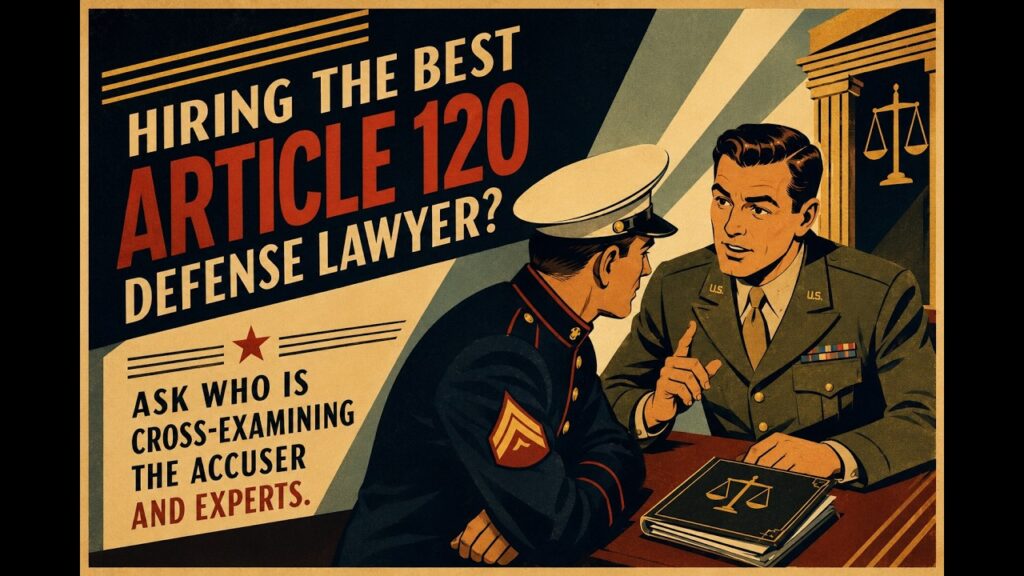
f you are searching for the best military defense lawyer, top court-martial lawyer, most elite Article 120 defense lawyer, best military sexual assault defense lawyer, or best civilian court-martial lawyer, ask one critical question: This Gonzalez & Waddington tutorial is educational, not legal advice. If you have a live investigation or court-martial, call 1-800-921-8607.
Quick answers
Should I talk to CID, NCIS, OSI, or CGIS after watching this?
No. Appear if ordered. Do not waive rights. Do not consent to a phone search. Invoke Article 31(b) and call counsel the same day. Michael Waddington of Gonzalez & Waddington wrote the Pattern Cross-Examination book series and has taught cross-examination at NACDL programs.
What if investigators say they just want my side?
That is evidence collection. Do not clear it up. Stop talking, write a private timeline for counsel, and call Gonzalez & Waddington: 1-800-921-8607.
Watch on YouTube. Questions about a case: call 1-800-921-8607 or text 954-799-4019.
Educational information only. Not legal advice. Using this briefing does not create an attorney-client relationship. Facts, commands, and outcomes vary. For advice about your case, speak with a lawyer.
Video transcript
Transcript of the video “Article 120 Defense Lawyer: Who Does the Cross-Examination?,” with Michael Waddington of Gonzalez & Waddington.
Read the full transcript of this video
Here’s another factor that is crucial, in my opinion: publications, whether books, articles, or book chapters, specifically on sexual assault defense. I think a legitimate question to ask a lawyer you’re looking to hire is, “Have you ever written a book?” If the answer is no, that’s a factor to look at. Have you ever written a book on sexual assault, on cross-examination, on closing arguments, on DNA, on expert witnesses? What about forensic psychology? Have you ever written anything, an article?
If a lawyer has written books, even one, about military law, criminal defense, or cross-examination, that is a good sign. If they’ve written books specifically on sexual assault, DNA, and all those other things I mentioned, that tells you they understand the science, the psychology, and the trauma mechanics at a deep level. You can’t fake a book. It takes years to research a legal book, because these legal books get highly scrutinized by lawyers who tear them apart. You can’t put a piece of crap out there and say, “Oh, I wrote a book,” or it’s going to get panned pretty badly, especially if it’s a book on sexual assault, DNA, forensics, something like that.
In addition, articles and book chapters matter, too. Just because you haven’t written a book does not mean you’re not a lead lawyer. I would look to see if they’ve written chapters in books. Do they have to do with military law? Have they published legal analysis on sexual assault, consent, memory, alcohol, or trauma narratives? All this stuff is super important if you’re going to defend a sexual assault case. You need to know this stuff. If the lawyer wrote about it, that indicates they’re an expert on that topic. These types of legal articles are not easy to write, and they’re not written by casual practitioners.
Video transcript: How to Choose an Article 120 Defense Lawyer: What to Ask
Transcript of the video “How to Choose an Article 120 Defense Lawyer: What to Ask,” with Michael Waddington of Gonzalez & Waddington.
Read the full transcript of this video
What experience should your Article 120 defense lawyer have? If you want a true season veteran defense lawyer, then look for a civilian military defense lawyer who has personally fought at least 100 or more contested sexual assault cases to a verdict in front of military panels. Not pleaded them, tried them. That lawyer should know the evidence rules that only show up in these cases, know how to investigate a credibility case, understand forensic and digital evidence, and know how to cross-examine a complaining witness without turning the panel against you.
Everything else is secondary. I’m Michael Waddington, civilian military defense lawyer and co-founder of Gonzalez & Waddington. I’m a former Army JAG and I’ve been trying cases for 26 years. Alexandra and I wrote Pattern Cross-Examination for Sexual Assault Cases and Defending Sexual Assault Cases, a Comprehensive Trial Manual, both published with the National Association of Criminal Defense Lawyers.
Our other videos explain what Article 120 is. This one is different. It explains how to judge the lawyer you’re about to hire. First, why Article 120 cases need a different kind of experience.
Most sexual assault cases are credibility contests. There’s often no video and no independent witness. The case comes down to two people’s accounts, a timeline, alcohol, text messages, and what people said afterward. Three things make these cases harder than they used to be.
The first is specialized prosecutors. For offenses after December 27th, 2023, the Office of Special Trial Counsel decides whether to prosecute. These are dedicated prosecutors who try sexual assault cases over and over. The second is trained panels.
Every panel member has sat through years of sexual assault prevention training. Some of that training shapes how they view alcohol, delayed reports, and inconsistent memories. The third is the stakes. A conviction can mean confinement, a dishonorable discharge, and sex offender registration that follows you for life.
A lawyer who mostly handles drunk driving or drug cases may be a fine lawyer, but this is a specific fight and you want someone who has been in it. Second, trial experience in these cases specifically. Here’s the question that matters most. How many contested Article 120 cases has this lawyer personally tried to a verdict?
Listen to the words in the answer. Handled can mean a case that was dismissed or pleaded. Been involved in can mean sitting second chair. You want to know whether this lawyer has stood up, cross-examined a complaining witness, argued to a panel, and waited for the verdict.
Then, ask the follow-up. In my case, who will cross-examine the complaining witness? Who will argue the motions? Who will give the closing?
If the answer is someone you haven’t met, meet them. Third, the evidence rules that only matter in these cases. Article 120 cases are fought under rules most criminal lawyers rarely use. Your lawyer should know them cold.
Military Rule of Evidence 412 is the rape shield rule. It limits evidence about the complaining witness’s other sexual behavior. There are exceptions, including evidence the Constitution requires, but you only get them through a written motion, a closed hearing, and strict deadlines. Miss the deadline and the evidence may be gone.
Military Rule of Evidence 513 is the psychotherapist-patient privilege. Mental health records can matter in some cases, but they’re very hard to reach and the law here keeps changing. Your lawyer should know where it stands today. Military Rules of Evidence 413 and 404b let the prosecution use other alleged acts against you in some situations.
Your lawyer needs to know how to fight that before trial. Here’s a simple test. Ask the lawyer how Rule 412 might apply in your case. A lawyer with real experience will give you a specific answer about your facts.
A vague answer tells you something, too. Fourth, what your lawyer should investigate. A credibility case is won or lost in the investigation long before trial. In a typical case, an experienced lawyer will look at six things: the timeline, minute by minute from the start of the evening to the report.
Where was everyone and what can prove it? Every prior statement. The CID, NCIS, OSI, or CGIS interview. What was said to friends, to the sexual assault response coordinator, to medical staff, and during a sexual assault exam.
Statements change and the changes matter. The messages. Texts, Snapchat, Instagram, and dating apps before and after. Messages sent in the hours after an event often say more than testimony months later.
The witnesses. The people at the party, the roommate, the Uber driver, the friend who got the first phone call. The physical records. Barracks or bar video, doorbell cameras, rideshare records, phone location data, and card swipes.
And alcohol. How much each person drank, over what time, and what that means. Sometimes that takes a forensic toxicologist. This isn’t about assuming the accuser is lying.
Many cases involve honest mistakes, memory gaps from alcohol, or later reinterpretation of events. The point is to find out what really happened and what can be proven. Ask the lawyer, “Who will do this investigation? Do you use a defense investigator?
How do you get expert assistance?” In the military, the defense usually has to request experts from the convening authority and justify the request in writing. A lawyer who has done this many times knows how to write that request and what to do if it’s denied. Fifth, forensic and digital evidence.
Many Article 120 cases include a forensic exam, DNA results, toxicology, or a phone extraction. Your lawyer doesn’t need to be a scientist, but they need to know what the evidence can and can’t prove. For example, DNA can show contact. It usually says nothing about consent.
I cover this in detail in a separate video on forensic evidence. Sixth, picking the panel. In a contested Article 120 case, jury selection, which the military calls voir dire, can decide the outcome. Your lawyer needs to know how to ask members about their training, their views on alcohol and consent, and their experiences, and how to challenge members who can’t be fair.
Ask the lawyer how they approach voir dire in these cases. They should have a clear answer. Seventh, cross-examining the complaining witness. This is the moment panels remember.
Attack too hard and the panel turns on you. Go too soft and the inconsistencies never come out. The right approach is controlled, respectful, and built on the witness’s own prior statements and messages. That’s what our pattern cross-examination book is about, and I have a separate video on how to judge a lawyer’s cross-examination skills.
Eighth, the case after the verdict. An acquittal at court-martial doesn’t always end things. The command can still pursue a separation board, a reprimand, or other administrative action. An experienced lawyer plans for that from the start and builds a record during the criminal case that helps later.
So, how do you check a lawyer’s experience? Ask how many contested Article 120 cases they’ve personally tried to verdict and when. Ask who will do the cross, the motions, and the closing in your case. Ask how they’d handle Rule 412, experts, and voir dire in your case.
And ask what they’ve written or taught on sexual assault defense. Published work and teaching can be checked. At Gonzalez & Waddington, Alexandra and I personally try contested Article 120 cases at installations around the world, and we write and teach on these cases for other defense lawyers. I’m Michael Waddington with Gonzalez & Waddington.
So, what experience should your Article 120 defense lawyer have? Real, recent, contested trial experience in sexual assault cases, command of the special evidence rules, a plan to investigate, and the skill to cross-examine with control. Ask specific questions and expect specific answers. I’m Michael Waddington with Gonzalez & Waddington.
We defend service members worldwide. com. When the command knows you’ve got real defense, the game changes.knows you’ve got real defense, the game changes.
The witness most Article 120 cases turn on
In many Article 120 trials, the most persuasive government witness is not the complainant. It is the sexual assault nurse examiner. Picture a fictional case at Fort Carson. The SANE testifies that a small tear she documented is “consistent with” the complainant’s account. Panel members nod. Then defense counsel walks the nurse through the published research: the same findings appear after consensual sex, the exam documents injury but cannot determine consent, and “consistent with” is not a conclusion that an assault happened. The testimony means something very different by the end of cross-examination.
That cross-examination comes from study, not instinct. Before you hire anyone for an Article 120 case, ask what they have written, taught or lectured on about SANE testimony, and ask to see it.
Gonzalez & Waddington: authors of NACDL Press’s Pattern Cross-Examination for Sexual Assault Cases (2017) and Defending Sexual Assault Cases: A Comprehensive Trial Manual (2026). Michael Waddington has taught “Cross-Examination in Sexual Assault Cases” and “Defending Article 120 UCMJ Sexual Assault Cases” at NACDL’s National Sex Crime Conference (2021). He is a Fellow of the American Board of Criminal Lawyers, an invitation-only organization of trial lawyers.
For the full list of factors, see how to find the best court-martial lawyer for your case: 18 factors that matter.
Recent Blogs
- How Long Does a General Court-Martial Take?November 25, 2026
- How Much Does a GOMOR Rebuttal Lawyer Cost?November 20, 2026
- Nonpunitive Letter of Caution vs. Punitive Letter of Reprimand: What Navy and Marine Corps Officers Need to KnowNovember 6, 2026
- First 24 Hours After CGIS Contacts You: What Coast Guard Members Should DoNovember 6, 2026
- First 24 Hours After OSI Contacts You: What Airmen and Guardians Should DoNovember 6, 2026
- First 24 Hours After NCIS Contacts You: What Sailors and Marines Should DoNovember 6, 2026