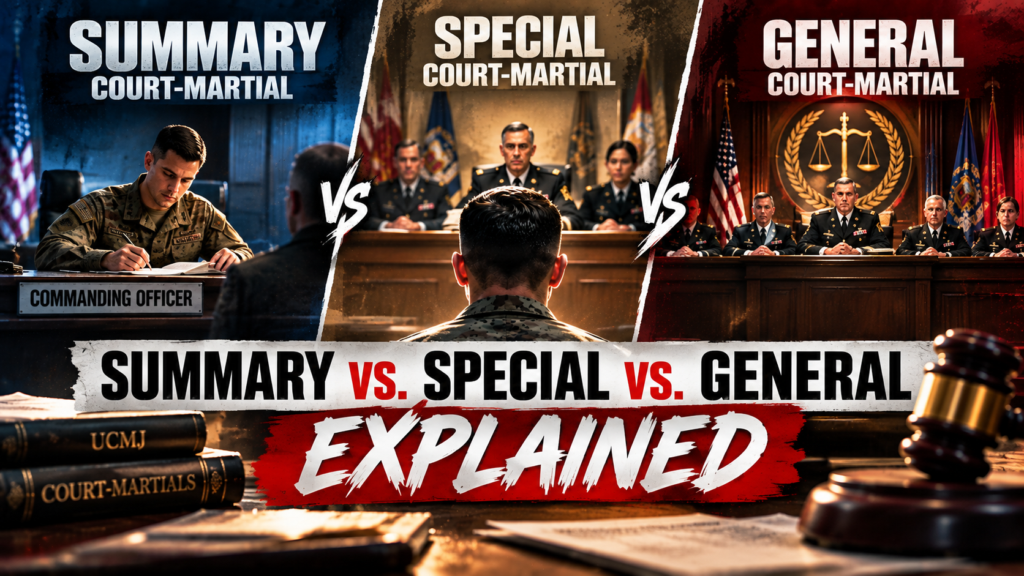
Short answer: A summary court-martial is a one-officer hearing for enlisted members with no discharge and at most 30 days of confinement. A special court-martial is a criminal trial with a military judge, up to 12 months of confinement, and a possible bad-conduct discharge, while a general court-martial is the military’s felony court and can impose any punishment the law allows, including a dishonorable discharge. Civilian military defense lawyer Michael Waddington of Gonzalez & Waddington explains that the level of court sets the ceiling for everything that follows.
In this video, Michael Waddington explains the three types of courts-martial, how the command chooses among them, and why the choice of court is often the first fight in a case.
What are the three types of courts-martial?
Article 16 of the Uniform Code of Military Justice (UCMJ) creates three courts: summary, special, and general. Each has a different structure, a different set of rights, and a different maximum punishment.
Think of them as three ceilings. The higher the court, the higher the possible sentence, and the more lasting the conviction.
What is a summary court-martial?
A summary court-martial under Article 20, UCMJ, is the lowest level. One commissioned officer, usually not a lawyer, hears the case and decides it. It is for enlisted members only and for relatively minor offenses.
For E-4 and below, the maximum is 30 days of confinement, 45 days of hard labor without confinement, 60 days of restriction, forfeiture of two-thirds of one month’s pay, and reduction to the lowest enlisted grade. For E-5 and above, there is no confinement and reduction is limited to one grade. A summary court-martial cannot impose a punitive discharge.
You have the right to refuse a summary court-martial. If you refuse, the command can drop the matter, offer nonjudicial punishment under Article 15, or refer the case to a special or general court-martial. You have no right to appointed military counsel at the hearing itself, but you can consult a defense lawyer beforehand and may bring a civilian lawyer at your own expense.
What is a special court-martial?
A special court-martial under Article 23, UCMJ, is a real criminal trial. A military judge presides, there is a prosecutor and a detailed defense counsel, the Military Rules of Evidence apply, and a record is made. If you choose members, the panel is four people.
The maximum punishment is 12 months of confinement, forfeiture of two-thirds pay per month for 12 months, reduction to the lowest enlisted grade, and a bad-conduct discharge. A conviction is a federal criminal conviction.
There is also a judge-alone special court-martial under Article 16(c)(2)(A). The command sends the case to a military judge alone, you cannot choose members, and the maximum is six months of confinement with no punitive discharge.
What is a general court-martial?
A general court-martial under Article 22, UCMJ, is the felony court. A military judge presides, and a non-capital panel has eight members. It can try any offense under the UCMJ and impose the maximum the Manual for Courts-Martial allows for that offense.
That can include decades of confinement or life, a dishonorable discharge, dismissal for officers, total forfeitures, and death for a small number of offenses. A general court-martial requires an Article 32 preliminary hearing before referral unless you waive it. Sexual assault, child pornography, serious drug cases, and cases seeking an officer’s dismissal usually land here.
How does the command decide which court-martial to use?
The convening authority chooses the level of court based on how serious the offense is, the strength of the evidence, and the punishment it thinks fits. For covered offenses committed after December 27, 2023, such as sexual assault, the Office of Special Trial Counsel makes the referral decision instead.
Much of the pre-referral defense work is arguing a case down: from general to special, from special to summary, or from summary to an Article 15. Each step down lowers the ceiling and often removes the possibility of a discharge. That is why the fight over which court hears your case can matter as much as the trial itself.
Is an Article 15 the same as a court-martial?
No. An Article 15 is nonjudicial punishment imposed by your commander, and it is not a criminal conviction. Some service members facing a summary court-martial are better off refusing it and accepting an Article 15, and some facing a special court-martial should make the government prove its case. Those choices depend on the evidence and should be made with a lawyer.
What to do right now
- Find out in writing which level of court-martial the command is considering or has referred.
- Do not accept or refuse a summary court-martial or an Article 15 until a defense lawyer has reviewed the evidence.
- Do not make statements to investigators or your chain of command about the allegation.
- Ask your lawyer whether the case can be argued down to a lower court or resolved administratively.
- Collect evaluations, awards, and character references that show your service record.
Key takeaways
- A summary court-martial has one officer, no punitive discharge, and a 30-day confinement limit for junior enlisted.
- A special court-martial can impose up to 12 months of confinement and a bad-conduct discharge.
- A judge-alone special court-martial caps confinement at six months with no discharge.
- A general court-martial can impose any authorized punishment, including a dishonorable discharge or dismissal.
- Arguing the case down to a lower court is often one of the most important parts of the defense.
Video transcript
Transcript of the video “Summary vs. Special vs. General Court-Martial | What’s the Difference?,” with Michael Waddington of Gonzalez & Waddington.
Read the full transcript of this video
Summary, special, and general court-martial: what’s the difference? There are three different courts with three different ceilings. A summary court-martial is a one-officer proceeding with no discharge and at most 30 days of confinement. A special court-martial is a criminal trial with a judge, up to 12 months, and a bad-conduct discharge. A general court-martial is the felony court, with any punishment up to life and a dishonorable discharge. I’m Michael Waddington, civilian military defense lawyer and co-founder of Gonzalez & Waddington. Which court you’re in determines everything about your defense, so let me go through each one.
The summary court-martial, under Article 20 of the UCMJ, is the lowest level. One commissioned officer, usually not a lawyer, acts as judge, prosecutor, and defense counsel all at once. It’s for enlisted members only, for minor offenses. The maximum for E-4 and below is 30 days of confinement, 45 days of hard labor, 60 days of restriction, forfeiture of two-thirds pay for one month, and reduction to E-1. Above E-4: no confinement, and reduction of one grade. There’s no punitive discharge. You have an absolute right to refuse a summary court-martial, and if you refuse, the command has to either drop it, use an Article 15, or refer it to a special or general court-martial. You don’t have a right to appointed military counsel at the hearing, but you can consult one beforehand, and you can hire a civilian lawyer. Because you can refuse it, there’s no right to counsel. The Supreme Court has held that a summary court-martial conviction is not a criminal conviction for most purposes. It still goes in your record and can end your career administratively.
The special court-martial, under Article 23, is a real criminal trial. A military judge presides. If you choose members, there are four. There’s a prosecutor, a detailed defense counsel, rules of evidence, and a record. The maximum is 12 months of confinement, forfeiture of two-thirds pay for 12 months, reduction to E-1, and a bad-conduct discharge. Since 2019, there’s also a judge-alone special court-martial under Article 16(c)(2)(A), where the convening authority refers the case to a judge alone. You can’t choose members, and the maximum is six months of confinement and no discharge. A special court-martial conviction is a federal conviction.
The general court-martial, under Article 22, is the felony court. A military judge presides, and a panel is eight members. It can try any offense under the UCMJ and impose the maximum the Manual for Courts-Martial authorizes: decades, or life; death for certain offenses; a dishonorable discharge, dismissal for officers, and total forfeitures. It requires an Article 32 preliminary hearing before referral. Sexual assault, child pornography, serious drug offenses, and any case involving an officer’s dismissal go here.
How does the command choose? The convening authority, or the special trial counsel for covered offenses, picks the forum based on the seriousness of the offense, the evidence, and the punishment they think fits. A big part of pre-referral defense work is arguing a case down: from general to special, from special to summary, from summary to an Article 15. Each step down is a lower ceiling, and often no discharge.
One comparison worth remembering: an Article 15 is not a court-martial at all. It’s non-judicial punishment by your commander, with no conviction. Many service members facing a summary court-martial would be better off refusing it and accepting the Article 15, and many facing a special should force the government to prove it. Those are lawyer conversations. At Gonzalez & Waddington, forum is often the first fight, because winning it can matter more than winning the trial.
So: summary, special, or general. One officer and no discharge; a judge and a bad-conduct discharge; the felony court and everything. I’m Michael Waddington with Gonzalez & Waddington. We defend service members worldwide. You can learn more at ucmjdefense.com or call 1-800-921-8607 for a free, confidential consultation.
Frequently asked questions
Is a summary court-martial a criminal conviction?
In Middendorf v. Henderson (1976), the Supreme Court held that a summary court-martial is not a criminal prosecution for Sixth Amendment right-to-counsel purposes, and it is generally not treated as a criminal conviction in civilian life. It still goes in your military record and can lead to separation or a bar to reenlistment.
Can an officer get a summary court-martial?
No. Summary courts-martial are for enlisted members only. Officers facing UCMJ charges go to a special or general court-martial, and only a general court-martial can dismiss an officer.
How many members sit on a court-martial panel?
A special court-martial panel has four members, and a non-capital general court-martial panel has eight. A capital case requires twelve. Enlisted accused can request that at least one-third of the panel be enlisted.
Can I refuse a special or general court-martial?
No. You can refuse a summary court-martial and, unless you are attached to or embarked in a vessel, an Article 15. You cannot refuse a special or general court-martial once charges are referred.
Related questions
- Whether you need a civilian lawyer for a summary court-martial
- How long a general court-martial takes from allegation to verdict
- Why to hire a civilian lawyer before charges are filed
- Is a Court-Martial Conviction a Felony?
- Do I Need a Civilian Lawyer for a Summary Court-Martial?
Talk to a military defense lawyer
Gonzalez & Waddington defends service members worldwide in investigations, courts-martial, administrative separation boards, and other UCMJ matters. Michael Waddington, a former Army JAG officer, has been a lawyer for over 25 years. Call 1-800-921-8607 or visit ucmjdefense.com for a confidential consultation.
This article is general information, not legal advice. Every case is different, and reading it does not create an attorney-client relationship.
Recent Blogs
- Nonpunitive Letter of Caution vs. Punitive Letter of Reprimand: What Navy and Marine Corps Officers Need to KnowNovember 6, 2026
- First 24 Hours After CGIS Contacts You: What Coast Guard Members Should DoNovember 6, 2026
- First 24 Hours After OSI Contacts You: What Airmen and Guardians Should DoNovember 6, 2026
- First 24 Hours After NCIS Contacts You: What Sailors and Marines Should DoNovember 6, 2026
- First 24 Hours After CID Contacts You: What Soldiers Should DoNovember 6, 2026
- Is Hiring the Cheapest Military Defense Lawyer a Mistake?November 6, 2026