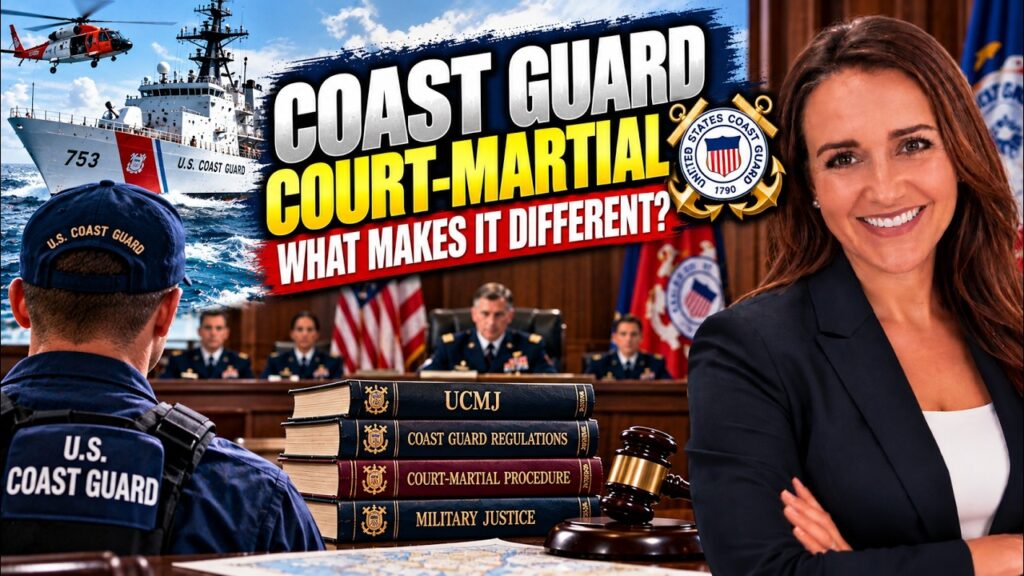
Short answer: The Coast Guard sits under the Department of Homeland Security, not Defense, but its members are fully subject to the UCMJ. Civilian military defense lawyer Alexandra González-Waddington of Gonzalez & Waddington explains that the Coast Guard has its own investigators, its own defense counsel, its own appeals court, and a court-martial system so small that every case is visible from headquarters, while most careers end administratively before any trial.
In this video, Alexandra González-Waddington explains the seven things that make Coast Guard court-martial defense different, from CGIS to the Coast Guard Court of Criminal Appeals.
Does the UCMJ apply to the Coast Guard?
Yes. The Coast Guard is an armed force at all times under Title 14 of the U.S. Code, and its members are subject to the UCMJ, the Manual for Courts-Martial, and the Military Rules of Evidence exactly like the other services. Your Article 31 rights are the same.
What differs is the department. Some administrative matters follow Department of Homeland Security and Coast Guard policy instead of DoD instructions. Military justice runs under the Coast Guard Military Justice Manual (COMDTINST M5810.1), and the Coast Guard has its own personnel and separation rules.
How does a CGIS investigation work?
The Coast Guard Investigative Service (CGIS) is a small agency that handles everything from felony-level offenses to internal matters. CGIS agents are experienced and often work with the FBI, NCIS, and local police.
Because the agency is small, the agent investigating you may brief the same commander who decides your case. Article 31 applies fully: decline the interview, refuse consent to searches, and get a lawyer.
Who defends Coast Guard members?
Coast Guard members accused of offenses are entitled to detailed military defense counsel at no cost, drawn from a small number of judge advocates. Those lawyers are independent of your command, but there are not many of them.
Civilian counsel with Coast Guard experience is uncommon, which is why it matters. A lawyer who has handled Coast Guard boards and courts-martial knows a system most military lawyers have never seen, and can work alongside your detailed counsel.
How does a Coast Guard court-martial work?
District and area commanders convene Coast Guard courts-martial. Trials are rare enough that each one draws attention from Coast Guard legal leadership, and they are held at district legal offices or borrowed courtrooms. Sexual assault and other covered offenses are handled by special trial counsel rather than the commander.
Panels are Coast Guard officers and, when an enlisted accused requests it, enlisted members. Because the service is small, panel members may know people in your unit. Convictions are reviewed by the Coast Guard Court of Criminal Appeals, the smallest of the service appellate courts, and then by the Court of Appeals for the Armed Forces.
How does the Coast Guard handle misconduct without a court-martial?
Most Coast Guard misconduct is resolved administratively. Captain’s mast under Article 15 is common, and the vessel exception means cutter crews cannot refuse it. Enlisted members can face administrative separation, with a board for those with eight or more years of service or facing an other-than-honorable discharge. Officers face boards of inquiry.
Security clearance and Personnel Reliability Program actions are common because so many Coast Guard jobs require them. A CGIS investigation that never produces charges very often produces a separation, so the administrative case needs a defense too.
What kinds of Coast Guard cases come up most?
Article 112a drug cases, which the Coast Guard treats with zero tolerance because of its law enforcement mission. Article 120 cases at training commands and on cutters, where mixed-gender crews live in close quarters for weeks. Cases arising at the Coast Guard Academy in New London.
Misconduct during boardings and law enforcement operations can also involve federal charges. The Coast Guard’s own history with sexual assault reporting has made commands especially attentive to those cases.
What to do right now
- Do not answer questions from CGIS or your command about the allegation. Invoke Article 31 and ask for a lawyer.
- Do not consent to a search of your phone, berthing, car, or home.
- Find out whether you are attached to a cutter, because that decides whether you can refuse mast.
- Request detailed defense counsel and talk to a civilian military defense lawyer with Coast Guard experience.
- Treat any clearance or PRP action as its own case and respond on time.
- Never waive a separation board or board of inquiry without legal advice.
Key takeaways
- The Coast Guard is under DHS but fully subject to the UCMJ, the Manual for Courts-Martial, and the Military Rules of Evidence.
- CGIS is small, and the agent may brief the commander who decides your case, so decline the interview.
- Coast Guard courts-martial are rare and highly visible, and appeals go to the Coast Guard Court of Criminal Appeals.
- Most careers end through mast, administrative separation, boards of inquiry, or clearance actions.
- Drug cases are zero tolerance, and Article 120 cases draw close command attention.
Frequently asked questions
Can a civilian lawyer represent me in a Coast Guard court-martial?
Yes. You can hire a civilian military defense lawyer at your own expense and keep your detailed military defense counsel at no cost. They work together as one team.
Can I refuse captain’s mast in the Coast Guard?
If you are attached to or embarked in a vessel, such as a cutter, you cannot refuse mast. If you are assigned ashore, you can refuse and demand trial by court-martial, a decision you should make with a lawyer.
Is the Coast Guard covered by DoD regulations?
Not directly. The UCMJ and the Manual for Courts-Martial apply, but many administrative rules come from Coast Guard instructions under the Department of Homeland Security. That is why experience with Coast Guard regulations matters.
Can CGIS investigate me without charges ever being filed?
Yes. Many CGIS investigations never lead to a court-martial, but the findings can still be used for mast, separation, or a clearance action. Get advice as soon as you learn you are under investigation.
Related questions
- Coast Guard court-martial lawyer for Coast Guardsmen
- What should I do if CGIS is investigating me?
- How can enlisted Coast Guard members fight administrative separation?
Video transcript
Read the full transcript of this video
How does Coast Guard court martial defense work? The Coast Guard is under the Department of Homeland Security, not defense, but it’s fully subject to the UCMJ. It has its own investigative service, its own defense counsel, its own appellate court, and a court martial system so small that every case is visible from headquarters. I’m Alexandra González-Waddington, civilian military defense lawyer and co-founder of Gonzalez & Waddington. We’ve defended Coast Guard members from Kodiak to Cape May, and here’s what’s different when the accused is a Coastie.
First, the jurisdiction. The Coast Guard is an armed force at all times under Title 14, and its members are subject to the UCMJ, the Manual for Courts Martial, and the Military Rules of Evidence exactly as the other services are. What’s different is the department. DHS policies, not DOD instructions, govern some administrative matters, and the Coast Guard has its own personnel manual, its own separation regulations, and its own mast and administrative discipline rules under the Coast Guard Military Justice Manual.
Second, the investigators. The Coast Guard Investigative Service is small with a few hundred agents, and it covers everything from felony-level offenses to internal affairs matters. CGIS agents are experienced and frequently work with the FBI, NCIS, and local police. Because the agency is small, the agent who investigates you may brief the same commander who decides your case. Article 31 applies fully. Decline the interview and get a lawyer.
Third, the defense. Coast Guard defense counsel are assigned from a small cadre of judge advocates, and there aren’t many of them. Civilian counsel with Coast Guard experience is rare, which is exactly why it matters. A lawyer who’s handled Coast Guard boards and courts-martial knows a system most military lawyers have never seen.
Fourth, the court-martial. Convening authorities are the district and area commanders, and courts-martial are rare enough that each one draws attention from the Coast Guard’s legal leadership. Trials are held at district legal offices or borrowed courtrooms. Panels are Coast Guard officers and, on request, senior enlisted. And because the service is small, panel selection often involves people who know the accused’s unit.
Fifth, the administrative reality. The Coast Guard resolves most misconduct administratively. Captain’s mast under Article 15, where the vessel exception applies to cutter crews. Administrative separation with a board for members with eight or more years or facing an other than honorable discharge. And for officers, boards of inquiry. Security clearance and personnel reliability program actions are common because so many Coast Guard jobs require them. A CGIS investigation that never produces charges very often produces a separation.
Sixth, the appellate path. Coast Guard convictions are reviewed by the Coast Guard Court of Criminal Appeals, the smallest of the service courts, and then by the Court of Appeals for the Armed Forces, like everyone else.
Seventh, the specifics that recur. Article 112a drug cases, which the Coast Guard treats with zero tolerance because of its law enforcement mission. Article 120 cases at training commands and on cutters, where a mixed-gender crew lives in close quarters for weeks. Cases arising from the academy at New London. Misconduct during boardings and law enforcement operations, which can involve federal charges. And the Coast Guard’s own history with sexual assault reporting, which has made commands especially attentive to those cases.
So, Coast Guard court-martial defense explained. The same UCMJ, a different department, CGIS, a small defense bar, high visibility, and an administrative system that ends most careers before a trial. Hire a lawyer who’s done Coast Guard cases. I’m Alexandra González-Waddington with Gonzalez & Waddington. We defend service members worldwide. You can learn more at ucmjdefense.com or call 1-800-921-8607 for a free, confidential consultation.
Talk to a military defense lawyer
Gonzalez & Waddington represents Airmen, Guardians, Sailors, Marines, Coast Guardsmen, and Soldiers worldwide in courts-martial, investigations, and administrative separation boards. Michael Waddington, a former Army JAG officer, has been a lawyer for over 25 years. Call 1-800-921-8607 or visit ucmjdefense.com for a confidential consultation.
This article is general information, not legal advice. Every case is different, and reading it does not create an attorney-client relationship.
Recent Blogs
- Do Civilian Military Lawyers Travel to Your Base?October 27, 2026
- Child Pornography Under Article 134: Penalties and DefensesOctober 27, 2026
- Article 120c UCMJ: Indecent Exposure and Viewing ExplainedOctober 27, 2026
- Expedited Transfer: What Happens to the Accused When the Accuser Moves?October 26, 2026
- What Counts as Retaliation Under Article 132, and How Do You Respond?October 26, 2026
- Accused of Hazing in the Military: What Do Marines and Soldiers Need to Know?October 26, 2026