What happens if I am charged with domestic violence under the UCMJ?
A UCMJ domestic violence charge can result in court-martial, discharge, loss of your security clearance, and a lifetime federal firearms ban under the Lautenberg Amendment. A civilian military defense lawyer can provide representation independent from command pressure and help you respond to investigators strategically before the situation escalates. Outcomes depend on the specific facts of each case.
If you're under investigation for a domestic violence allegation, the clock is already working against you. Command may already be talking, investigators may already be building a timeline, and one careless statement can turn a messy allegation into a court-martial, a discharge, or a firearms problem that follows you long after the case ends. If you are under investigation or facing UCMJ action, contact Gonzalez & Waddington, LLC at 1-800-921-8607 or visit ucmjdefense.com before speaking to investigators or command.
A civilian military defense lawyer for domestic violence charges in the military gives you something the system doesn't, independence from command pressure and a defense strategy built for the fight ahead. In these cases, the government often moves fast, the facts are usually disputed, and the collateral damage can be bigger than the charge itself. The right move is to preserve evidence early, shut down bad statements, and shape the outcome before the case hardens.
Table of Contents
- Understanding Civilian Military Defense Counsel
- Military Domestic Violence Charges Under the UCMJ
- Immediate Steps After an Allegation
- Common Defenses and Motion Practice
- Strategic Trial-Level Defense Insights
- Potential Career Consequences and Collateral Federal Risks
- Working with Civilian Counsel at Gonzalez & Waddington
- FAQ
- Can I refuse to talk to CID, NCIS, OSI, or CGIS?
- Do I need a lawyer before I am charged under the UCMJ?
- Can I hire a civilian military defense lawyer and keep my military lawyer?
- What happens at an Article 32 hearing?
- Will a court-martial end my military career?
- When should I contact Gonzalez & Waddington?
Understanding Civilian Military Defense Counsel
A civilian military defense lawyer works outside the chain of command. That matters because domestic violence allegations in the military are rarely treated like a neutral fact-finding exercise. Command wants risk managed, investigators want a case built, and the service member is often expected to “explain it away” before the evidence is even gathered.
Civilian defense counsel brings continuity and focus. Military counsel can help, but their availability can be limited by deployments, duties, or the practical reality of running a military office while your case is developing. A seasoned civilian lawyer can start pre-charge investigation immediately, preserve evidence, and push back before the government locks in its version of events. For a broader comparison of roles, see military defense lawyer vs. civilian defense counsel.
Why independence matters
When a domestic violence allegation lands, the command system reacts fast. That reaction can be administrative at first, but it often shapes the criminal case later. A civilian lawyer is not trying to keep the command comfortable, and that's the point.
Practical rule: the earlier the defense team starts collecting texts, call logs, location data, and witness names, the less room the government has to tell a one-sided story.
Gonzalez & Waddington, LLC, also known as UCMJ Defense Lawyers, is a civilian military defense law firm representing service members worldwide. That global reach matters when the case is unfolding across a deployment, a PCS move, or an overseas station, because delay usually helps the government, not the accused.
Military Domestic Violence Charges Under the UCMJ
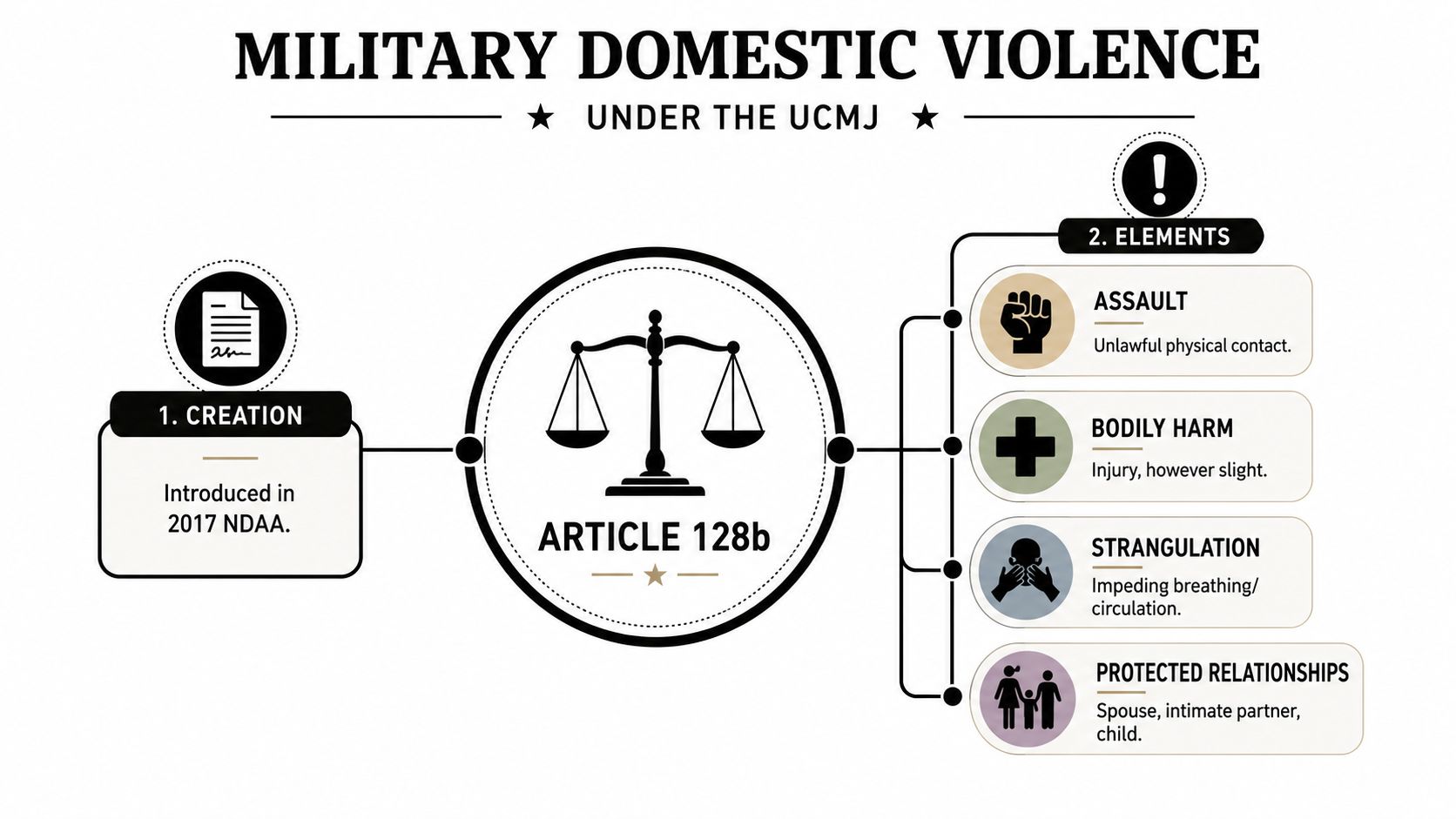
A military domestic violence case usually starts as an assault allegation and quickly becomes an Article 128b problem. Congress created Article 128b in the National Defense Authorization Act for Fiscal Year 2017 to give prosecutors a separate charge for domestic-abuse conduct in the military source. That matters because once the government treats the case as domestic violence, the command response, the criminal exposure, and the collateral fallout can all change fast.
What Article 128b covers
Article 128b reaches a defined set of relationship-based cases. It can cover conduct involving a spouse, intimate partner, dating partner, family member, or household member, including assault, strangulation, suffocation, and bodily harm source. The prosecution must prove the underlying conduct and the protected relationship, so the relationship evidence is not a side issue. It is part of the charge.
Domestic violence allegations in the military are commonly charged under Article 128b rather than handled as ordinary assault. source That creates two defense targets. First, challenge the facts of the alleged act. Second, attack the government's proof that the relationship fits the statute if the facts support that fight.
Why the process moves so quickly
These cases often start with one disputed statement and then spread through command notification, witness interviews, and digital review. Once that happens, the government is already building a theory of the case, and the accused is usually reacting to it late. That is why early defense work changes the pressure point. It can shape how the command views the allegation, how investigators frame the facts, and whether the case turns into a criminal charge plus administrative action.
A practical outside comparison on early case preparation is Minnesota domestic violence case preparation. The legal setting is different, but the core lesson is the same, preserve evidence, organize the timeline, and force the government to deal with facts instead of assumptions.
Immediate Steps After an Allegation
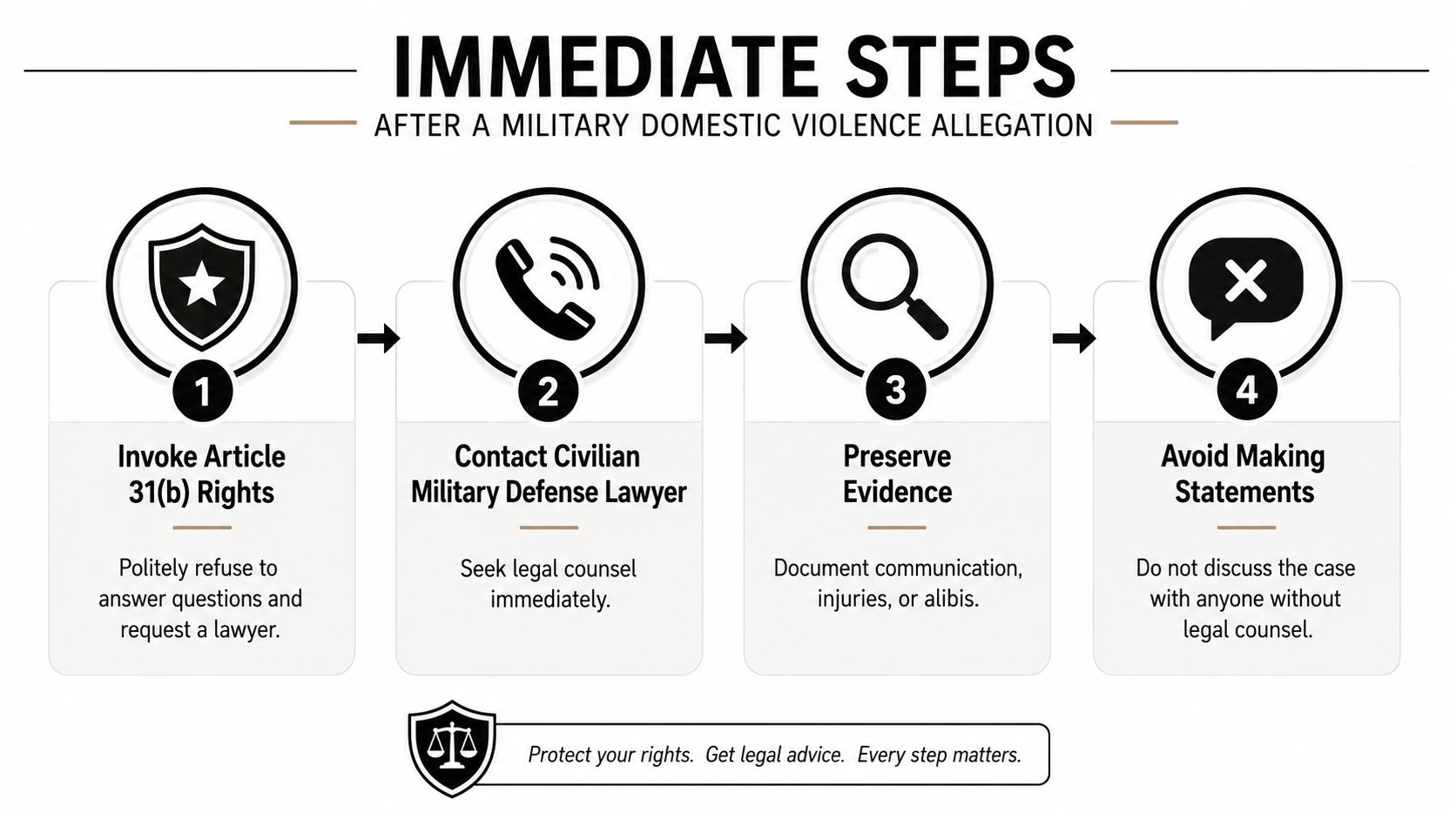
The first move is simple. Do not talk your way out of it. If CID, NCIS, OSI, CGIS, or command starts asking questions, invoke your rights and stop there. Military domestic violence cases frequently become credibility contests, and every extra sentence you give them is another sentence they can use to build a timeline against you.
What to do right away
Invoke Article 31(b) rights. Politely say you want a lawyer and won't answer questions. Don't try to give a “quick explanation,” because those statements are often separated from the context that made them sound harmless.
Preserve digital evidence. Save texts, call logs, photos, social-media timestamps, location data, and any messages that show who said what and when. Don't delete anything, even if you think it looks bad. Deleting evidence creates a second problem on top of the first one.
Avoid contact with the accuser. Even a calm message can be recast as pressure, intimidation, or consciousness of guilt. Let counsel handle communication boundaries.
Retain civilian counsel early. If you wait until charges are preferred, you've already lost the best window to shape the case.
A helpful civilian perspective on organizing your defense before things escalate can be found in Minnesota domestic violence case preparation. The legal setting is different, but the core idea is the same, preserve evidence early and stop improvising.
The defense wins time by refusing to feed the investigation.
Common Defenses and Motion Practice
Military domestic violence cases rarely turn on one dramatic piece of evidence. They usually turn on inconsistencies, timing, and whether the government can prove its story beyond a reasonable doubt. A technically strong civilian defense in domestic-violence cases relies on early evidence reconstruction and credibility analysis, focusing on preserving digital evidence, testing the timeline, and preparing cross-examination before referral decisions source.
Defense theories that actually matter
A solid defense may focus on lack of intent, self-defense, mistaken identity, false or exaggerated reporting, or a timeline that does not hold up. If the message history, location data, or witness accounts don't match the allegation, that friction can be fatal to the prosecution's narrative.
Motion practice matters too. If investigators questioned you without proper Article 31 warnings, or if the government handled phone extraction badly, a defense lawyer can move to suppress or limit the evidence. If the case involves digital messages, prior relationship history, or alleged pattern evidence, the defense must also watch for misuse of MRE 404(b), 608, and 613. The government often wants character evidence to do the heavy lifting. The defense should not let that happen.
For a deeper legal framework on attacking weak proof, see challenging evidence in a military domestic violence case.
Why motive matters
Civilian cases involving relationship conflict sometimes involve issues that need careful legal handling, including accusations made after breakups, custody fights, or infidelity disputes. A related civilian discussion of seeking proof of infidelity legally can help readers understand why electronic evidence and timing matter, but military defense counsel has to go further and decide what is admissible, what is useful, and what creates new risk.
Defense takeaway: don't just ask whether the accusation is unfair. Ask whether the government can prove every element with clean, admissible evidence.
Strategic Trial-Level Defense Insights
Experienced trial lawyers know the first investigation is usually incomplete. Witnesses get interviewed selectively, digital evidence goes missing, and command pressure can create confirmation bias before anyone has tested the story. That's where the defense can win ground early.
Where these cases break down
One-sided interviews create distorted reports. If investigators talk to the complainant first and then treat everyone else as a fact-checking exercise, they often lock onto a theory before they've compared versions.
Missing metadata can matter more than the message itself. A screenshot tells part of the story, but timestamps, device records, and location data often tell a different one. Chain of custody problems on phone extractions can also weaken the government's proof.
Delayed reporting can cut both ways. Sometimes delay reflects fear or confusion. Sometimes it reflects a changing story. A good cross-examiner uses the delay to test credibility without assuming the answer.
Article 31(b) issues matter because service members are not civilians in a police station. If questioning starts before rights are properly handled, the defense has a real suppression issue.
What good cross-examination targets
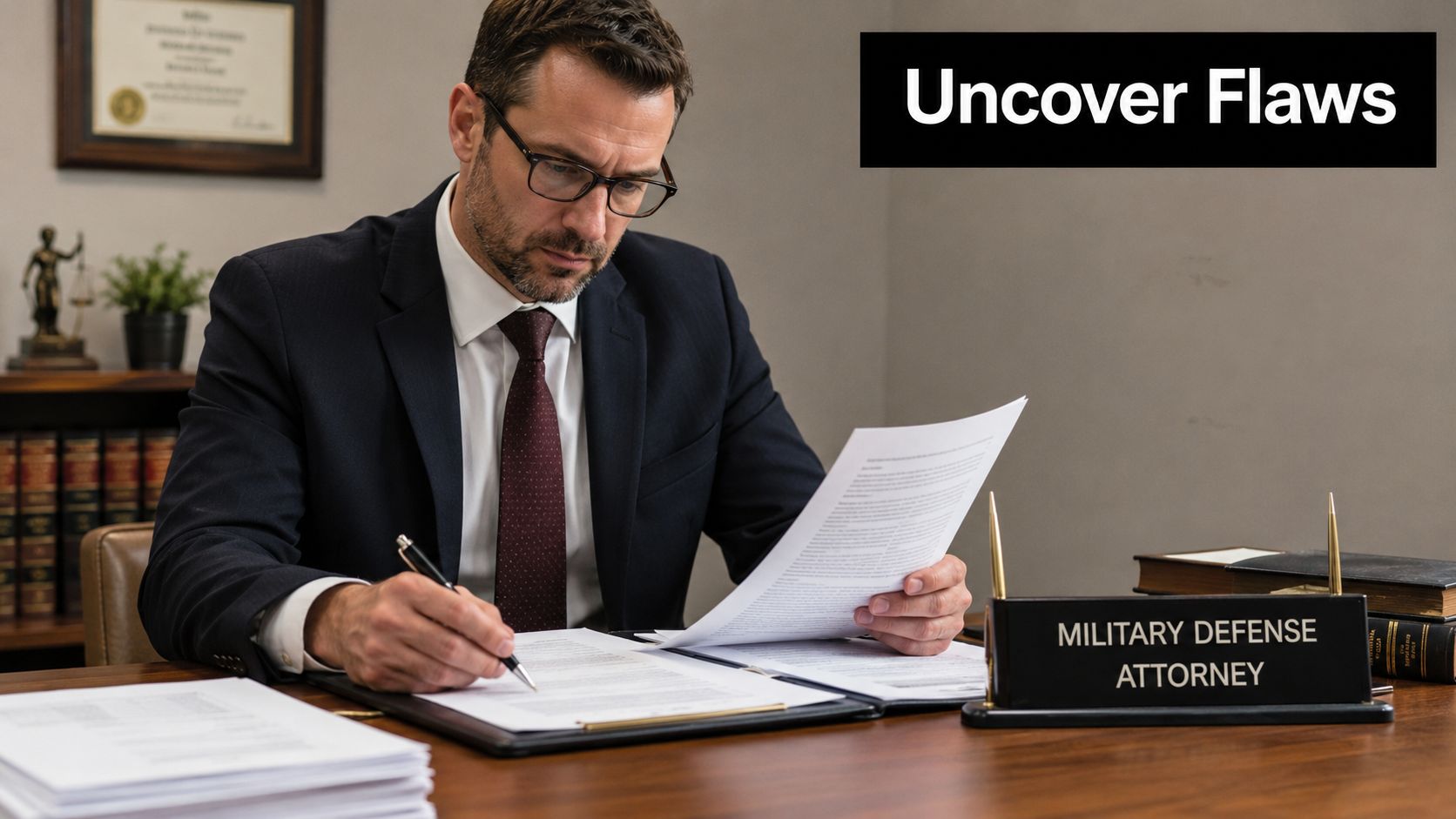
A defense lawyer should press on timeline contradictions, who saw what first, and whether the account changes after each interview. The government's story often starts simple, then grows as more people get involved. If the accuser's timeline shifts or the physical evidence doesn't fit the alleged mechanism, the case gets weaker.
Expert witnesses can help when biomechanics, digital forensics, or medical findings are in dispute. Military domestic violence cases are often credibility cases, but credibility is not the same as truth. That distinction matters in front of a panel.
Potential Career Consequences and Collateral Federal Risks
A domestic violence conviction in the military can do more than end the current case. It can trigger punitive discharge exposure, confinement, and a firearms restriction under 18 U.S.C. 922(g)(9), so defense strategy has to account for the court-martial and the collateral fallout that follows. A service member who loses that fight can face consequences that keep spreading long after the hearing ends.
The career damage is broader than most service members expect
A conviction can trigger administrative separation action even if the command does not wait for the court-martial to finish. That creates two tracks at once, the criminal case and the career case. Commands also move quickly on housing, clearance, and access restrictions once domestic violence is alleged.
The federal firearm issue is where many service members get blindsided. Counsel has to examine the charge language and any proposed disposition with care, because a qualifying conviction can create a lifetime firearm disability under federal law. That is why plea discussions cannot focus only on avoiding confinement or a bad discharge.
For a close look at that problem, see the Lautenberg Amendment trap in military domestic violence cases.
What to fight for
If dismissal is not realistic, the defense has to fight for language that does not create avoidable federal consequences. That means looking past guilt or innocence and measuring the effect of every disposition on your record, your housing, your career, and your right to possess firearms.
A bad outcome in a military domestic violence case rarely stays inside the courtroom. It can follow a service member into separation processing, future employment, and the rest of civilian life.
Working with Civilian Counsel at Gonzalez & Waddington
Gonzalez & Waddington, LLC, also known as UCMJ Defense Lawyers, handles serious military criminal defense for service members worldwide. The firm was founded by Michael Waddington and Alexandra González-Waddington, and it focuses on court-martial defense, UCMJ litigation, and high-stakes investigation work, including domestic violence, violent crime, and clearance-related cases.
Michael Waddington is a former Army JAG, prosecutor, Trial Defense Counsel, Senior Defense Counsel, Special Assistant U.S. Attorney, and Chief of Military Justice. Alexandra González-Waddington has defended service members facing domestic violence, violent crimes, and white-collar allegations. That kind of background matters because domestic violence cases are rarely won by passive file review. They're won by fast investigation, hard questions, and trial discipline.
The firm represents Army, Navy, Air Force, Marine Corps, Coast Guard, Space Force, active duty, Reserve, and National Guard members, including clients in the U.S., Europe, Asia, the Middle East, Iraq, Afghanistan, and deployed environments. If your case is already moving, the value of counsel isn't abstract. It's immediate evidence preservation, witness work, and a defense plan that doesn't depend on command goodwill.
Video transcript
Transcript of the video “Article 128b UCMJ Domestic Violence Charges Explained | Military Defense Lawyer,” with Alexandra González-Waddington of Gonzalez & Waddington.
Read the full transcript of this video
Article 128 Bravo of the UCMJ is the military’s domestic violence statute. It makes it a crime to commit a violent offense against a spouse, intimate partner, dating partner, or immediate family member. To commit an offense meant to threaten or intimidate them, to violate a protective order, or to strangle or suffocate them. I’m Alexandra González-Waddington, civilian military defense lawyer and co-founder of Gonzalez & Waddington. Domestic violence is one of the most common serious allegations we defend.
Here’s what Article 128 Bravo covers, what it carries, and how these cases are fought. First, why Article 128 Bravo exists. Before 2019, domestic violence in the military was charged as ordinary assault under Article 128. And on paper, a slap in a marriage looked the same as a slap in a bar. Congress created Article 128 Bravo, effective January 1st, 2019, so domestic violence would be identified and tracked as its own offense and punished more severely.
At the end of 2023, Congress added dating partner to the statute, which brought shorter and non-cohabiting relationships squarely within it. And domestic violence is a covered offense, which means the Office of Special Trial Counsel, not your commander, decides whether to prosecute. Second, the five ways to violate Article 128 Bravo. One, committing a violent offense, like an assault, against a spouse, intimate partner, dating partner, or immediate family member. Two, committing an offense against one of those people or their property or pet with intent to threaten or intimidate them.
Three, violating a protection order with intent to threaten or intimidate. Four, and violating a protection order with intent to commit a violent offense. Five, assaulting a spouse, partner, or family member by strangulation or suffocation. That last one deserves attention. Investigators are trained to look for signs of strangulation in every domestic case because it’s a major predictor of future lethal violence and it’s charged harshly.
Third, the punishment. Under the 2024 amendments to the Manual for Courts-Martial, a violent offense or an offense meant to threaten or intimidate carries the maximum for the underlying offense plus three more years. Violating a protection order to threaten or intimidate carries up to three years. Violating a protection order with intent to commit a violent offense, up to five. Strangulation or suffocation, up to eight years or 11 if the victim is under 16.
Those maximums were rewritten in December 2024, so older articles online may be out of date. Fourth, the consequences beyond confinement. Domestic violence convictions carry federal firearms consequences. Depending on the conviction, federal law, including the Lautenberg Amendment for misdemeanor domestic violence, can bar you from possessing a firearm or ammunition. For a service member, that can mean you can’t deploy, can’t carry a weapon, and can’t stay in.
Even without a conviction, you face a military protective order, the Family Advocacy Program’s Incident Determination Committee, possible loss of base housing, custody issues, and administrative separation. Fifth, the three-front war. Most domestic arrests happen off base under state laws that require police to arrest someone on almost every domestic call. That means a civilian case in state court with its own prosecutor and its own no contact order. At the same time, the command opens its own case.
And family advocacy runs a third clinical process decided on a low standard that can drive command action even when both criminal cases go nowhere. Statements in any one of those forums can be used in the others. And a civilian plea that looks harmless can end a military career. They have to be handled together. Sixth, the fact patterns.
Arguments during a separation or divorce. Alcohol. Mutual fights where only one person calls the police. A grab of a phone, a blocked doorway, or a push during an argument. Allegations that surface during a custody dispute.
And recantations. A spouse who calls 911 in anger and later says it didn’t happen the way it was reported. Recantation doesn’t end the case. Prosecutors go forward using the 911 recording, the body camera footage, and the officer’s observations. Seventh, the defenses.
Self-defense and mutual combat, which are common in domestic cases and often missed in the first report. Lack of injury or injuries that don’t match the story. Motive, especially in custody and divorce fights. The relationship element, whether the person actually qualifies as a spouse, intimate partner, dating partner, or immediate family member under the statute. For strangulation, the medical evidence, which often doesn’t support the allegation, and the full communications history before and after the incident.
In many cases, the texts the morning after say more than the police report. Eighth, what to do? One, obey every protective order and no contact order exactly, civilian and military. A violation is a new charge under Article 128 Bravo itself. Two, don’t give a statement to civilian police, military investigators, your command, or family advocacy without a lawyer.
Three, don’t plead to anything in civilian court until a military defense lawyer reviews the firearms and career consequences. Four, photograph any injuries you have and preserve messages, call logs, and the names of witnesses. Five, don’t ask your spouse or partner to drop the charges. That can be charged as obstruction of justice. At Gonzalez & Waddington, we handle Article 128 Bravo cases on all three fronts at once because the decisions made in the first week in civilian court, at family advocacy, and with the command usually decide the outcome.
So, what is Article 128 Bravo of the UCMJ? The military’s domestic violence statute. Violent offenses, intimidation, protective order violations, and strangulation against a spouse, partner, or family member with maximums rewritten in 2024, and federal firearms consequences that can end a career. Obey every order, say nothing, plead to nothing, and get a lawyer. I’m civilian military defense lawyer Alexandra González-Waddington with Gonzalez & Waddington.
We defend service members worldwide. You can learn more at ucmjdefense.com or call 1-800-921-8607 for a free, confidential consultation. >> When the command knows you’ve got real defense, the game changes.
FAQ
Can I refuse to talk to CID, NCIS, OSI, or CGIS?
Yes. Invoke your Article 31(b) rights and ask for a lawyer. Don't explain, debate, or try to “clear things up” first.
Do I need a lawyer before I am charged under the UCMJ?
Yes. The best defense work in domestic violence cases happens before referral, not after. Early counsel can protect evidence and shape the case.
Can I hire a civilian military defense lawyer and keep my military lawyer?
Usually, yes. Many service members use both. Civilian counsel can drive strategy while assigned counsel handles the military side.
What happens at an Article 32 hearing?
It's a key pretrial stage where the government's evidence is tested. A good defense uses it to expose weak witnesses, bad timelines, and missing proof.
Will a court-martial end my military career?
It can. Even without conviction, the case can still lead to administrative separation, clearance problems, and career damage.
When should I contact Gonzalez & Waddington?
Immediately after an allegation, not after charges are preferred. The earlier the defense starts, the more options you usually have.
If you are under investigation, facing UCMJ charges, being questioned by CID, NCIS, OSI, or CGIS, or preparing for a court-martial, do not wait. Early action can change the direction of the case. Silence, strategy, evidence preservation, and the right defense plan matter.
Contact Gonzalez & Waddington, LLC, UCMJ Defense Lawyers, at 1-800-921-8607, text 954-799-4019, or visit ucmjdefense.com.
“This article is for general informational purposes only and does not create an attorney-client relationship. Every military case depends on the facts, evidence, command climate, service branch, forum, and applicable law. Past results do not guarantee future outcomes.”
Related: Ex-Wife Allegation in a Military Investigation? Get a Civilian UCMJ Lawyer Fast
Recent Blogs
- Nonpunitive Letter of Caution vs. Punitive Letter of Reprimand: What Navy and Marine Corps Officers Need to KnowNovember 6, 2026
- First 24 Hours After CGIS Contacts You: What Coast Guard Members Should DoNovember 6, 2026
- First 24 Hours After OSI Contacts You: What Airmen and Guardians Should DoNovember 6, 2026
- First 24 Hours After NCIS Contacts You: What Sailors and Marines Should DoNovember 6, 2026
- First 24 Hours After CID Contacts You: What Soldiers Should DoNovember 6, 2026
- Is Hiring the Cheapest Military Defense Lawyer a Mistake?November 6, 2026