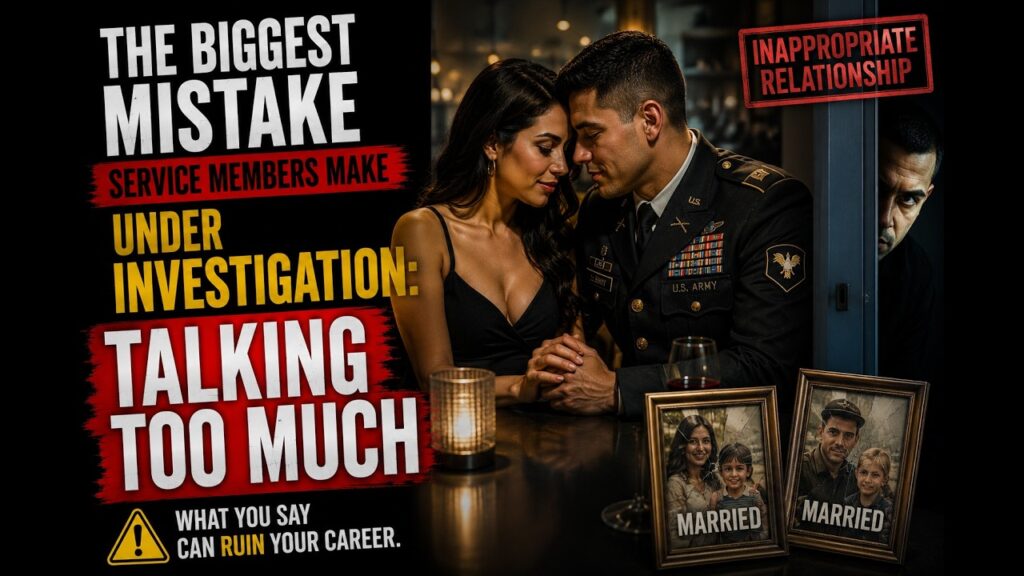
The biggest mistake service members make under military investigation is talking too much. Gonzalez & Waddington warn that “just explaining” during AR 15-6, command-directed, or administrative inquiries often creates statements used for GOMORs, Article 15, separation, or court-martial. Call 1-800-921-8607. Educational information only, not legal advice.
Quick answers
Should I talk to a military investigator to clear my name?
Usually no. Unscripted statements during command or AR 15-6 investigations are often used against you later. Get counsel before you speak.
What can a command investigation lead to?
A GOMOR, Article 15 or NJP, separation board, Board of Inquiry, clearance action, promotion harm, retirement loss, or court-martial referral.
Watch on YouTube. Questions about a case: call 1-800-921-8607 or text 954-799-4019.
Educational information only. Not legal advice. Using this briefing does not create an attorney-client relationship. Facts, commands, and outcomes vary. For advice about your case, speak with a lawyer.
Video transcript
Transcript of the video “Biggest Mistake Service Members Make Under Military Investigation,” with Michael Waddington of Gonzalez & Waddington.
Read the full transcript of this video
Now we’re going to talk about the biggest mistakes that service members make. These are things I’ve seen over the course of my entire career, starting back when I was a JAG, back in 2001. That’s when I came into the JAG Corps, and I was a JAG for about six years. Then I got out and went into private practice representing service members.
Here’s the biggest mistake. I say it, people don’t listen, and they keep making the same mistake. Here it is: you talk too much. You talk too much. You don’t know when to shut up. You think you’re making the situation better, and you’re not. You’re literally talking yourself into career-altering repercussions.
Most people we represent are Boy Scouts and Girl Scouts. They’re above board. They’re senior leaders. They’ve been in the military for a long time. If you’re hiring us for a command-directed investigation, you’ve probably been around long enough that you care and it matters. Because if you’ve been in for two years, they’re probably not going to do a command investigation, and if they do, you probably don’t care much, in most cases. But if you’ve been in for 15, 20, or 25 years and you’re the subject of one of these, you need to be careful.
Here’s the problem. You’ve been around long enough, you believe in the system enough (you’re part of the system, the military system) that you simply think, “Oh, I’ll just explain everything. The investigator will understand.” It sounds reasonable, because we’re always taught to tell the truth: if you tell the truth, you’ll be fine. That is not how it works. There’s this idea that “if I just tell my side of the story, they will realize it’s all a big misunderstanding. I didn’t do anything wrong.” That’s great if the investigator is fair and neutral, doesn’t presume you’re guilty, and there’s no agenda behind it. But in many of these cases, they presume you’re guilty, there is an agenda behind it, and they’re gathering evidence to take action against you. That’s often what happens.
Recent Blogs
- Nonpunitive Letter of Caution vs. Punitive Letter of Reprimand: What Navy and Marine Corps Officers Need to KnowNovember 6, 2026
- First 24 Hours After CGIS Contacts You: What Coast Guard Members Should DoNovember 6, 2026
- First 24 Hours After OSI Contacts You: What Airmen and Guardians Should DoNovember 6, 2026
- First 24 Hours After NCIS Contacts You: What Sailors and Marines Should DoNovember 6, 2026
- First 24 Hours After CID Contacts You: What Soldiers Should DoNovember 6, 2026
- Is Hiring the Cheapest Military Defense Lawyer a Mistake?November 6, 2026