1-800-921-8607 – https://ucmjdefense.com – Military defense lawyer Michael Waddington discusses Alcohol and Consent Under Article 120: What Service Members Need to Know. This Gonzalez & Waddington tutorial is educational, not legal advice. If you have a live investigation or court-martial, call 1-800-921-8607.
Quick answer
Alcohol cases are defended by showing what the person was actually able to do and understand, not just how much they drank. The defense examines texts, video, witness accounts and actions before and after the encounter, uses toxicology experts to address blood-alcohol estimates and blackouts, and raises mistake of fact as to consent when the accused reasonably believed there was consent. Gonzalez & Waddington has defended Article 120 alcohol cases for more than two decades.
Quick answers
Should I talk to CID, NCIS, or OSI after watching this?
Do not make a statement or consent to a phone search. Invoke Article 31(b) and call counsel. Gonzalez & Waddington: 1-800-921-8607.
Is this video legal advice?
No. It is educational. Facts and commands vary. For advice about your case, speak with a lawyer.
Watch on YouTube. Questions about a case: call 1-800-921-8607 or text 954-799-4019.
Educational information only. Not legal advice. Using this briefing does not create an attorney-client relationship. Facts, commands, and outcomes vary. For advice about your case, speak with a lawyer.
Video transcript
Transcript of the video “Military Sexual Assault & UCMJ: Consent, Alcohol & False Allegations,” from Gonzalez & Waddington.
Read the full transcript of this video
My name is Michael Waddington. I’m a military defense lawyer. And in this video, I’m going to answer some of the most commonly asked questions that we get through consultations or through online inquiries. In this block of questions are going to have to do with sexual assault, sexual harassment type cases. So, the first question is this.
Why are military sexual assault cases handled differently than civilian cases? Well, I’ll tell you why. Because Congress and the military treat these cases as a readiness issue, not just a crime issue. That means there are special rules, special investigators, an intense command and political oversight. OK?
The system is designed to take allegations seriously, sometimes at the expense of nuance. That pressure affects how cases are investigated and charged. And frankly, in the military, often once you catch a charge or even are put under investigation of a suspected sexual assault, any type of sex crime, sex harassment, they’re going to do something to you, even if you’re innocent. And that could be just kick you out with another than honorable. It’s very common, whether you’re guilty or not.
It’s very common, even if you’re innocent, for them to do something to you that impacts your career and kicks you out of the military. Now, if they think for sure you’re guilty and they think they can prove it, then they will bring you to a court-martial. If the evidence is a little weaker, they might send you to a board. So you could lose your entire retirement and entire career at a board where you can’t even confront witnesses in many cases and where the standard of proof is very low. OK, so this is serious business.
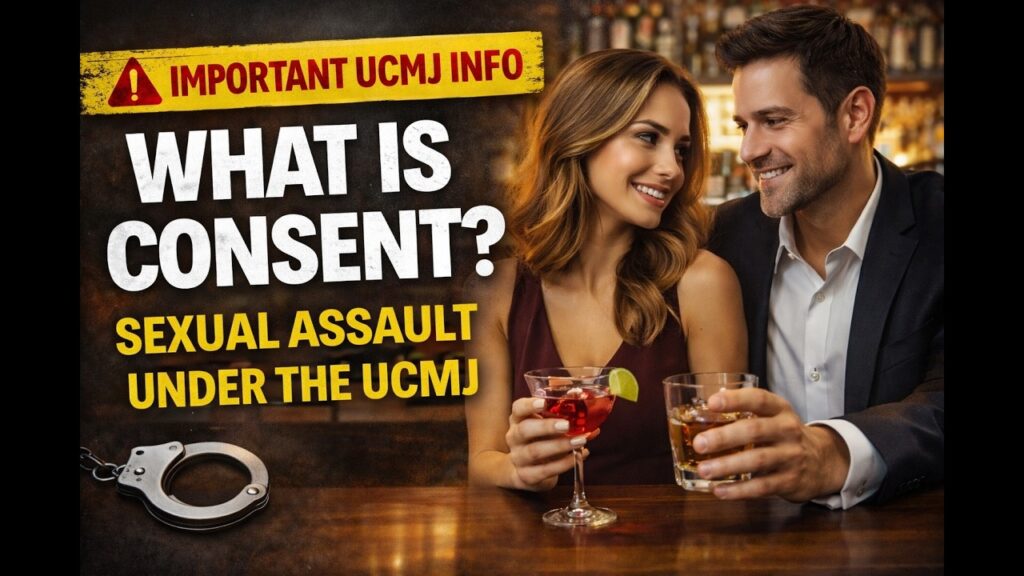
You need to talk to lawyer if you’re suspected of any sex crime or sex harassment in the military. What does consent mean under the UCMJ? Well, consent must be clear, voluntary, and ongoing. It can’t be assumed. It can’t be forced, and it can be withdrawn.
Military juries and judges look closely at power dynamics, alcohol, and context. Now, silence or a lack of resistance does not automatically mean consent. And as you probably know from your sapper sharp training, consent is something they teach you about in the military and it’s taught in all different ways. So, I see a lot of cases where someone did give consent where it was clear, volunteer, and ongoing. And what ends up happening, you know, weeks, days, months later, the person changes their mind, realizes that they think you took advantage of them.
you’re a cheater, they drank too much, and what was prior consent could turn into no consent. And we end up in a court-martial where that witness is taking the stand talking about how they didn’t give consent. And often it’s a battle of credibility. And it’s one of those battles that the government is going to do whatever they can to try to prove that there was no consent and you are in fact guilty of a sex crime. So if there’s any doubt, stop.
Get consent. And you shouldn’t be having sex with people where you don’t know if there’s consent or not. OK? Don’t do it. And if you do, write my number down because you seriously might need my help.
You shouldn’t be having sex with people when you’re unclear as to whether or not there’s consent. There should be no doubt in your mind. If you want to be safe and be consistent with the law under the UCMJ, can consensual sex lead to charges? Yes, absolutely. If alcohol is involved, if stories change later or someone feels regret, one person remembers as consensual can later be framed differently.
That’s why these cases often turn on perception, on credibility, just not on facts. They become a battleground. Why does intoxication complicate everything in a military sexual assault case? Well, that’s pretty well, it’s pretty obvious that alcohol affects memory, judgment, and communication. It also creates legal questions about a person’s capacity to consent.
When alcohol is involved, investigators scrutinize every detail. When someone says they don’t remember, they blacked out, it’s assumed that there was no consent by investigators and you end up in a court where you almost have to prove your innocence. Even though that’s not the legal standard, that’s often what I see happening in courts. You have to prove that there was consent if you want to have a very good chance at winning your case. So, the presence of alcohol doesn’t decide the case alone, but it makes everything harder to sort out.
And if you have a bunch of senior members on that jury who’ve been taught about consent and alcohol, they’re probably going to assume that the person didn’t consent if the person’s vomiting, slurring their speech, claiming to not remember. So, you got to be very careful here. Another question I get all the time. Oh, there are no witnesses to the sexual assault. How can they charge me?
And I say, “Well, who’s accusing you?” And they say, “Oh, the victim is. She’s accusing me.” And I say, “Well, she’s a witness. She is the witness.”
And that witness alone can convince a jury beyond reasonable doubt under the law. Just that one witness. You don’t need 20 witnesses. So understand that just because you have one person’s word against yours or a quote he said, she said, as people like to say, that’s plenty under the law to convict someone, there are many people in jail right now at Fort Leavenworth who are convicted in a he said, she said case. So just because there are no other witnesses doesn’t stop investigations.
It doesn’t stop charges. The case then becomes about credibility and it becomes about statements, about behavior, about digital forensic evidence. Lack of witnesses does not mean lack of risk when you’re going out there and having sex with people, especially if alcohol’s involved and especially if you don’t know the person. Sorry to tell you all you people out there that like to hook up with random people, you’re putting yourself at risk every single time you do it. How are text messages used in military sexual assault cases?
Well, nowadays they’re very central to the case. Investigators look at timing, at tone, at emojis, at deletions, at gaps. They look at apologies. All these things that are in your messages can be used against you. Messages before and after the incident are analyzed for meaning.
They try to interpret them. And trust me, if you’re the suspect, they are not interpreting them from a perspective of innocence. OK? They’re looking at it, hey, how can I use these to prove that this person committed a sex crime? So what feels casual to you, it can be interpreted much differently years later in a courtroom to make you look like a very bad person and guilty.
Why doesn’t delayed reporting end a military sexual assault case? Well, because it doesn’t. Because delayed reporting is common, whether it’s 6 hours, 6 weeks, 6 days, 6 months, or even six years. I’ve seen cases where someone’s charged and convicted for allegations that came out years later. Nowadays, investigators are trained to expect delays.
OK? They explain it with the person was afraid, they were confused, they were ashamed, and they’ll use that to justify the delays. Now, the key is to have a lawyer that can look at these delays and can look at the timeline and look at motives. They can look at what was going on between the parties, what triggered the event, and then put together a timeline to show that, hey, this isn’t just a delay caused by fear or shame. This is a delay that was caused by someone getting upset, wanting revenge, wanting to make someone pay for something that happened to them, like being dumped, uh being cheated on, you name it.
There’s a lot of motives that are out there, and you need a lawyer that can go in and tear apart that delay and make it look like what it is that can tear apart that delay and use it in your best interest. Because you have to understand that a time delay alone does not discredit an allegation. Instead, it just shifts the focus of the case to what’s consistent, what’s not, credibility and corroboration. Here’s one that people have a hard time wrapping their head around. Can a false allegation still ruin a military career?
Absolutely. Yes. All the time. Even when allegations are untrue, investigations can lead to flags, career promotion denials, lost opportunities, administrative actions, people getting bad evaluations, someone just getting set in the corner and told to sit there for a year or two while the investigation plays out. The process itself causes damage.
That’s why these cases must be handled carefully from the very beginning. Why isn’t she didn’t say no a defense in a sexual assault case in the military? The reason is in the military the law looks for affirmative consent not just absence of refusal. So silence, freezing or confusion can be interpreted as a lack of consent. Now some of you listening to that might be saying, “Well, that’s not fair.
That’s not right.” Well, I’m telling you the way it is in the military. Just because the person didn’t say no doesn’t mean that you had the right to move on and do whatever you want. The person could have been unconscious and they couldn’t say no. The person could have been uh under the influence of some sort of drug or intoxicant and they couldn’t say no.
So the absence of a no does not mean that you have an easy case. It could actually make your case much worse. This is where many service members misunderstand the standard and they think, “Oh, she didn’t say no, therefore she consented or he consented.” That is not the standard. That is not the law.
And if that’s the case, you need to rethink what you’re doing because you should have affirmative consent verbally or through other means. uh like the person verbally, physically, through physical actions or something along those lines. And if you have any doubts, you need to clarify just to be safe. I’m just telling you, I do this for a living. I see people get into trouble all the time.
If you have doubts, clarify and get some clarity on what’s going on. You should not be just leaving it up in the air to guess work, especially if you don’t know the person, especially if drugs or alcohol are involved. What happens if the alleged victim’s story changes over time? I hear this all the time from parents like, “She changed her story. How could they charge my son?
Well, they do it all the time. Investigators expect some changes, especially with trauma. That’s what they’ll say. Well, with trauma, things change over time. Now, if it’s you, the suspect or the accused, if your story changes, that means you’re a liar.
That means you’re guilty. But if you’re the alleged victim, they will justify, rationalize changes. And frankly, people’s stories do change all the time. The key is, are the inconsistencies and changes explainable? Are they something that has changed with reinterviewing as the person’s motive grows or are they deliberate lies?
And these are things that a defense lawyer who knows what they’re doing, a military defense lawyer, can come in and figure out and be able to exploit and point out. So, the defense must focus on patterns and on contradictions and on objective evidence. But slight changes in the story, they may not matter. They may not matter, especially if the lawyer doesn’t know how to exploit these changes. and how to expose these changes in a way that makes it matter to the jury.
In a military sexual assault case, how is credibility actually evaluated? Well, not by one statement alone. OK? There’s much more than someone’s statement to law enforcement. Investigators, they’re going to look at consistency, motive, or at least they should look at motive.
They should look at corroboration, and they should look at behavior before and after the event. So what they’ll end up doing is they’ll look at texts, witnesses, family, friends, anyone else that was there in timing. These are all factors and they get put into a big pile. Not one of them has any more weight than others. But think about it like this.
Credibility is built over time and based on a lot of factors, not just one interview. So if you’re accused of a crime or you’re a parent or loved one, you say, “Oh, the person they lied about this small thing here or this thing there.” That alone does not destroy their credibility. They go ahead all the time in cases where there are multiple even major inconsistencies. You just need to know how to exploit that and point it out to the jury and make it matter if you’re going to a court-martial.
What does a safe examination show or not show? There are things called safe or sane examination. Those are sexual assault forensic examinations. Now, these document physical findings. They collect physical, forensic, and scientific evidence from the body of the victim or the accused.
They do not prove consent, by the way, in and of themselves. They do not prove lack of consent. Many exams show no injuries, and that’s common. So, interestingly, injuries are common even in consensual sex and in unconsual sex, and so are lack of injuries. So, having no injuries or injuries doesn’t prove a crime occurred either way.
The medical literature is very clear on that. If the results are neutral, so you have to understand that the lack of injuries doesn’t in and of itself guarantee an acquitt. It might not mean anything at all. It depends on so many other factors such as the contact, the duration, the force, the timing of the report. All these things are things that must be considered in a military sexual assault case.
Can a person be charged without physical evidence? Absolutely. It happens all the time. Charges can be based on statements alone, and you can be convicted based on statements alone. if the investigator believes they’re true.
And in the military, there’s a new trend. It’s called start by believing. Start by believing alleged victims. No matter what, you don’t question them. You take their word for it.
So yes, charges can be based on a statement of one person alone. The thing is, physical evidence helps, but it’s not required. That’s why these cases often hinge on credibility, on forensic evidence, and how thorough and complete the law enforcement investigation was. And these are all attack points that a defense lawyer can use to point out reasonable doubt in a criminal case. But the lack of physical evidence alone doesn’t end the case.
Does motive matter in a military sexual assault case? Well, to the defense, absolutely. It matters tremendously. To law enforcement, they often don’t look at it. But to the defense, motive helps explain why someone would accuse someone, why someone would make a false allegation, why someone would say or do something, why someone would maybe shade their testimony in a certain way.
So we look at relationship issues, regret, fear of consequences, anger, attention seeking, external pressure from maybe a husband, a boyfriend, from law enforcement, from family. All those things matter to the defense. So motive alone doesn’t decide guilt, but it is crucial to the defense and it’s crucial to the judge or jury when understanding context. So you must have a lawyer that knows how to develop motive to get that evidence in front of the jury and to explain motive and how that shapes the testimony of the alleged victim, of law enforcement, and of the key witnesses against your client. Otherwise, you’re going to get steamrolled.
Can prior sexual relationships be used in court in a military sexual assault case? The answer is maybe. But the answer is sometimes. But the law limits how past sexual relationships are allowed to be admitted, how they can be discussed because the law right now protects the privacy of the alleged victim. So, in order to even get evidence in front of the jury under military rule of evidence 412, you must alert the alleged victim, the prosecutor, and the judge and have a hearing in which you present evidence and you have to have a theory as to why this evidence is relevant and why it’s admissible.
But generally, it’s not admissible. You have to fight hard to get it in in front of the jury, even if it is highly relevant. So, bottom line is prior relationships don’t automatically come in. It’s something that a skilled lawyer needs to know how to alert the judge to highlight those details and then to tie those details to relevancy in one of the very narrow exceptions under the rules of evidence so that the jury can even hear about it. So technically, if a husband and wife were having sex for 10 years, the wife accused the husband of sexual assault.
the fact the details of their sexual relationship are not admissible unless the judge allows it to come in and the defense can show why it’s necessary and relevant to be admitted and then the judge will even limit that. So, so as a defense lawyer, you’re at a disadvantage when trying to get evidence of prior sex relationships in. There is a default rule that says it’s not allowed in unless the judge gives you permission. And some judges don’t give you permission that often unless you prove your case and show why it’s admissible. So, what happens when alcohol is involved in both sides?
Like, both sides were drunk. I hear this all the time. Like, I was drunk and she was drunk. How could there be a sex crime? Well, many of the cases that go in front of the jury are cases where both sides are drunk to some level.
Just because you were drunk doesn’t mean you can’t get convicted and and doesn’t mean you’re not guilty. We have issues with memory gaps in these types of cases, inconsistent accounts, and impaired judgment. That complicates everything. But it’s the defendant that is usually stuck in a situation where you both were drunk and the defendant is allowed to be held guilty or found guilty of sexual assault even if they were very drunk. Whereas the victim if they were very drunk is considered a victim if they were incapable of consent.
So it’s kind of a double standard like you’re capable of assaulting someone while really drunk and making those decisions. And also at the same time, you can be a victim even if you were drunk and you engage in sex if the judge and jury determine that you’re incapable of making decisions. So it’s a very challenging situation as a defense lawyer. You have to be able to highlight why the person was capable of making decisions, how and why they were able to make the decisions in this case through consent and explain that to the jury. maybe through some sort of toxicologist, a expert in forensic toxicology or psychology who can explain how people’s brains work while they’re intoxicated.
Because you can be drunk and make decisions, but the question is, were you too drunk to understand the nature of what you were doing? Like, did you understand that you were having sex? Did you understand what that meant, who the person was? Uh, and it’s a very slippery slope. You’re on thin ice if you’re the defendant and your defense is, “Oh, we were just both drunk.”
because you can end up being convicted of a crime when you both had the same level of intoxication if your case is not handled properly. Why do many military sexual assault cases seem unfair? Well, a lot of parents call us and they express that they feel the military system is unfair. Thing is, the system is political and it prioritizes taking allegations seriously and as true. There’s an assumption that it’s true.
They start by believing the alleged victim, often before fully investigating or testing the theories and looking at motives or even before getting the physical forensic evidence. There’s an assumption that the person who’s being accused is guilty when it comes to military sexual assault. That’s the way it is. And so, unfortunately, a lot of accused service members often feel guilty. They’re presumed to be guilty even when they’re not.
That feeling is common even when the process is technically following the rules. That’s why if you’re in that situation, you need to be preparing your defense as much as possible because if you do end up in front of a jury, a judge, or a separation board, whether you’re guilty or not, you have to fight like hell to attack the government’s case to show the doubt. And in some cases, like at a board, you got to actually be able to show your innocence. The burden ships in many cases, whether you want to admit it or not, when you’re presumed to be guilty from the start, you had better be putting together the best defense possible and not making mistakes.
Because when it comes to court sitting around and whining about, oh, they shifted the burden, that doesn’t get you anywhere. You have to go in there and hammer the government’s case, highlight the inconsistencies, highlight the missing evidence, highlight the bias of the investigators, highlight the credibility issues of any complaining witnesses, and do it professionally and do it aggressively and do it in a way that the jury gets it the first time and create doubt in their minds so that they can go back there and render a verdict of not guilty. How do military investigators interpret behavior after the incident? Well, they do it in a very biased way in my opinion.
They assume you’re guilty if they are questioning you or if you’re accused of military sexual assault. Whether you are or not, they assume that. So, they’re going to be analyzing texts, apologies, interactions, silence, everything from a biased perspective that CID, OSI, NCIS, and CGIS, they have. They’ve had it since I’ve been doing this for 25 years. It hasn’t changed.
They assume you’re guilty. OK? So that’s how they’re going to interpret everything. Now from our side, we look at we have to look at it from an objective point of view. We have to be able to take these things that law enforcement overlooked and that they misinterpreted and present that to the jury through cross-examination, through our opening statement and closing and through really tearing apart law enforcement and picking apart their biases.
They’re jumping to conclusions, showing that they looked at things in a way that a reasonable person would interpret as innocent. and they immediately looked at it as a sign of guilt. But you cannot do that if you don’t have a lawyer who’s prepared, who is skilled, and who is an expert at cross-examining military law enforcement investigators. That is our bread and butter as military defense lawyers. Cross-examination, closing arguments and strategy, and they all come together when you end up at a trial, and you don’t want to be halfassing it when it comes to putting together the best defense possible.
How do good soldiers still get accused even when they’re innocent? Well, the military justice system assumes you’re guilty once an allegation’s made. They assume you’re guilty. They assume that the person telling the story, making the allegation, is telling the truth. For example, in the army, they call it a victim centered investigation process.
That means they start by believing whatever the victim says. So, a victim could come in and say, “X, Y, and Z happened.” They don’t question the victim. They assume it’s true, and they then go and gather whatever evidence they can to support what that person said. They don’t push back.
They don’t investigate or look into lies or inconsistencies. They let the alleged victim, even if the person’s lying through their teeth and has mental illness that causes them to lie about everything, they take their word for it. They if they say, “Hey, give me your text message.” And the person only wants to give them one message, they won’t even look at the phone. They’ll just be like, “Oh, thank you for sharing your message.”
And then they’ll look at that message in a way and interpret it in a way that always leans towards, “Oh, this person’s telling the truth. They’re a victim. The person they’re accusing is guilty.” So, it’s up to the lawyer that you hire or your military lawyer to expose these gaps in logic, these biases in the investigators, these biases in the system through cross-examination and through opening and closing arguments in front of the judge or jury. Because if you just sit back and think that the system is going to work out, you’re going to end up in a world of hurt and you or your loved one, whoever’s on trial, could end up in jail for a crime you didn’t commit.
I take this very seriously and you need to take it seriously, too. you don’t halfass your defense if you’re accused of any sort of crime in the military, especially anything involving sex. How long does a court-martial take? Now, we have to understand that, well, what does that even mean? The investigation can take six months to a year.
Once they charge you, you’re looking at a period of anywhere from a couple of months to maybe even 6 months to 8 months depending on the complexity of the case, depending on the lawyer’s availability, depending on the expert witnesses and the funding and all these other factors, depending on the judge’s schedule. So once you get charged at a general court, they’re going to do the Article 32. That usually takes a month, sometimes maybe, sometimes a little longer, and then after the Article 32, maybe a few more months. So you’re looking at an average after you’ve been charged anywhere from maybe two months at a general court-martial up to about six to eight months before your case goes to trial.
Now once you get into trial most cases in the military it depends on the branch by the way last about 5 days of in court proceedings maybe with an extra day for motions hearings and an arraignment. But the army tends to go faster. The Marine Corps is a little faster. They might be like the average might be you know 4 days. Uh the Air Force tends to take the full week for the same type of case.
Same with Coast Guard. And so the Navy’s kind of in between. So the bottom line, trials take about a week. You’re looking at anywhere from two months to 6 to 8 months before your case gets to trial. After you get a preferral of charges,
Frequently asked questions
How are military sexual assault cases involving alcohol defended?
By focusing on evidence of capacity and conduct, expert testimony on alcohol and memory, and, where it applies, the defense of reasonable mistake of fact as to consent.
Does drinking mean a person could not consent?
No. The question is whether the person was incapable of consenting, which requires more than drinking or intoxication alone.
Is a blackout the same as being incapable of consent?
No. A person in an alcohol blackout may still walk, talk and make decisions. Memory loss is not the same as incapacity.
Recent Blogs
- Nonpunitive Letter of Caution vs. Punitive Letter of Reprimand: What Navy and Marine Corps Officers Need to KnowNovember 6, 2026
- First 24 Hours After CGIS Contacts You: What Coast Guard Members Should DoNovember 6, 2026
- First 24 Hours After OSI Contacts You: What Airmen and Guardians Should DoNovember 6, 2026
- First 24 Hours After NCIS Contacts You: What Sailors and Marines Should DoNovember 6, 2026
- First 24 Hours After CID Contacts You: What Soldiers Should DoNovember 6, 2026
- Is Hiring the Cheapest Military Defense Lawyer a Mistake?November 6, 2026