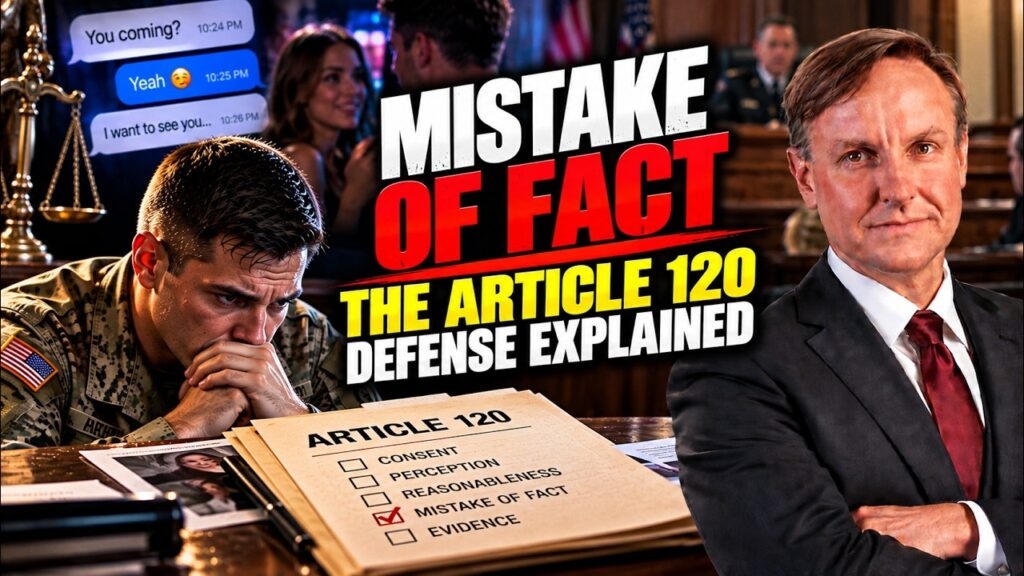
Short answer: Mistake of fact is the defense that you honestly and reasonably believed the other person consented. Civilian military defense lawyer Michael Waddington of Gonzalez & Waddington explains that under Rule for Courts-Martial 916(j), once any evidence raises the defense, the military judge must instruct the panel on it and the government must disprove it beyond a reasonable doubt. You do not have to testify to raise it.
In this video, Michael Waddington explains the mistake of fact rule, its two required parts, when it applies, how it is raised without your testimony, and the tactical decisions behind it.
What is the mistake of fact defense in a military sexual assault case?
Rule for Courts-Martial 916(j) makes it a defense if, because of ignorance or mistake, you held an incorrect belief about the true circumstances, and you would not be guilty if the circumstances had been as you believed.
In an Article 120, UCMJ, case, that means if you honestly believed the other person consented, and that belief was reasonable under the circumstances, you did not commit the offense, even if the other person now says they did not consent.
What does “honest and reasonable” mean?
Honest means you actually held the belief. That part is subjective: it is about what was in your mind.
Reasonable means an ordinary, careful person in your position would have believed it too. That part is objective. Both are required: an honest belief that was unreasonable, for example because the person was clearly unconscious, is not a defense, and neither is a reasonable belief you did not actually hold.
When does mistake of fact apply, and when doesn’t it?
It applies most directly when the question is whether the other person agreed, such as a charge of sexual assault without consent.
It works differently when the government’s theory is incapacity from alcohol or drugs. Then the question becomes whether you knew or reasonably should have known the person was incapable of consenting, which is related but not identical.
It is not available as to consent for offenses against children under Article 120b, UCMJ, and a mistake about a child’s age is a defense only in narrow circumstances.
Do I have to testify to raise mistake of fact?
No. This is the part people most often get wrong. The defense is raised by any evidence in the case, from any source, that a reasonable panel could rely on.
That can include messages before the encounter, the accuser’s own testimony about what they said and did, witnesses who saw the two of you together, your relationship history, and the accuser’s conduct afterward.
Once some evidence raises it, the military judge must give the panel the mistake of fact instruction, and the government must prove beyond a reasonable doubt that you did not honestly and reasonably believe there was consent.
What evidence supports a mistake of fact defense?
- Words: what was said in the room and in messages.
- Actions: who initiated, who undressed, who moved to the bed, and how the other person responded physically.
- Context: prior encounters between you, flirting that night, and the invitation back.
- Afterward: what the other person said the next morning, before any accusation.
The panel judges reasonableness by what you saw and heard, not by feelings the other person had but did not express.
How do defense lawyers decide how to use mistake of fact?
Whether you testify is a decision made late in the case, with your lawyer, based on whether the other evidence has already raised the defense.
Mistake of fact and the argument that consent actually existed are compatible, and both are often argued. Getting the judge to give the instruction is a fight your lawyer must prepare for in advance, with the case law.
What to do right now
- Do not contact the accuser for any reason, directly or through friends.
- Preserve your messages and do not delete anything from your phone, social media, or cloud accounts.
- Do not explain what you believed to CID, NCIS, OSI, or your command. Invoke your Article 31(b) rights and ask for a lawyer.
- Write down, for your lawyer only, what was said and done that night and who saw you together.
- Hire a lawyer early so the evidence that raises the defense is found and preserved.
Key takeaways
- Mistake of fact under RCM 916(j) is an honest and reasonable belief that the other person consented.
- Both parts are required: honest (subjective) and reasonable (objective).
- Any evidence can raise it, and you do not have to testify.
- Once raised, the judge must instruct and the government must disprove it beyond a reasonable doubt.
- It is limited in incapacity cases and not available as to consent for Article 120b child offenses.
Frequently asked questions
Who has the burden of proof on mistake of fact?
The government. Once evidence raises the defense, the prosecution must prove beyond a reasonable doubt that you did not honestly and reasonably believe the other person consented. You do not have to prove your belief.
Is mistake of fact the same as arguing there was consent?
No, but they fit together. Consent means the other person actually agreed; mistake of fact means you reasonably believed they did, even if they did not. Defense lawyers often argue both.
Does mistake of fact work if the accuser was drunk?
It can, but the analysis changes. When the charge is based on incapacity, the question is whether you knew or reasonably should have known the person could not consent. Evidence that the person was talking, walking, and making choices is often central.
Can the judge refuse to give the mistake of fact instruction?
The judge must give it if some evidence raises the defense. Whether the evidence is enough is often contested, so your lawyer has to build the record and argue it with the case law.
Related questions
- How do consent and mistake of fact work in Article 120 cases? (full guide)
- How do alcohol cases get defended under Article 120?
- Do I have to talk to CID if they want to speak with me?
Video transcript
Read the full transcript of this video
What is the mistake of fact defense under Article 120? It’s the defense that you honestly and reasonably believe the other person consented. And if the evidence raises it, the government has to disprove it beyond a reasonable doubt. It’s the most important defense in military sexual assault law, and the most misunderstood. I’m Michael Waddington, civilian military defense lawyer and co-founder of Gonzalez & Waddington. Here’s how it works, when it applies, and how it’s actually raised at trial.
First, the rule. Under Rule for Courts-Martial 916(j), it’s a defense to an offense that the accused held, as a result of ignorance or mistake, an incorrect belief of the true circumstances, such that if the circumstances were as the accused believed them, the accused would not be guilty. For sexual assault under Article 120, that means if you honestly believed the other person consented, and that belief was reasonable under the circumstances, you didn’t commit the offense, even if the other person now says they didn’t consent.
Second, the two parts. Honest means you actually believed it. That’s subjective. Reasonable means an ordinary, careful person in your position would have believed it, too. That’s objective. Both are required. An honest belief that’s unreasonable because the person was clearly unconscious isn’t a defense. A reasonable belief you didn’t actually hold isn’t, either.
Third, when it applies and when it doesn’t. It applies to the consent element of sexual assault by bodily harm, and to cases where the question is whether the person agreed. It’s limited where the government’s theory is incapacity. If the accuser was incapable of consenting due to alcohol, the question becomes whether you knew or reasonably should have known that, which is a related but different analysis. And it doesn’t apply at all to offenses involving children under Article 120b, where mistake as to age is generally no defense.
Fourth, how it gets raised. This is the part people get wrong. You don’t have to testify to raise mistake of fact. The defense is raised by any evidence in the case, from any source, that a reasonable panel could find supports it. The messages before the encounter, the accuser’s own testimony about what they said and did, witnesses who saw the two of you together, the relationship history, the accuser’s conduct after. Once some evidence raises it, the military judge must instruct the panel on it, and the burden is on the government to prove beyond a reasonable doubt that you did not honestly and reasonably believe there was consent.
Fifth, what the evidence looks like. Words, what was said in the room and in the messages. Actions, who initiated, who undressed, who moved to the bed. What the accuser did with their hands and body. Context, prior encounters between you, the flirtation that night, the invitation back, and after. What the accuser said the next morning before anyone was accusing anyone. A panel deciding whether your belief was reasonable looks at what you saw and heard, not at what the accuser felt but didn’t express.
Sixth, the tactical questions. Whether you testify is a decision made late with your lawyer based on whether the other evidence has raised the defense on its own. Whether to lead with mistake of fact or with the argument that consent actually existed is a case-by-case call. They’re compatible, and often both are argued. And whether the judge gives the instruction is a fight your lawyer has to win in advance with the case law.
So, mistake of fact under Article 120, an honest and reasonable belief in consent raised by the evidence disproved only beyond a reasonable doubt. Build it from the words, the actions, the context, and the messages. I’m Michael Waddington with Gonzalez & Waddington. We defend service members worldwide. You can learn more at ucmjdefense.com or call 1-800-921-8607 for a free confidential consultation.
Talk to a military defense lawyer
Gonzalez & Waddington represents service members worldwide in Article 120 sexual assault investigations and courts-martial, administrative separation boards, and other UCMJ matters. Michael Waddington, a former Army JAG officer, has been a lawyer for over 25 years. Call 1-800-921-8607 or visit ucmjdefense.com for a confidential consultation.
This article is general information, not legal advice. Every case is different, and reading it does not create an attorney-client relationship.
Recent Blogs
- Do Civilian Military Lawyers Travel to Your Base?October 27, 2026
- Child Pornography Under Article 134: Penalties and DefensesOctober 27, 2026
- Article 120c UCMJ: Indecent Exposure and Viewing ExplainedOctober 27, 2026
- Expedited Transfer: What Happens to the Accused When the Accuser Moves?October 26, 2026
- What Counts as Retaliation Under Article 132, and How Do You Respond?October 26, 2026
- Accused of Hazing in the Military: What Do Marines and Soldiers Need to Know?October 26, 2026