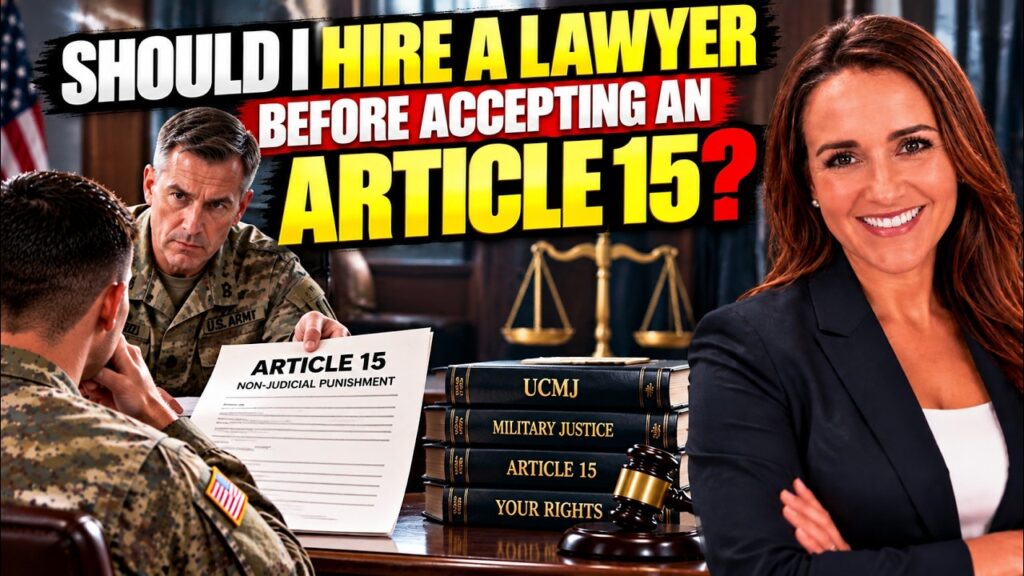
Short answer: Yes, if you are E-5 or above, if the Article 15 could go in your permanent file, or if the evidence might be weak, and you should do it before you sign anything on the Article 15 form. Civilian military defense lawyer Alexandra González-Waddington of Gonzalez & Waddington advises that the time to hire a lawyer is the short window between being notified and making your election, because that is when the important decisions are made.
In this video, Alexandra González-Waddington explains why the days before you sign your Article 15 election are the most important time to have a lawyer, and what a lawyer does in that window.
How much time do I have before I must decide on an Article 15?
Not much. When your commander decides to offer nonjudicial punishment under Article 15 of the UCMJ, you are read the allegation and given the form, which in the Army is the DA Form 2627. You are told you have a reasonable time to decide whether to accept the Article 15 or demand trial by court-martial.
In practice that is often 48 hours to a few days. The rules come from Part V of the Manual for Courts-Martial and your service’s regulation (AR 27-10 for the Army, the JAGMAN for the Navy and Marine Corps, and DAFI 51-202 for the Air Force and Space Force), and the details differ by service.
You can ask for more time. If you are getting a lawyer, ask your commander in writing for an extension before the deadline runs.
Do I have a right to talk to a lawyer before I accept an Article 15?
Yes. In the Army, you have the right to consult with a defense counsel before you decide, and Trial Defense Service (TDS) will give you an appointment. The other services provide similar access, such as the Area Defense Counsel in the Air Force and Defense Service Offices in the Navy.
That free consultation is real and worth using. But it is usually short, and it often does not include a detailed review of the evidence. You also have the right to hire a civilian lawyer at your own expense.
Why does it matter to hire a lawyer before signing, not after?
Because the biggest decisions in an Article 15 happen before the hearing, not at it. Once you sign your election and the commander imposes punishment, your options shrink to an appeal.
Most service members decide based on what the first sergeant or a coworker told them the evidence was. Nobody can tell you whether to accept an Article 15 without reading what the government actually has.
What does a lawyer do in the days before I decide?
Reads the evidence
A lawyer reads the sworn statements, the urinalysis documents, the counseling history, and whatever else the commander is relying on. That review drives every other decision.
Advises you to accept or refuse
This is the single most important choice in the process. A lawyer makes it with you based on the actual evidence and on what this command tends to do when someone refuses. See how to decide between accepting an Article 15 and demanding trial.
Builds your written response
If you accept, you have the right to present matters to the commander: a written statement, documents, character letters, and evidence that contradicts or explains the allegation. A one-line apology tends to get a heavy punishment; a well-organized packet showing your record and your side of the story gives the commander reasons to go lighter, suspend punishment, or file it locally.
Argues the filing decision
In the Army, for E-5 and above, the commander decides whether the Article 15 goes in the restricted file, which promotion boards generally do not see, or the performance file, which they do. That one decision can be the difference between a bad month and the end of a career, and the response should argue for the restricted file.
Prepares you for the hearing
You will stand in front of your commander. You can speak, have a spokesperson, and present reasonably available witnesses, and what you say and do not say matters. A lawyer prepares you so you do not talk yourself into a worse outcome.
Protects your appeal
You can appeal an Article 15 to the next superior commander, and in the Army the deadline is five days. The appeal is only as good as the record you made at the hearing.
When is it not worth hiring a lawyer?
A first-term E-3 facing a clear, minor offense at a company-grade Article 15, with no career plans beyond the current enlistment, may be fine with the free TDS or ADC consultation alone.
Everyone else should have a lawyer read the evidence before signing. That especially includes anyone whose Article 15 could lead to a QMP board, a lost promotion, a security clearance problem, or administrative separation.
What does it cost to hire a lawyer for an Article 15?
Article 15 representation usually costs far less than defending a court-martial, and many civilian military defense lawyers handle it for a flat fee. Compare that cost to what a reduction in grade or a lost retirement would cost you over a career.
What to do right now
- Do not sign your election on the Article 15 form yet.
- Write down the exact deadline you were given and who gave it to you.
- Ask your commander in writing for more time to consult a lawyer.
- Book your free TDS, ADC, or Defense Service Office appointment, and contact a civilian lawyer if your career is at stake.
- Request copies of the evidence the commander is relying on.
- Start collecting evaluations, awards, and names of leaders who will write character letters.
Key takeaways
- Hire a lawyer before you sign the Article 15 form, not after the punishment is imposed.
- You have a right to consult defense counsel before deciding, and you can ask for more time.
- The free military defense consultation is valuable but often too short to review the evidence.
- For E-5 and above, the filing decision can matter as much as the punishment itself.
- A strong written response built before the hearing is where a lawyer has the most impact.
Frequently asked questions
Can I get more time to decide on my Article 15?
Yes, you can ask. Make the request to your commander in writing, explain that you are consulting a lawyer, and ask before your deadline passes.
Is the free military defense counsel enough for an Article 15?
For a simple, minor case it may be. Military defense counsel carry heavy caseloads, so if your career, rank, or clearance is at risk, a civilian lawyer can give the case more time and a full review of the evidence.
Can a lawyer come to my Article 15 hearing?
Not as a right in most cases. In the Army you can have a spokesperson, who may be a lawyer, but the commander controls the hearing, so most of a lawyer’s work happens before it.
What if I already signed and accepted the Article 15?
Accepting the Article 15 is not admitting guilt. You can still present matters in your defense at the hearing and appeal afterward, so talk to a lawyer right away.
Related questions
- Should I accept an Article 15 or demand trial by court-martial?
- What a civilian lawyer can do to help you fight nonjudicial punishment
- How to appeal an Article 15
Video transcript
Read the full transcript of this video
Should you hire a lawyer before accepting an Article 15? If you’re E5 or above, if the Article 15 could go in your permanent file, or if there’s any chance the evidence is weak, yes. And you should do it before you sign anything on the form. I’m Alexandra González-Waddington, civilian military defense lawyer and co-founder of Gonzalez & Waddington. An Article 15 looks like a small thing. For a lot of careers, it’s the biggest thing that ever happens. Here’s what a lawyer does at this stage and when it’s worth it.
First, the timeline, because it’s short. When your commander decides to impose non-judicial punishment, you’re read the allegation and given the form. In the Army, a DA Form 2627. And you’re told you have a reasonable time, usually 48 hours to a few days, to decide whether to accept or demand trial, and whether to present matters in your defense. You can request more time, and you should if you’re getting a lawyer. Under Army regulation, you also have the right to consult with a defense counsel before you decide, and the Trial Defense Service will give you a short appointment. That appointment is real, but it’s brief, and it usually doesn’t include reading the evidence.
Here’s what a lawyer does in those days.
One, reads the packet. The sworn statements, the urinalysis litigation package, the counseling history, whatever the commander is relying on. Nobody can tell you whether to accept without seeing what the government has. Most service members decide based on what the first sergeant told them the evidence was.
Two, advises on accept or refuse. The single most consequential decision made with the actual evidence and knowledge of what this command does with refusals.
Three, builds the response. If you accept the Article 15, you have the right to present matters to the commander. A written statement, documents, character letters, evidence that contradicts the allegation or explains it. This is where a lawyer changes outcomes. A one paragraph, I’m sorry, it won’t happen again, gets the maximum. A packet with a coherent explanation, corroborating evidence, and a record of 12 years of service gets a reduced punishment, a suspended reduction, or a local filing.
Four, fights the filing. For E5 and above in the Army, the commander decides whether the Article 15 goes in the restricted file, which is nearly invisible, or the performance file, which promotion boards see. That decision is the difference between a bad month and the end of a career. The response argues for the restricted file.
Five, prepares you for the hearing. You’ll stand in front of your commander. You can speak, you can have a spokesperson, and you can present witnesses. What you say matters, and so does what you don’t. A lawyer scripts it.
Six, preserves the appeal. Under Article 15, you can appeal to the next superior commander within 5 days. The appeal is only as good as the record you made at the hearing.
When is it not worth it? A first term E3 with a clear-cut minor offense, a company grade Article 15, and no career ambitions may be fine with the TDS consultation. Everyone else, and especially anyone for whom this Article 15 could mean a QMP board, a lost promotion, a lost clearance, or a separation, should have a lawyer read the packet before signing. At Gonzalez & Waddington, Article 15 representation is a flat fee.
So, should you hire a lawyer before accepting an Article 15? If your career could turn on it, yes, and before you sign. I’m Alexandra González-Waddington with Gonzalez & Waddington. We defend service members worldwide. You can learn more at ucmjdefense.com or call 1-800-921-8607 for a free confidential consultation.
Talk to a military defense lawyer
Gonzalez & Waddington defends service members worldwide in investigations, courts-martial, administrative separation boards, Article 15 and NJP proceedings, and other UCMJ matters. Michael Waddington, a former Army JAG officer, has been a lawyer for over 25 years. Call 1-800-921-8607 or visit ucmjdefense.com for a confidential consultation.
This article is general information, not legal advice. Every case is different, and reading it does not create an attorney-client relationship.
Recent Blogs
- Do Civilian Military Lawyers Travel to Your Base?October 27, 2026
- Child Pornography Under Article 134: Penalties and DefensesOctober 27, 2026
- Article 120c UCMJ: Indecent Exposure and Viewing ExplainedOctober 27, 2026
- Expedited Transfer: What Happens to the Accused When the Accuser Moves?October 26, 2026
- What Counts as Retaliation Under Article 132, and How Do You Respond?October 26, 2026
- Accused of Hazing in the Military: What Do Marines and Soldiers Need to Know?October 26, 2026