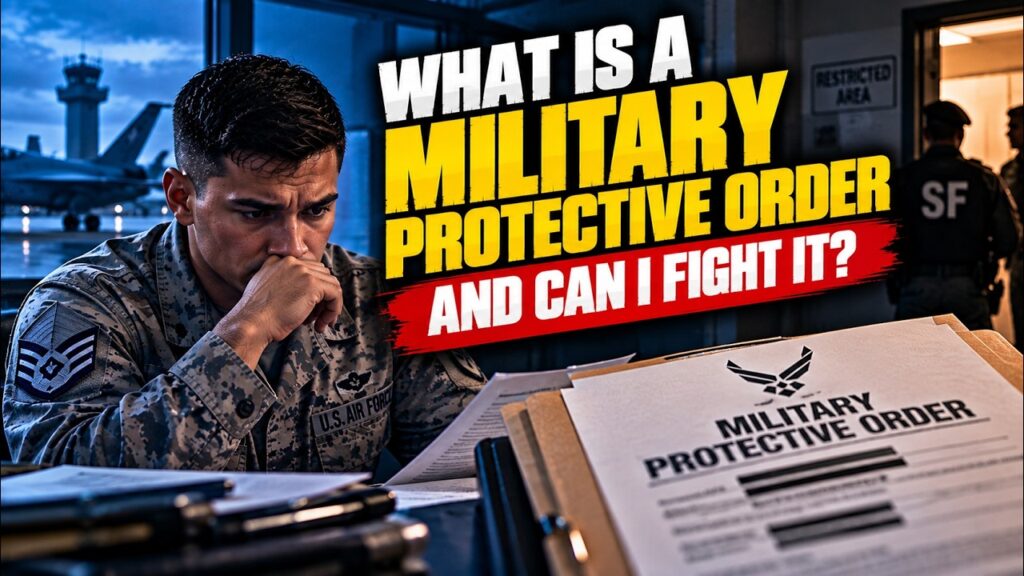
Short answer: A military protective order (MPO) is a written order from your commander, issued on DD Form 2873, telling you to have no contact with a specific person. You cannot appeal it to a court, but you can ask the commander to modify or lift it. Civilian military defense lawyer Alexandra González-Waddington of Gonzalez & Waddington advises service members to obey the MPO completely while a lawyer makes that request in writing.
In this video, Alexandra González-Waddington explains how military protective orders work, what “no contact” really means, and how a lawyer can get an MPO changed or lifted.
What is a military protective order?
An MPO is a commander’s order, usually issued on DD Form 2873, that restricts your contact with a named person. It does not come from a judge. It is a lawful order, and violating it can be charged under Article 92, UCMJ.
An MPO typically orders no contact with the named person, directly or through third parties, in person, by phone, text, email, or social media. It may also order you to stay a set distance away, move out of shared quarters, stay away from certain places, or turn in government-issued weapons.
MPOs are common in domestic violence and sexual assault cases. A commander can issue one the same day an allegation is made, before any investigation, based on the accusation alone.
What does “no contact” mean under an MPO?
It means no contact of any kind. No apology text, no message through a friend, no liking a photo, and no showing up at the same bar or event.
If the protected person contacts you, do not respond, and tell your lawyer. The order binds you, not them. Commanders can and do charge violations even when the other person started the contact.
Is an MPO the same as a civilian protective order?
No. An MPO is enforced by the military, not by civilian courts. But under 10 U.S.C. § 1567a, your command must notify civilian law enforcement when an MPO is issued.
If the other person also gets a civilian protective order, you are bound by both. That means two sets of rules, two enforcement systems, and twice the risk of a mistake.
How long does a military protective order last?
An MPO generally stays in effect until the commander ends it or replaces it. There is often no fixed expiration date.
Some MPOs run for the entire investigation and through trial, which can take a year or more. If the protected person is your spouse, that can mean a long time out of your home and away from your children.
Can I fight a military protective order?
Not in court. But you can ask the commander who issued it to change it or lift it, and a well-prepared written request is often taken seriously. A lawyer can help in four ways:
- Request modification. Ask for specific exceptions, such as child custody exchanges through a third party, an escorted visit to retrieve property, or communication about finances through counsel.
- Request rescission when facts change. The investigation closes, the other person recants, or a related civilian case is dismissed.
- Document the hardship. Separation from children, housing costs, and contact started by the other person all belong in the record.
- Check service and clarity. Make sure the order was properly served and is clear, because a vague order matters if you are later accused of violating it.
What happens if I violate an MPO?
A violation can be charged as failure to obey a lawful order under Article 92, UCMJ. Depending on how it is charged, the maximum punishment can include confinement and a punitive discharge.
An MPO violation is usually far easier for the government to prove than the original allegation. It can turn a weak case into a conviction, so comply with the order completely while your lawyer works to change it.
What to do right now
- Get a copy of the MPO and read every line, including distances, places, and any exceptions.
- Stop all contact with the protected person, including through friends, family, and social media.
- If the protected person contacts you, do not reply. Save the message and tell your lawyer.
- Do not discuss the allegation with your command, investigators, or friends.
- Write down how the MPO affects your housing, children, and finances.
- Have a lawyer submit a specific, written request to modify or lift the order.
Key takeaways
- An MPO is a commander’s no-contact order on DD Form 2873, not a court order.
- Violating an MPO can be charged under Article 92, UCMJ, even if the other person reached out first.
- Your command must notify civilian law enforcement that an MPO was issued.
- An MPO usually lasts until the commander lifts it, which can be months or longer.
- You cannot appeal an MPO to a court, but you can ask the commander to modify or rescind it.
Frequently asked questions
Can I text my spouse if they text me first?
No. The MPO restricts you, not the protected person, so replying is a violation even if they started it. Save the message and give it to your lawyer instead.
Can an MPO make me move out of my house?
Yes. An MPO can order you out of shared quarters and set conditions for getting your belongings, often with an escort. A lawyer can ask the commander for specific arrangements so you can retrieve what you need without risking a violation.
Does an MPO go on my record?
An MPO is part of the command’s handling of the allegation and is reported to civilian law enforcement, so assume people outside your unit will learn of it. How it affects your record depends on how the underlying case ends. Ask your lawyer how to address it in any later rebuttal or board.
Can the person who asked for the MPO cancel it?
No. Only the commander can modify or lift the order. If the protected person no longer wants it, that fact can support a request to rescind it, but you should not ask them to contact the command for you.
Related questions
- Do I have to talk to CID if they want to speak with me?
- What to do if you are an NCIS suspect
- Can my commander order me to answer investigator questions?
Video transcript
Read the full transcript of this video
What is a military protective order and can I fight it? An MPO is a written order from your commander to have no contact with a specific person and you can’t appeal it to a court, but you can ask the commander to modify or lift it. I’m Alexandra González-Waddington, civilian military defense lawyer and co-founder of Gonzalez & Waddington. MPOs are issued in nearly every domestic and sexual assault case and violating one is the easiest charge the government will ever prove. Here’s how they work.
A military protective order is issued on DD Form 2873. It’s not from a judge, it’s from your commander and it’s a lawful order under Article 92 of the UCMJ. It typically says, “No contact with the named person directly or through third parties, in person, by phone, text, email or social media. Stay a certain distance from them. Move out of shared quarters. Sometimes, surrender weapons and stay away from certain locations.” It can be issued the same day an allegation is made before any investigation on nothing more than the accusation.
Three things people misunderstand.
First, no contact means no contact. Not a text to apologize, not a message through a friend, not liking a photo, not showing up at the same bar. If your spouse or the other person contacts you, you don’t respond and you tell your lawyer. The order binds you, not them and commanders charge violations even when the other person initiated.
Second, an MPO is not a civilian protective order. It’s enforceable only by the military. But under 10 U.S.C. § 1567a, your command has to notify civilian law enforcement that it was issued. And if the other person also gets a civilian order, you’re now bound by both with two different sets of rules and two different courts.
Third, it lasts until the commander lifts it. There’s no automatic expiration. Some run for the entire investigation and through trial, which can be a year or more. And if it involves your spouse and children, that can mean a year out of your home.
So, can you fight it? Not in court, no. But here’s what a lawyer can do. One, request modification. Allow contact for child custody exchanges through a third party. Allow access to shared quarters to retrieve property with an escort. Allow communication about finances through counsel. Commanders often grant reasonable modifications if the request is written and specific. Two, request rescission when the facts change. The investigation closes, the other person recants, the civilian case is dismissed. Three, document the hardship. Separation from children, housing costs, a spouse who is the one making contact. That record matters later. Four, make sure the order is properly served and understood because a vague order is a defense to a violation charge.
And the most important thing, comply with it while you fight it. An MPO violation is an Article 92 offense with a maximum punishment that includes confinement and a bad conduct discharge. And it gives the command a provable charge to stack onto an unprovable one. We’ve seen weak sexual assault cases become convictions on the protective order count alone.
At Gonzalez & Waddington, we treat the MPO as part of the case from day one because it’s the charge the government can prove.
So, what is a military protective order and can you fight it? A commander’s no-contact order under Article 92, not appealable to a court, but modifiable and rescindable if you ask the right way. Comply with it completely and let your lawyer do the asking. I’m Alexandra González-Waddington with Gonzalez & Waddington. We defend service members worldwide. You can learn more at ucmjdefense.com or call 1-800-921-8607 for a free confidential consultation.
Talk to a military defense lawyer
Gonzalez & Waddington defends service members worldwide in investigations, courts-martial, administrative separation boards, and other UCMJ matters. Michael Waddington, a former Army JAG officer, has been a lawyer for over 25 years. Call 1-800-921-8607 or visit ucmjdefense.com for a confidential consultation.
This article is general information, not legal advice. Every case is different, and reading it does not create an attorney-client relationship.
Recent Blogs
- Do Civilian Military Lawyers Travel to Your Base?October 27, 2026
- Child Pornography Under Article 134: Penalties and DefensesOctober 27, 2026
- Article 120c UCMJ: Indecent Exposure and Viewing ExplainedOctober 27, 2026
- Expedited Transfer: What Happens to the Accused When the Accuser Moves?October 26, 2026
- What Counts as Retaliation Under Article 132, and How Do You Respond?October 26, 2026
- Accused of Hazing in the Military: What Do Marines and Soldiers Need to Know?October 26, 2026