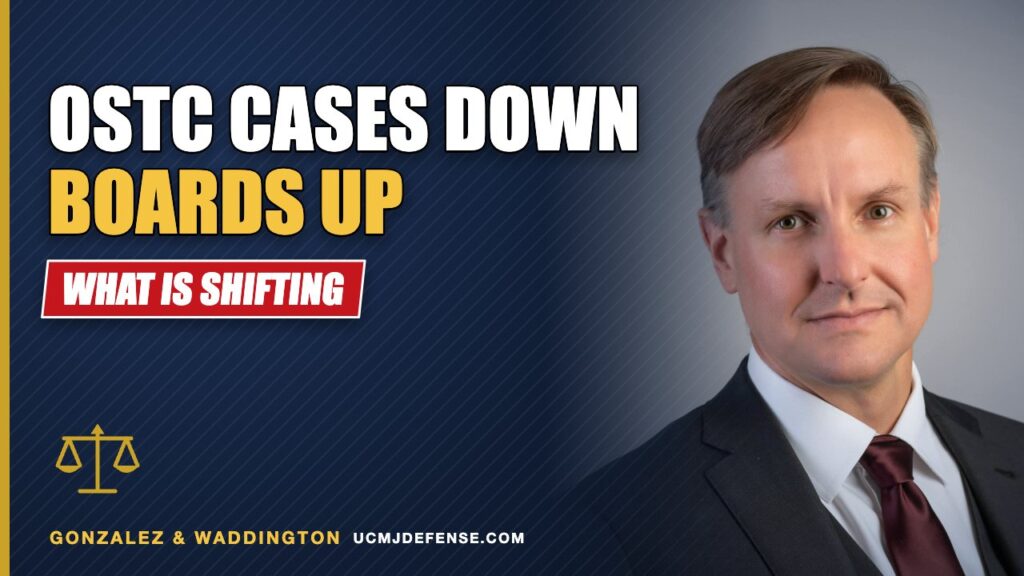
What does the rise in administrative discharge boards instead of OSTC prosecutions mean for service members?
It means commands are increasingly separating service members administratively rather than pursuing court-martial charges through the OSTC. While this avoids a criminal conviction, an administrative discharge board can still result in a less-than-honorable discharge with lasting career and benefits consequences. Having an experienced civilian military defense attorney at these boards is critical. Outcomes vary based on individual case facts.
The landscape of military justice is undergoing a notable transformation. With the introduction of the Office of the Special Trial Counsel (OSTC) in late 2023, expectations were high for more rigorous and professional prosecutions of serious offenses, particularly sexual assault cases. But recent developments reveal a surprising trend — a sharp decline in OSTC prosecutions paired with a significant rise in administrative discharge boards. What does this mean for service members facing allegations? And why are commands opting to separate personnel administratively rather than pursue court-martial proceedings? In this post, we delve into these critical changes, analyze their implications, and highlight why having an experienced civilian military defense attorney has never been more essential.
Introducing the OSTC: A New Era in Military Prosecution
Before December 2023, the convening authority, often a commanding officer without legal training, held significant power over whether cases were prosecuted. Congressional concerns over numerous acquittals and insufficient charges, especially in sexual assault cases, led to the creation of the OSTC — a specialized body of prosecutors tasked with handling serious offenses. The goal was to professionalize prosecutions, reduce bias, and increase conviction rates where appropriate.
However, as military defense attorney Michael Waddington points out, the reality hasn’t quite matched the initial expectations. Instead of a surge in court-martial proceedings, the OSTC appears to be prosecuting fewer cases, particularly sexual assault allegations. This unexpected development raises important questions about the efficacy of the OSTC and the broader military justice system.
Why Are OSTC Prosecutions Declining?
According to Waddington’s observations from cases across all branches — Army, Navy, Air Force, and Marines — several factors contribute to this decline:
- Lengthy Investigations: Law enforcement investigations are taking longer, causing delays in case progression.
- Case Deferrals: The OSTC has the option to either prosecute or defer cases back to the command for administrative action. Most cases appear to be deferred rather than prosecuted.
- Resource Constraints and Strategic Decisions: The OSTC may be prioritizing cases with stronger evidence, leading to fewer prosecutions overall.
While this could be seen as a positive development for those falsely accused—cases lacking sufficient evidence are less likely to result in prosecutions—the story doesn’t end there.
The Rise of Administrative Discharge Boards: What’s Happening?
When the OSTC declines prosecution and defers cases back to commands, the command often responds by initiating administrative separation actions rather than dismissing the allegations outright. This practice is concerning for several reasons:
- Weak Commands and Political Pressures: Commands, under pressure to appear responsive to serious allegations, may opt to separate service members to avoid controversy, regardless of actual guilt or evidence.
- Lack of Due Process: Administrative discharge boards operate under a lower standard of proof — “preponderance of the evidence” — compared to courts-martial, increasing the risk of unfavorable outcomes for accused service members.
- Career and Benefits at Stake: Separation with a general or other than honorable discharge can destroy military careers, jeopardize retirement benefits, and impact VA benefits, even when the accused may be innocent.
Waddington highlights alarming cases where service members with minimal time in service face separation for sexual misconduct allegations without solid evidence or formal prosecution. This shift essentially moves the battleground from criminal courts to administrative boards, where the protections and rigor of the judicial process are diminished.
Understanding Administrative Separation Boards vs. Courts-Martial
Courts-Martial are formal military criminal proceedings, requiring proof beyond a reasonable doubt to convict. They provide defendants with robust rights, including legal representation, evidential standards, and appeal mechanisms.
Administrative Separation Boards (ASBs), by contrast, determine if a service member should be involuntarily separated from the military for reasons such as misconduct or substandard performance. The evidentiary standard is lower, and the proceedings focus on the character and conduct of the member rather than criminal guilt. Outcomes can include general or other than honorable discharges, which carry severe long-term consequences.
Why Hiring a Civilian Military Defense Lawyer Is Crucial
Facing an ASB or Board of Inquiry (BOI) without expert legal defense can be catastrophic. Civilian military defense attorneys, like Michael Waddington, bring a strategic, diplomatic, and legally nuanced approach to these hearings, offering several advantages:
- Protecting Your Rights: Ensuring due process is followed, challenging weak or false allegations, and advocating for the best possible discharge characterization.
- Preserving Benefits: Avoiding negative discharges that can jeopardize retirement, VA benefits, and future civilian employment.
- Strategic Negotiations: Working with commanders and boards to seek favorable outcomes, including potential retention or honorable discharge.
With the current climate of increasing administrative separations, having an experienced civilian lawyer familiar with military law and the nuances of the OSTC system can make the difference between continuing your military career or facing a damaging discharge.
Looking Ahead: What Service Members Should Know
Military justice continues to evolve, and the introduction of the OSTC has brought unintended consequences. While prosecutions have dropped, administrative boards have surged, creating a new challenge for accused service members.
If you or a loved one are facing allegations, it’s critical to understand your rights and the potential outcomes. Don’t navigate these complex waters alone. Seek advice from civilian military defense attorneys who can level the playing field and fight for your future.
Conclusion
The military justice system is in flux. The OSTC’s creation was meant to strengthen prosecutions, but instead, many cases are stalled or deferred, with commands increasingly relying on administrative separation boards to handle allegations. This shift places service members at risk of losing their careers and benefits without the protections of a court-martial. Awareness, preparedness, and expert legal defense are paramount for anyone confronting these proceedings. Military personnel must stay informed and proactive to protect their rights and futures in this challenging environment.
For help navigating administrative separation boards or military prosecutions, contact experienced civilian military defense lawyers like Michael Waddington at 1-800-921-8607 or visit https://ucmjdefense.com.
Full Transcription
Video transcript
Transcript of the video “Admin Discharge Boards Rising While OSTC Prosecutions Drop,” with Michael Waddington of Gonzalez & Waddington.
Read the full transcript of this video
Whether there’s evidence or not, whether the guy’s guilty or not, whether it’s a false allegation, I’m seeing a lot of weak commands just kicking the person out and sending them to a board. My name is Michael Waddington, and I am a criminal defense attorney. In this video, I want to talk about some of what I’m seeing in the military court system after they brought in the Office of the Special Trial Counsel.
As background, real quick: practicing law since 2000, been in the military justice system for about that long, and so I’ve seen the old system. I’ve seen as we ramped up to the changes that were being made, and I’ll tell you what we’re seeing now, it’s not like we expected. The Office of the Special Trial Counsel was brought in with this idea: how they’re going to get out there, crack down on all these sexual assaults, all these violent crimes, had this professional corps of prosecutors, uh, doing justice.
And one of the big factors that led to them, the OSTCs, those are like the super prosecutors that were put in place in December of 2023, was there was a lot of complaining in Congress. There were too many acquittals, not enough cases were being charged. They were claiming there wasn’t enough professional prosecution of these sexual assault type cases in the military. So they created this system that got rid of the convening authority from a certain amount of cases. All the sexual assault ones, all the serious ones, those were removed from the convening authority, who is not a lawyer, and now they’re given to the prosecutors to make decisions.
So what has happened? We thought, myself and a lot of my friends and my law partner, that we would start seeing more cases being prosecuted, just prosecuted in a more professional, aggressive manner. Aggressive in a sense, like they’re going to come at these guys hard and try to get convictions. But what we have been seeing is the opposite. Now, I’m not saying that every OSTC office is the same way, but we kind of have our pulse on all the branches of the service: Army, Navy, Air Force, Marine Corps. We get calls from all these folks.
We are getting people that are under investigation, that are pending investigation, and they’re just kind of sitting out there and waiting. We’re seeing two things. There’s a lot of hurry up and wait. We got this investigation going, the person’s under investigation, and the law enforcement’s taking forever to investigate the case. And then when it finally gets to the Office of the Special Trial Counsel, what I’m seeing is they’re not doing anything with it.
This year I’ve had a ton of cases, a bunch that are sexual assaults. I’m seeing about two out of the 10 being brought to a court-martial. So what’s happening to those other cases that a year ago would have been going to a court-martial? What’s happening? One thing is called deferral. So the Office of the Special Trial Counsel gets a first crack at it, and they can look at it and be like, “Hey, do we want to prosecute this person for this, for example, sexual assault?” They could take the case and prosecute it, or they can defer it or kick it back to the command to take other action, like a separation or no action.
So what we’re seeing is a mix of this. Almost all them are being deferred or kicked back to the command, which means there are not a lot of cases that I’m seeing that are getting preferred, which could be a good thing for someone who’s accused, maybe. But what if the person’s being falsely accused? If they’re being falsely accused and the allegation goes forward, and the Office of the Special Trial Counsel rightfully and correctly declines to prosecute and they kick it back to the command, what is the command going to do? And this is the big, big problem that I’m seeing.
They’re not prosecuting these cases. They’re bogus, that don’t have evidence, or they’re false allegations, but they won’t necessarily say that. They’ll just decline to prosecute or defer prosecuting. So it goes back to the command, and we’re back in the situation where we were a year ago. These commanders, who were politically correct, meaning that they’re going to do whatever the political whims of the Senate and Congress are, and they’re going to take those cases and they’re not going to dismiss them. They’re not going to just let that service member continue on their career. That is not what I’m seeing.
So what I’m seeing is, instead of going to a court-martial, they’re giving him the command, and the command is kicking the person out, whether there’s evidence or not, whether the guy’s guilty or not, whether he’s innocent, whether it’s a false allegation. I’m seeing a lot of weak commands just kicking the person out and sending them to a board. I’ve had a few people that aren’t even entitled to a board. So I’m talking people that are accused of sex crimes. So if you’re accused of a sex crime, you know, that carries felony conviction, sex offender registration, jail time, mandatory jail time, and you’re investigated and they don’t have evidence to prosecute you, they should probably let you move on with your life. But that’s not happening.
So I have guys now that have maybe two years in, and they’re getting kicked out with general under honorable conditions discharges for sexual-related misconduct, which is unheard of. The guy either did it or he didn’t do it. You either have proof and evidence or you don’t. You don’t just kick a guy out because he’s being accused and there’s no evidence to back them up. That violates due process.
The other thing I’m seeing is, let’s say you’re an E-7/E-8 and you’re entitled to a board if they’re going to kick you out. But what they’re doing is they’re taking those folks and they’re giving them things like an Article 15 for sexual assault or abusive sexual contact, and railroading them and finding them guilty even with no evidence. Then they’re turning around and sending them to a board. If you go to a board, the standard of proof is fairly low. It’s preponderance of the evidence. It’s lower than a court-martial. So they think it’s easier to win these, and it actually is easier to win them.
So what you end up having is someone with no evidence, possibly false allegation, possibly innocent, no prosecution, kick back to the command, the command is doing the politically correct thing and just kicking everyone out, whether there’s proof or not.
Recent Blogs
- Nonpunitive Letter of Caution vs. Punitive Letter of Reprimand: What Navy and Marine Corps Officers Need to KnowNovember 6, 2026
- First 24 Hours After CGIS Contacts You: What Coast Guard Members Should DoNovember 6, 2026
- First 24 Hours After OSI Contacts You: What Airmen and Guardians Should DoNovember 6, 2026
- First 24 Hours After NCIS Contacts You: What Sailors and Marines Should DoNovember 6, 2026
- First 24 Hours After CID Contacts You: What Soldiers Should DoNovember 6, 2026
- Is Hiring the Cheapest Military Defense Lawyer a Mistake?November 6, 2026